

What is the soul made of? Explore philosophy, religion, and neuroscience—from Plato to modern brain science—for clear, evidence-based answers.
🧭 Key Takeaways
- The soul has been described as breath, energy, spirit, or consciousness depending on cultural and scientific context.
- Ancient civilizations such as Egypt and China viewed the soul as multi-part and relational, not a single entity.
- Plato defined the soul as immortal and immaterial, while Aristotle saw it as the form and function of a living body.
- Hinduism equates the soul (Ātman) with the ultimate reality (Brahman); Buddhism denies a permanent self (Anattā).
- Abrahamic faiths describe the soul as a divine creation—moral, accountable, and eternal.
- Modern science and neuroscience now explore consciousness through theories like GNWT and IIT, asking if the soul is an emergent property of the brain.
Introduction | Why We Still Ask “What Is the Soul Made Of?”
The question What is the soul made of? has fascinated thinkers for over 3,000 years.
From the breath of life in Genesis to neurons firing in the brain, humanity has searched for what animates consciousness.
In this long-form exploration, we’ll trace how different civilizations—Egyptian, Greek, Chinese, Hindu, Buddhist, Abrahamic, and modern scientific—have tried to define the soul’s “substance.”
What Does “Made Of” Really Mean?

Before diving in, we must expand the phrase “made of.”
In history, it has meant four different things:
| Sense | Description | Example Tradition |
|---|---|---|
| Substance | The soul as a real, immaterial or divine stuff | Plato, Christianity |
| Function | The organizing principle that makes a body alive | Aristotle |
| Relation | A connection or kinship with the universe | Animism, Daoism |
| Process | An ever-changing pattern or consciousness | Buddhism, Neuroscience |
The Soul as Breath: The Earliest Answer
Across early civilizations, breath symbolized life itself.
- In Greek, psychē meant “breath” or “to breathe.”
- In Hebrew, nephesh and neshamah described the “breath of life.”
- In Latin, anima and spiritus carried the same meaning.
- In Sanskrit, ātman also came from “breath.”
These roots reveal a universal insight: when breath stops, life ends—so breath became the first metaphor for the soul.
The Egyptian Soul: A Composite of Many Parts
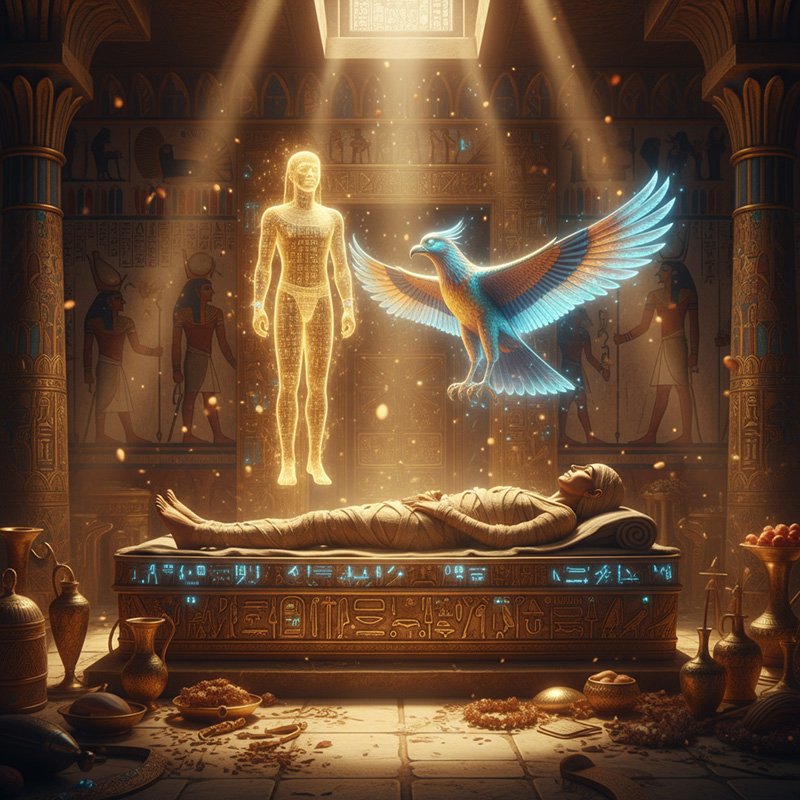
The ancient Egyptians believed the soul wasn’t one thing but a system of interconnected forces:
- Ka – Vital essence or life force
- Ba – Personality or individuality
- Ib – Heart, the seat of morality
- Ren – Name, identity
- Akh – Transfigured spirit after judgment
Mummification was essential to preserve the body (Khet) as a home for these forces.
A person achieved eternal life only when all parts—Ka, Ba, and body—reunited.
The Chinese View: Hun and Po — A Dual Soul of Yin and Yang
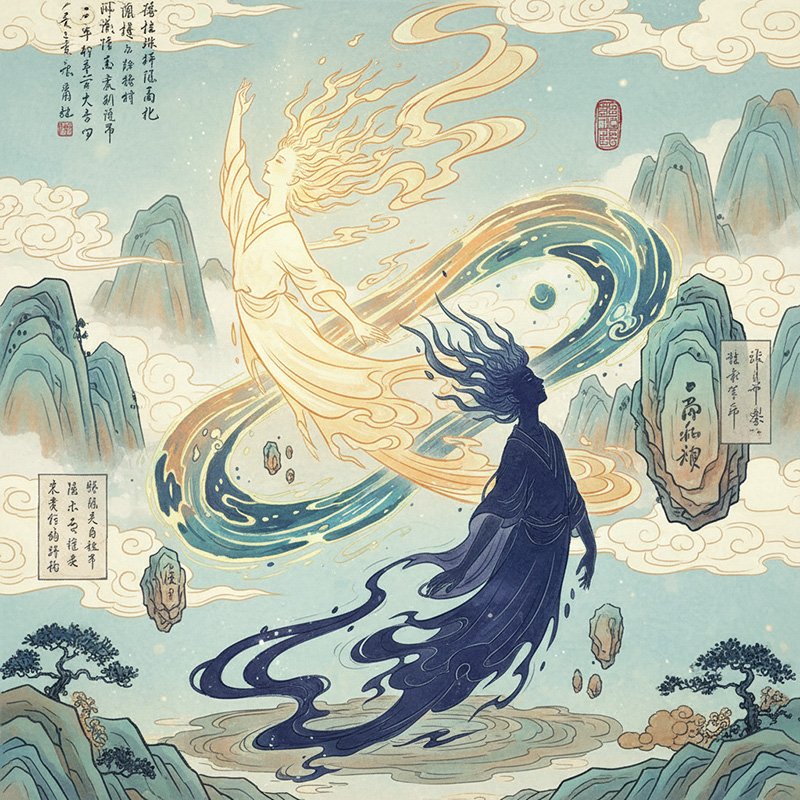
In Daoist and early Chinese philosophy, the human being contained two souls:
- Hun (魂) – The spiritual, Yang soul linked to consciousness and heaven
- Po (魄) – The bodily, Yin soul linked to physical life and the earth
Life was the union of both; death, their separation.
Later Daoist traditions expanded this into the Three Hun and Seven Po (Sanhun Qipo) model, describing layers of spirit and emotion.
Both were made of Qi (氣)—the cosmic energy flowing through all existence.
Plato vs. Aristotle: What Is the Soul Made Of in Greek Philosophy?
Plato: The Soul as an Immaterial and Eternal Substance
Plato saw the soul as immortal and divine, imprisoned in the body.
In his Phaedo and Republic, he divided it into:
- Reason (Logistikon)
- Spirit (Thymoeides)
- Appetite (Epithymetikon)
Virtue meant keeping reason in control.
When the body died, the soul returned to the Realm of Forms, continuing its eternal journey.
Aristotle: The Soul as the Form and Function of the Body
Aristotle rejected the idea of a separable soul.
In De Anima, he defined it as the form of a living body—what makes an organism alive.
He identified three levels:
The soul wasn’t a ghost inside the body—it was the body’s actuality.
Atman vs. Anattā: Is the Soul Real or an Illusion?
Hinduism: The Soul Is the Divine Self
In Hindu thought, Ātman is the true, eternal self, identical to Brahman, the cosmic reality.
The phrase Tat Tvam Asi (“Thou art that”) declares that the self is the universe.
Liberation (Moksha) occurs when one realizes this unity and escapes Samsara (rebirth).
Buddhism: The No-Self Doctrine
Buddhism directly rejects the idea of a permanent soul.
Instead, the human being is a bundle of five aggregates (Skandhas):
- Form (Rūpa)
- Feelings (Vedanā)
- Perception (Saññā)
- Mental Formations (Saṅkhāra)
- Consciousness (Viññāṇa)
Realizing that none of these are permanent leads to Nirvana, liberation from attachment.
The Soul in Abrahamic Faiths: Divine Breath and Moral Trial
Judaism: Five Levels of the Soul
Kabbalistic tradition describes five layers of soul:
- Nefesh – Basic life force
- Ruach – Spirit and emotion
- Neshamah – Intellect
- Chayah – Living essence
- Yechidah – Unity with God
Each level ascends toward divine consciousness.
Christianity: Created, Immortal, and Accountable
Christian theology blends Hebrew belief with Greek dualism.
The soul is created by God, immortal, and judged after death.
Debates include creationism vs. traducianism (how souls originate).
Islam: The Soul as Ruh and Nafs
In Islam, the Ruh (spirit) comes directly from God’s command, while the Nafs (self) struggles between good and evil.
The Qur’an describes three stages:
- Nafs al-Ammārah – commanding self
- Nafs al-Lawwāmah – self-reproaching soul
- Nafs al-Muṭmaʾinnah – peaceful soul
At 120 days of gestation, God breathes the Ruh into the fetus—a sacred act of creation.
The Modern Shift: Descartes and the Mind–Body Problem
Descartes’ Dualism: The Ghost in the Machine
In the 17th century, René Descartes redefined the soul as the thinking mind (res cogitans).
He separated it from matter (res extensa) and proposed their interaction in the pineal gland.
This idea solved one problem (immortality) but created another—the mind-body problem.
Physicalism: One Substance, Many Processes
Modern philosophers like Gilbert Ryle rejected dualism as a “category error.”
They argued the mind isn’t a separate thing—it’s what the brain does.
This gave rise to emergentism and non-reductive physicalism: consciousness “emerges” from complex brain processes.
The Neuroscience of the Soul: Consciousness Explained
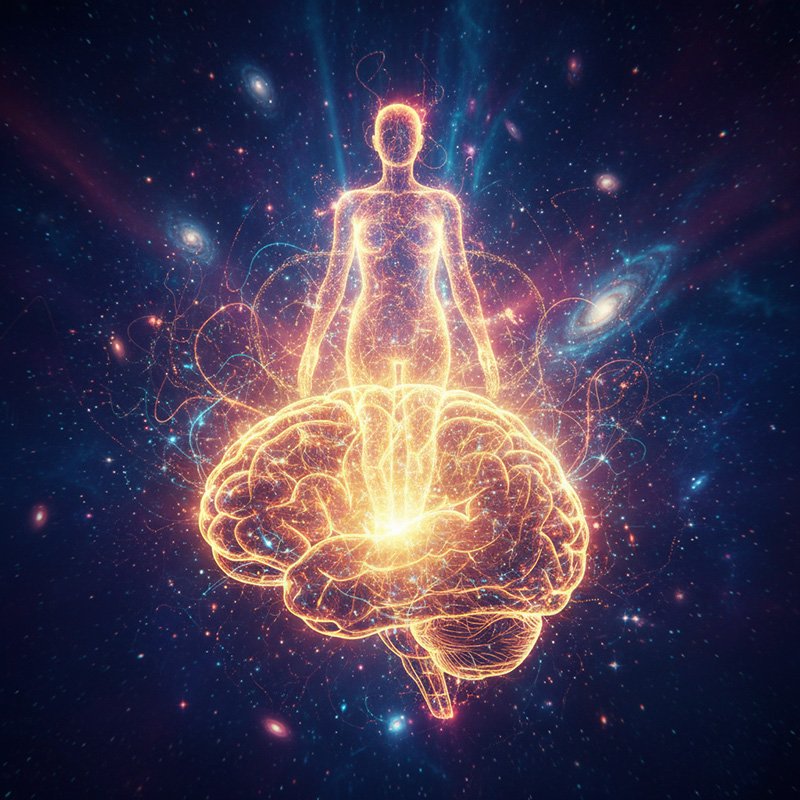
Neural Correlates of Consciousness (NCC)
Neuroscientists now map consciousness through neural correlates—specific brain patterns tied to experiences like color, memory, and emotion.
When neurons in the prefrontal cortex and parietal lobes synchronize, consciousness “ignites.”
GNWT vs. IIT: Competing Theories
- Global Neuronal Workspace Theory (GNWT): Consciousness arises when information becomes globally accessible across brain regions.
- Integrated Information Theory (IIT): Consciousness depends on how much information is integrated (Φ) in a system.
Both models replace metaphysical souls with physical patterns of awareness.
The Self as a Brain-Generated Process
Modern imaging shows that our “self” arises from:
- Medial prefrontal cortex – self-reflection
- Temporoparietal junction (TPJ) – body awareness
- Posterior cingulate cortex – autobiographical memory
Even mystical experiences and near-death experiences (NDEs) correlate with specific neural activity patterns.
Real-World Reflection: A Writer’s Perspective
When I visited a neuroscience lab in Baltimore, researchers used fMRI scans to show how the brain “lights up” when people recall meaningful memories.
I couldn’t help but think—if we can map love, memory, and awe, maybe the soul isn’t lost, just reframed.
The ancient breath of life now appears as an electrical symphony.
Our ancestors saw divinity in air; we now see it in energy.
Both may be describing the same mystery in different languages.
FAQs
What is the soul made of according to science?
Science suggests the soul isn’t a separate substance but a result of complex neural processes that produce consciousness.
What is the soul made of in the Bible?
In Genesis 2:7, the soul is the result of God breathing life into dust—divine breath animating matter.
Do animals have souls?
Many traditions say yes. Ancient Egypt, Daoism, and even Christian theologians like St. Francis believed animals share the life force.
What happens to the soul after death?
Views differ: Hinduism teaches rebirth; Christianity expects resurrection; Buddhism sees dissolution of the illusion of self.
Is consciousness proof of the soul?
That depends on worldview. Plato said consciousness proves the soul’s eternity; neuroscience says it emerges from the brain.
Conclusion | The Soul as Humanity’s Mirror
Whether viewed as breath, energy, divine spark, or neural pattern, the soul reflects our deepest attempt to understand life itself.
Every tradition—philosophical, spiritual, or scientific—asks the same question with a different accent.
Perhaps the soul is not made of something; it is the awareness asking the question.