

Have you ever wondered where the atoms in your body came from?
Take a deep breath. The oxygen filling your lungs right now wasn’t always there. Look at your hand. The carbon in your skin has a history.
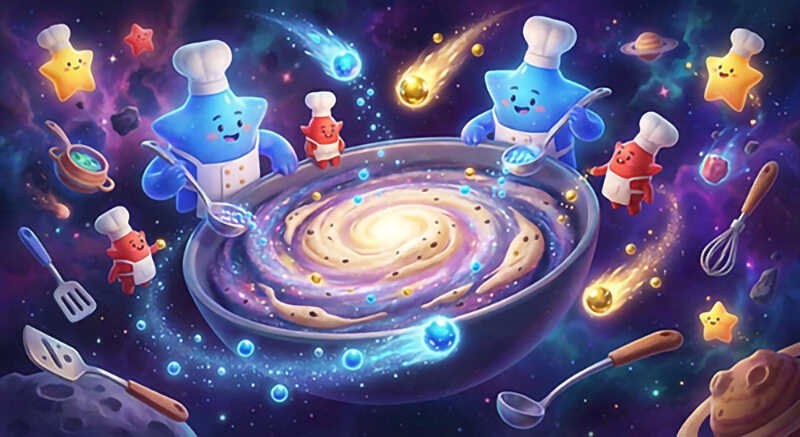
Scientists have known for a while that these elements were cooked up inside stars. But recently, a team of astronomers used some very small, faint stars—our neighbors, the Red Dwarfs—to figure out exactly how the galaxy cooked up the ingredients for life.
Here is the story of how they did it, and why these tiny stars are like cosmic time machines.
🐢 Why Ask the “Little” Stars?
Imagine you want to know what the world was like 100 years ago. You would ask the oldest person you know, right?
In our galaxy, Red Dwarfs (M Dwarfs) are the oldest, quietest residents.
- They are much smaller and dimmer than our Sun.
- They burn their fuel very slowly, so they live for a very long time.
- Because they live so long, they act like “Time Capsules.”
The gas that makes up a Red Dwarf is the same gas that was floating around when the star was born billions of years ago. By looking at them today, we are peeking into the past.
🔍 The Tools: Rainbows and Cousins
To understand this discovery, you need to know two cool science concepts.
1. Atoms have “Cousins” (Isotopes)
You probably know Carbon and Oxygen. But did you know there are different versions of them?
- The Popular Cousin: Most Carbon is Carbon-12. It’s super common.
- The Rare Cousin: There is a heavier version called Carbon-13. It’s rare and harder to find.
These different versions are called Isotopes. Some are made in exploding stars (supernovae), and others are made in dying, old stars. By counting how many “rare cousins” are in a star, scientists can tell what kind of “star factories” were active when that star was born.
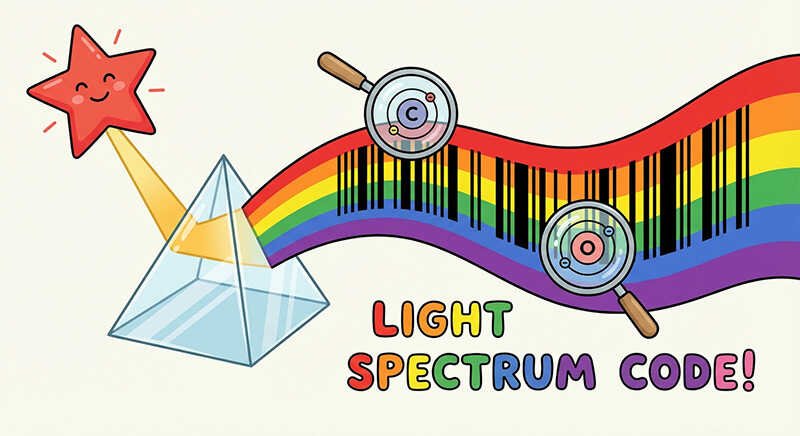
2. Barcodes in Light (Spectra)
How do we count atoms in a star that is light-years away? We look at its light!
When you spread starlight out (like a prism making a rainbow), you see dark lines. These lines are like barcodes.
- Carbon creates a specific pattern.
- Oxygen creates a specific pattern.
- Even the “rare cousins” (Isotopes) make tiny changes to the barcode.
♻️ A Clever Trick: Recycling Data!
Here is the coolest part of this study. The scientists didn’t use a telescope to take new pictures.
Instead, they went to the “library” of old data. Years ago, other astronomers used the CFHT telescope in Hawaii to look for planets orbiting these stars. They took high-quality pictures of the light to find planets.
The team led by Darío González Picos thought: “Hey, those pictures are really sharp. Instead of looking for planets, let’s look at the background chemistry!
It was like looking at old family vacation photos to find a secret clue hidden in the background.
🧪 What Did They Find?
They looked at 32 nearby Red Dwarfs and measured the Carbon and Oxygen. Here is the big discovery:
The “Recipe” of the Galaxy has changed over time.
They found that stars born earlier in the galaxy’s history (stars with fewer metals) had very few of the “rare cousins” (Carbon-13 and heavy Oxygen).
This tells us a story about how the galaxy grew up:
- The Early Days: The galaxy mostly had the “popular” types of Carbon and Oxygen, made by massive exploding stars.
- The Middle Ages: As time went on, smaller stars got old and puffed out gas. These stars were good at making the “rare cousins.”
- Today: The galaxy is now full of both types, mixed together.
🌍 Why Does This Matter to You?
This research helps us understand our own origins.
Our Sun formed about 4.6 billion years ago. It formed from a cloud of gas that had been “polluted” by generations of stars that lived and died before it. The mix of Carbon and Oxygen in your body is a specific blend—a recipe that took billions of years to perfect.
By studying these little Red Dwarfs, we are learning the history of that recipe.
🚀 What’s Next?
This is just the beginning! Now that scientists know they can use these little stars as chemical clocks, they want to:
- Look at even more Red Dwarfs to build a bigger map of the galaxy’s history.
- See if the chemistry of the star changes what kind of planets form around it.
It turns out, the smallest, dimmest stars in the sky have the biggest stories to tell. We just had to learn how to listen.
🧬 Key Vocabulary for Young Scientists:
- Red Dwarf: Small, cool, long-living stars. The most common type of star in our galaxy.
- Isotope: A version of an element with a different weight (like the “rare cousin”).
- Spectrum: The rainbow of light from a star that reveals what the star is made of.
- Archival Data: Old data stored in a database (science recycling!).