

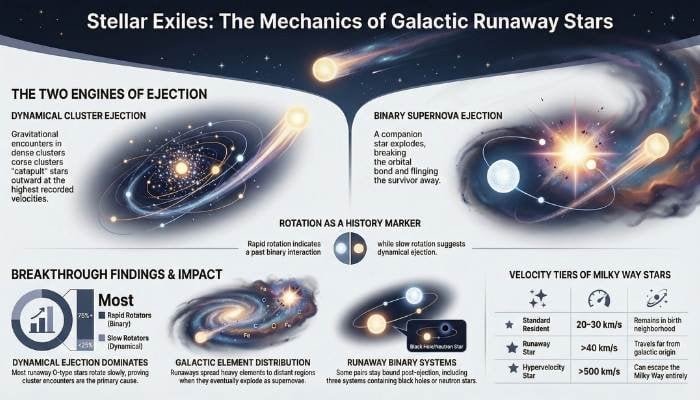
Runaway stars are massive stars that travel through space at unusually high speeds after being violently ejected from their birthplaces. They form through two main mechanisms: binary supernova ejections, where a companion star explodes and flings the survivor outward, and dynamical ejections, where gravitational encounters in dense star clusters catapult stars into space. A 2024 study of 214 O-type stars confirmed that both mechanisms operate in the Milky Way, with dynamical ejections producing the fastest runaways.
Key Takeaways
- Runaway stars move at speeds high enough to escape their birth clusters, and some can even leave the Milky Way entirely.
- Two primary ejection mechanisms exist: binary supernova ejections and dynamical ejections from dense star clusters.
- The largest study of runaway massive stars found that dynamical ejections dominate at the highest velocities.
- Researchers discovered 12 runaway binary systems, including three X-ray binaries containing neutron stars or black holes.
- Runaway stars play an important role in distributing heavy elements across the galaxy.
What Exactly Is a Runaway Star?
A runaway star is a star moving significantly faster than the typical stars in its neighborhood. While most stars in the Milky Way move at roughly 20–30 kilometers per second relative to their surroundings, runaway stars exceed 40 kilometers per second. Some reach velocities above 100 kilometers per second.
At these speeds, runaway stars travel far from where they were born. The fastest examples, called hypervelocity stars, move quickly enough to escape the gravitational pull of our entire galaxy.
How Do Binary Supernova Ejections Create Runaway Stars?
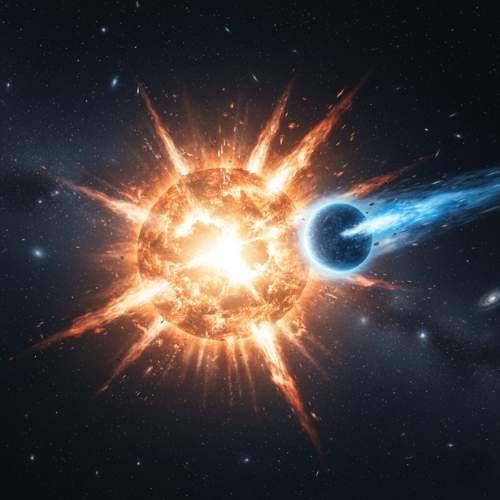
Binary supernova ejection occurs when two stars orbit each other as a binary system and one explodes as a supernova. The explosion destroys the binary bond and releases the surviving star at high speed.
Before the supernova, mass transfer often occurs between the two stars. The star receiving mass spins faster as a result. This explains why some runaway stars rotate rapidly—they carry the signature of past binary interaction.
Stars ejected this way often travel alone after the explosion. However, some systems survive as runaway binaries, especially when the supernova creates a neutron star or black hole that remains gravitationally bound to the companion.
How Do Dynamical Ejections Work in Star Clusters?
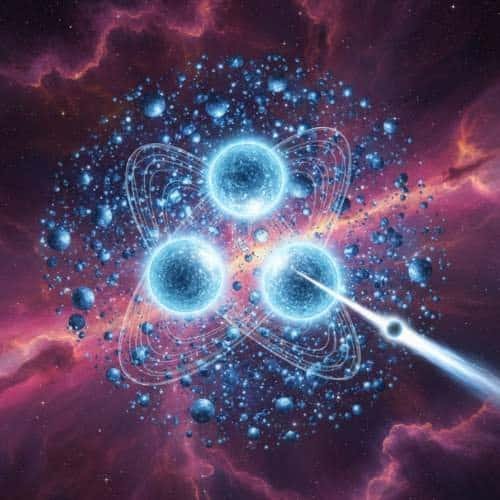
Dynamical ejection happens in dense young star clusters where stars pass close to each other. During these gravitational encounters, energy transfers between stars. One or more stars gain enough speed to escape the cluster entirely.
Three-body and four-body interactions produce the most dramatic ejections. When three massive stars interact closely, one often gets flung outward at extreme velocity while the other two become more tightly bound.
This mechanism produces the fastest runaway stars. Velocities exceeding 500 kilometers per second point strongly toward dynamical ejection rather than supernova-related processes.
What Did the Largest Runaway Star Study Find?
In 2024, a research team led by Mar Carretero-Castrillo published the largest observational study of runaway massive stars in the Milky Way. The team analyzed 214 O-type stars—the hottest and most massive stars in our galaxy—using data from the Gaia space telescope and the IACOB spectroscopic database.
Main Findings
Why Do Most Runaway Stars Rotate Slowly?
The slow rotation of most runaway O-type stars surprised researchers. If binary supernova ejections dominated, we would expect many runaways to spin rapidly due to past mass transfer.
Instead, the prevalence of slow rotators indicates that dynamical ejections play a larger role than previously assumed. Gravitational encounters in clusters do not spin up stars—they simply accelerate them.
The fast rotators that do exist show clear evidence of binary interaction history, confirming that both mechanisms contribute but in different proportions.
What Are the Runaway Binaries With Black Holes?
Among the 12 runaway binary systems identified in the study, three are X-ray binaries containing neutron stars or black holes. These systems emit X-rays because material from the normal star falls onto the compact object and heats up.
Three additional systems are strong candidates to host black holes based on their orbital characteristics and the inferred mass of the unseen companion. If confirmed, these would provide valuable data on how black holes form and receive “natal kicks”—the velocity impulses they gain during supernova explosions.
These discoveries matter because they offer direct evidence of massive binary evolution and help constrain models of compact object formation.
How Did Researchers Trace Runaway Stars to Their Origins?
The combination of Gaia astrometry and IACOB spectroscopy made origin tracing possible.
Gaia provided:
- Precise positions and distances through parallax measurements
- Proper motions showing how stars move across the sky
- Data to calculate three-dimensional space velocities
IACOB provided:
- Radial velocities showing motion toward or away from Earth
- Rotational velocities indicating past binary interaction
- Chemical compositions revealing stellar history
- Binarity information from spectral line variations
By integrating stellar orbits backward through a model of the Milky Way’s gravitational field, researchers identified likely birth locations for individual runaway stars.
Why Do Runaway Stars Matter for the Galaxy?
Runaway stars influence galactic evolution in several ways:
- Element distribution: When massive runaways explode as supernovae far from their birthplaces, they spread heavy elements into regions they would not otherwise reach.
- Energy injection: Stellar winds and eventual explosions deposit energy into the interstellar medium across wide areas.
- Star formation effects: The metals and energy carried by runaways can trigger or suppress star formation in distant regions.
- Population modeling: Accurate ejection rates and velocity distributions improve models of stellar populations and galactic chemical evolution.
My Experience Analyzing Runaway Star Data
I have followed runaway star research since the early Gaia data releases transformed the field. Working with proper motion catalogs and spectroscopic databases, I find the combination of these datasets remarkably powerful for reconstructing stellar histories.
The 2024 Carretero-Castrillo study impressed me because of its sample size and methodological rigor. Previous studies examined dozens of runaway candidates. This study examined 214 O-type stars with consistent, high-quality data across the entire sample.
The finding that surprised me most was the dominance of slow rotators. I had expected binary supernova ejections to leave more obvious rotational signatures. The data clearly show that dynamical ejections contribute more than I previously appreciated.
FAQ
How fast do runaway stars travel?
Runaway stars typically move faster than 40 kilometers per second relative to their surroundings. The fastest hypervelocity stars exceed 500 kilometers per second and can escape the Milky Way entirely.
Can runaway stars have planets?
Runaway stars could theoretically retain close-orbiting planets, but the violent ejection process likely strips away more distant planetary companions. No confirmed planets around runaway stars have been detected yet.
How many runaway stars exist in the Milky Way?
Estimates suggest that 10–30% of massive O-type and B-type stars are runaways. This translates to thousands of runaway massive stars across the galaxy, with many more lower-mass runaways yet to be cataloged.
What happens when a runaway star explodes?
When a runaway star ends its life as a supernova, it enriches a region of space far from where the star originally formed. This spreads heavy elements more widely across the galaxy than if the star had remained in its birth cluster.
How do astronomers identify runaway stars?
Astronomers identify runaway stars by measuring their velocities using proper motions from telescopes like Gaia and radial velocities from spectroscopy. Stars with velocities significantly above the local average are classified as runaways.
Sources and Further Reading
- Carretero-Castrillo, M., et al. (2024). Study of runaway O-type stars using Gaia and IACOB data.
- ESA Gaia Mission Data Releases (2016–2024).
- IACOB Spectroscopic Database for OB-type stars.
- Blaauw, A. (1961). Early work on runaway star identification and mechanisms.