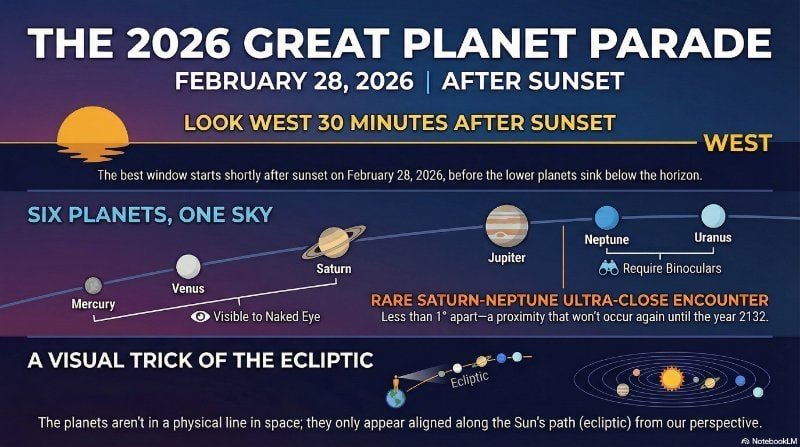


You can observe the six-planet alignment on the evening of February 28, 2026, by looking at the western horizon approximately 30 to 60 minutes after sunset. Four planets—Venus, Jupiter, Saturn, and Mercury—will be visible to the naked eye, while seeing Uranus and Neptune requires binoculars or a telescope. The planets will form an arc across the sky, starting low in the west and stretching to the southeast, with the best visibility occurring before Mercury sets in the evening twilight.
Key Takeaways
- Peak Date: The alignment is best viewed on February 28, 2026, though visibility extends from late February to early March depending on your location.
- Visible Planets: Mercury, Venus, Saturn, and Jupiter are visible to the naked eye; Uranus and Neptune require optical aid.
- Best Time: Start observing immediately as the sky darkens, roughly 30 minutes after sunset, to catch Mercury before it dips below the horizon.
- Direction: Scan from the low western horizon (Mercury, Venus, Saturn) up toward the southeast (Jupiter).
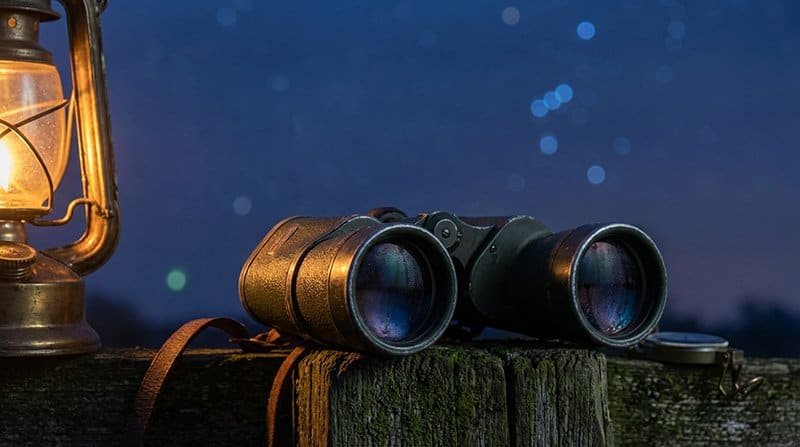
- Equipment: While a “parade” is visible to the eye, binoculars (7×50 or 10×50) are highly recommended to see Uranus, Neptune, and the details of the brighter planets.
Which planets will be visible during the February 2026 alignment?
Six planets will participate in this celestial event, but their visibility varies significantly based on their brightness and position relative to the Sun.
The Naked-Eye Planets
Four planets will be bright enough to see without special equipment, provided you have clear skies and an unobstructed view.
- Venus (-3.9 magnitude): Venus will be the brightest object in the western sky. It serves as your primary guidepost. Locate Venus first, as it dominates the twilight.
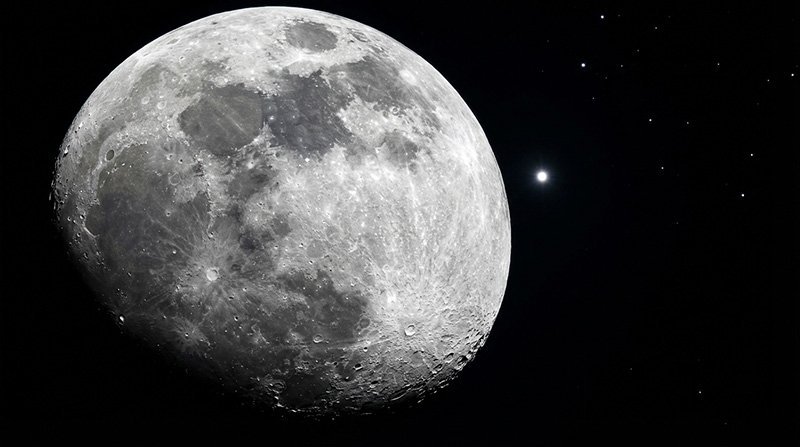
- Jupiter (-2.4 magnitude): Positioned high in the southeast, Jupiter is the second-brightest planet in this lineup. It will appear near a bright, 90% illuminated Moon, making it unmistakable.
- Saturn (1.0 magnitude): Saturn will appear as a steady, golden-yellow light slightly higher than Venus in the western sky. It does not twinkle like a star.
- Mercury (1.6 magnitude): This is the most challenging naked-eye target. Mercury sits very low on the western horizon and is visible only for a short window before setting. You must look for it beneath Venus in the fading twilight.
The Planets Requiring Optics
Two ice giants are part of this alignment but are too faint for the unaided human eye in typical conditions.
- Uranus (5.8 magnitude): Located higher in the southwest within the constellation Taurus, Uranus is theoretically visible to the naked eye in perfectly dark skies. However, in urban or suburban settings, binoculars are essential to spot its faint, greenish disc.
- Neptune (7.8 magnitude): This is the hardest planet to spot. It is located less than 1 degree away from Saturn. You will need a telescope or high-powered binoculars to distinguish it from background stars.
What is the best time to watch the planet parade?
Timing is critical for this specific alignment because the inner planets are close to the Sun.
The Golden Window: 30 to 60 Minutes After Sunset
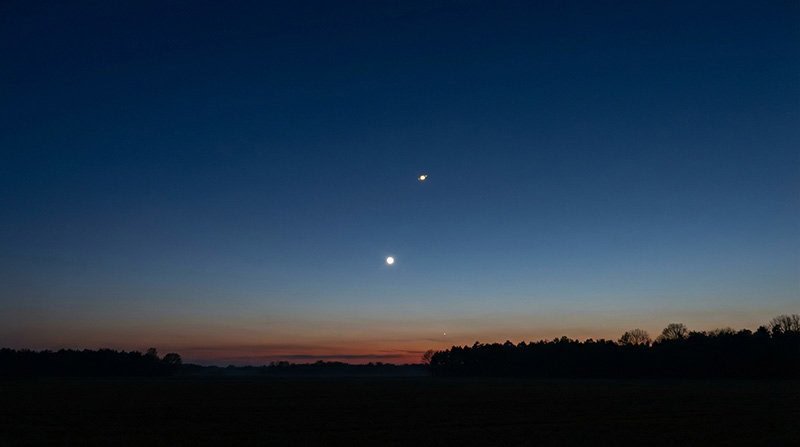
You should plan to start your observation 30 minutes after your local sunset. At this time, the sky is dark enough for planets to pop out against the twilight, but Mercury and Venus are still high enough above the horizon to be seen.
If you wait longer than 90 minutes after sunset, the alignment will “break.” Mercury and Venus will set below the western horizon, leaving only the outer planets visible.
Date Variations by Location
While February 28 is the global median date for the best view, your specific geographic location might shift the optimal viewing night by a day or two.
- São Paulo: Best viewed on February 25.
- New York, Mexico City, Tokyo: Best viewed on February 28.
- London, Beijing: Best viewed on March 1.
Where should I look in the night sky?
To see the full alignment, you need to scan a large arc of the sky known as the ecliptic. This is the imaginary line that marks the path of the Sun and where planets are always found.
The Western Sector
Face due West. This is where the action is most concentrated.
- Low Horizon: Look here for Mercury and Venus. You need a spot where trees or buildings do not block the horizon line.
- Mid-Elevation: Slightly higher in the West/Southwest, you will find Saturn. Use Saturn to find the invisible Neptune nearby.
The Southeastern Sector
Turn your gaze toward the Southeast.
- High Elevation: Jupiter will be high up, residing in the constellation Gemini. It will be located near the bright stars Castor and Pollux and a waxing gibbous Moon.
- The Bridge: Uranus sits in the “middle” of this parade, located high in the Southwest near the Pleiades star cluster (M45) in Taurus.
Do I need a telescope to see the alignment?
You do not need a telescope to enjoy the general “parade,” but you do need one to see every single planet listed.
For the Casual Observer (Naked Eye)
If you simply want to witness the event, your eyes are sufficient. Seeing Venus, Jupiter, Saturn, and Mercury simultaneously is a rare and beautiful event. The visual impact of these bright worlds strung across the sky is the main attraction for most people.
For the Completer (Binoculars/Telescope)
If your goal is to check all six planets off your list, optical aid is mandatory.
- Binoculars (7×50 or 10×50): These are perfect for finding Uranus near the Pleiades and for spotting Neptune next to Saturn. They also help pick Mercury out of the sunset glare.
- Telescope: A telescope is necessary to resolve Neptune as a disc rather than a star-like point. It will also reveal Saturn’s rings and Jupiter’s moons, enhancing the experience.
Is the February 2026 planetary alignment rare?
The rarity of this event depends on how you define “alignment.”
Large Scale Alignments (6+ Planets)
Alignments involving 6 planets are considered rare. For context, “mini” alignments of three planets happen regularly. However, a gathering of six planets visible in the evening sky is uncommon. The last major event was a 7-planet alignment in February 2025, and the next comparable large-scale display won’t occur until 2040.
Scientific vs. Visual Alignment
It is important to clarify that the planets are not physically lining up in space like billiard balls. They are scattered across the solar system but appear clustered in the same quadrant of the sky from Earth’s perspective. A “perfect” physical alignment of all planets in a straight line is impossible due to their different orbital inclinations.
My Experience: Tips for Spotting the Fainter Planets
As someone who has tracked planetary alignments for years, I can tell you that the biggest challenge on February 28 will be Mercury.
During similar alignments in the past, I found that even experienced observers struggle because they underestimate how bright the twilight sky remains 30 minutes after sunset. Mercury is fighting against that glare.
Here is my personal strategy for success:
- Arrive Early: I set up my viewing spot 20 minutes before sunset.
- Find Venus First: As soon as the sun dips, I lock onto Venus. It pops out first.
- Scan Down: Once I have Venus, I use binoculars to scan the area immediately below it toward the horizon to catch Mercury.
- Wait for Saturn: Saturn takes about 15–20 more minutes to become obvious to the naked eye after Venus appears. Be patient.
- Safety First: I never lift my binoculars until I am 100% certain the Sun has fully set. A moment of accidental solar viewing can cause permanent blindness.
Frequently Asked Questions
Will the planets form a straight line in the sky?
No, they will not form a perfectly straight ruler-line. Because the planets orbit on the ecliptic plane, they will appear to form a curved arc across the sky from the western horizon to the southeast.
Can I see the alignment from the Southern Hemisphere?
Yes, the alignment is visible globally. However, the orientation of the arc will be inverted compared to the Northern Hemisphere. In places like Sydney or São Paulo, the planets will trace a path from the North-West to the North-East.
Do planetary alignments cause earthquakes or tsunamis?
No. The combined gravity of all the planets is negligible compared to the gravitational pull of the Moon and Sun. There is no scientific evidence that planetary alignments affect Earth’s geology or climate.
Which app is best for finding the planets?
Sources consistently recommend apps like Star Walk 2 or Sky Tonight. These apps have specific “Planet Walk” features that allow you to hold your phone up to the sky and identify the dots of light in real-time, which is essential for distinguishing Saturn from nearby stars.
What happens if it is cloudy on February 28?
Do not worry if you miss the peak date. The alignment changes slowly. You can view the planets for several days before and after February 28, though the grouping will be slightly less tight. Mercury will be the first to disappear from view as March begins.