

NASA’s exploration program continues to move forward on multiple fronts, from human missions around the Moon to robotic exploration of distant worlds. Over the past few days, several developments have highlighted how the agency is balancing near-term missions with long-term scientific exploration.
Below is a clear overview of the most important NASA-related stories shaping space exploration right now.
Artemis II mission moves closer to launch
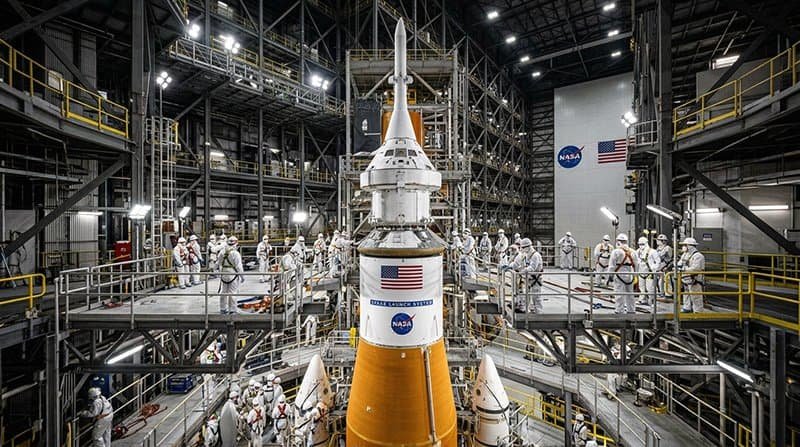
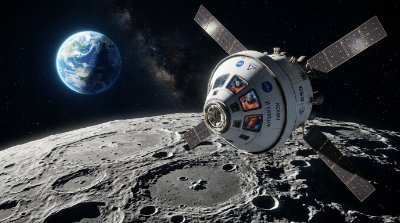
NASA is continuing preparations for Artemis II, the first crewed mission of the Artemis program. The flight will send four astronauts aboard the Orion spacecraft on a journey around the Moon before returning to Earth.
Unlike the earlier Artemis I mission, which was uncrewed, this upcoming mission will test the spacecraft’s life-support systems, navigation, and communications with astronauts onboard. The crew will travel thousands of miles beyond the Moon, farther than any human mission has gone since the Apollo era.
The flight is expected to last around ten days and will serve as a critical step toward Artemis III, the mission designed to land astronauts on the lunar surface later in the decade.
NASA officials say the goal of Artemis II is to validate systems needed for sustained deep-space exploration, including technologies that will eventually support human missions to Mars.
Dragonfly spacecraft enters construction phase
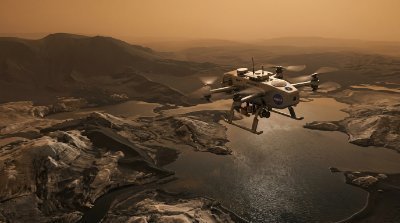
NASA has also started building components for Dragonfly, an ambitious robotic mission that will explore Saturn’s moon Titan.
Dragonfly is designed as a rotorcraft lander capable of flying between multiple locations on Titan’s surface. Because Titan has a dense atmosphere and low gravity, the aircraft-style design allows scientists to explore a much wider area than a traditional rover could reach.
The spacecraft will be powered by a radioisotope system rather than solar panels, enabling it to operate in Titan’s cold and dim environment.
Scientists are particularly interested in Titan because it contains lakes and rivers made of liquid methane and ethane. Its chemistry may resemble conditions that existed on early Earth, making it a compelling place to study the building blocks of life.
The Dragonfly mission is currently targeted for launch in 2028, with arrival at Titan expected in the mid-2030s.
Small asteroid safely passes near Earth
NASA’s planetary defense monitoring network recently tracked a small near-Earth asteroid that passed relatively close to our planet.
The object, designated 2026 EG1, is estimated to be roughly 10 to 15 meters in diameter. At its closest approach, the asteroid passed about 310,000 kilometers from Earth, which is slightly closer than the Moon’s average distance.
While the flyby attracted attention because of its proximity, NASA confirmed that the asteroid posed no impact risk.
Events like this highlight the importance of continuous monitoring. NASA currently tracks tens of thousands of near-Earth objects through telescopes and automated detection systems designed to identify potential threats well in advance.
Van Allen probe ends mission after more than a decade
Another recent milestone involves one of NASA’s long-running scientific missions closer to home.
A spacecraft from the Van Allen Probes mission, launched in 2012, has now reentered Earth’s atmosphere after more than a decade of studying the planet’s radiation belts. These belts are zones of energetic particles trapped by Earth’s magnetic field.
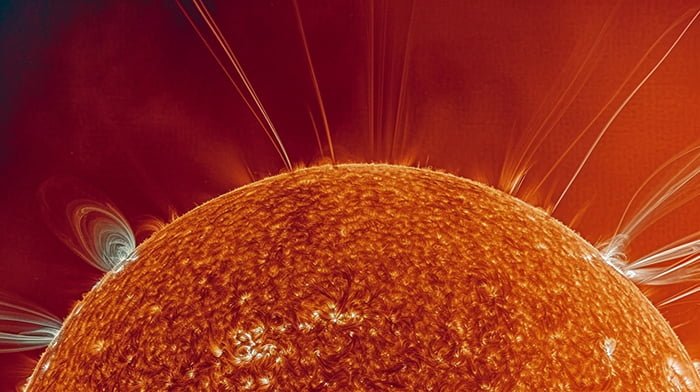
During its operational life, the spacecraft helped scientists better understand how solar storms influence radiation levels around Earth. The mission also revealed surprising structures in the radiation belts, including a temporary third belt that forms during intense solar activity.
Most of the spacecraft burned up during reentry, bringing the mission to a quiet but scientifically successful conclusion.
A broader moment for NASA exploration
Taken together, these developments illustrate how NASA’s work spans very different parts of the solar system at the same time.
The Artemis program is focused on returning humans to the Moon and establishing a sustainable presence there. Meanwhile, missions like Dragonfly extend scientific exploration far beyond Mars, targeting environments that could offer clues about the origins of life.
At the same time, near-Earth asteroid monitoring and long-term science missions continue to deepen our understanding of the space environment surrounding our own planet.
In many ways, the current moment reflects a transition period for NASA. Human exploration is returning to deep space while robotic missions push further outward, creating a new era of discovery across the solar system.
Source
NASA – Artemis II Mission Overview
NASA – Dragonfly Mission to Titan
Space.com – NASA begins building Dragonfly rotorcraft for Titan mission
CNN – NASA asteroid tracking and planetary defense efforts
NASA – Van Allen Probes Mission Overview
The New York Times – NASA and near-Earth asteroid monitoring