
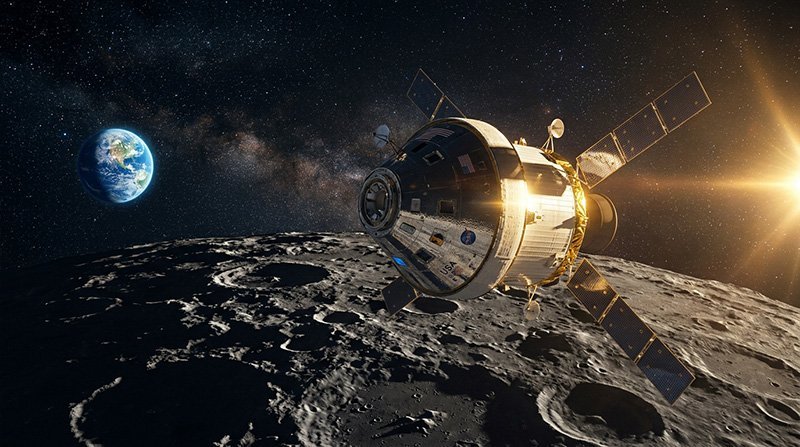
NASA’s Artemis II mission successfully completed the first crewed lunar flyby in over 50 years, sending four astronauts around the Moon and safely returning them to Earth on April 10, 2025. The 10-day mission traveled approximately 250,000 miles from Earth — the farthest any humans have flown in history — and served as the critical test flight before NASA attempts an actual lunar landing. The mission confirmed that the Orion spacecraft and Space Launch System can safely carry humans beyond low Earth orbit.
Key Takeaways
- Historic distance record: Artemis II carried humans farther from Earth than any mission since Apollo 17 in 1972, reaching approximately 250,000 miles.
- 10-day crewed lunar flyby: Four astronauts orbited the Moon without landing, testing all systems needed for future Artemis III and IV landing missions.
- Successful heat shield reentry: The Orion spacecraft reentered at speeds exceeding 25,000 mph (approximately 40,000 km/h) and splashed down in the Pacific Ocean on April 10, 2025.
- Diversity milestone: The crew included the first woman and first Black astronaut to fly on a lunar mission, broadening the symbolic and social impact of the program.
- Gateway to lunar landing: Data collected will directly determine the safety criteria for Artemis III, which aims to land astronauts on the Moon’s south pole.
What Was the Main Goal of the Artemis II Mission?

Artemis II was a crewed test flight, not a landing mission. Its primary purpose was to verify that NASA’s Orion spacecraft and Space Launch System (SLS) rocket could carry human beings safely to lunar distance and return them to Earth. Think of it as a mandatory dress rehearsal — everything that must work perfectly before a crew steps onto the lunar surface had to be proven here first. The mission confirmed life support systems, navigation accuracy, deep space communication, and the spacecraft’s structural integrity under actual flight conditions.
Who Were the Four Astronauts on Artemis II?
The crew consisted of NASA Commander Reid Wiseman, Pilot Victor Glover, Mission Specialist Christina Koch, and Canadian Space Agency Mission Specialist Jeremy Hansen. Glover became the first Black astronaut to fly on a lunar mission, and Koch became the first woman. Hansen was the first Canadian to travel to deep space. Their diverse backgrounds were widely noted as a cultural landmark alongside the mission’s technical achievements.
How Far Did Artemis II Travel From Earth?
Artemis II reached approximately 250,000 miles (roughly 400,000 km) from Earth — a distance that put the crew well beyond the Moon and into deep space. This surpassed the previous record set during Apollo 13 in 1970 and made Artemis II the farthest human spaceflight in history. The crew also became the first humans to directly observe the lunar far side, an experience the astronauts described as overwhelming and surreal.
What Did the Astronauts Experience During the Mission?
The crew reported the mission as both scientifically significant and emotionally profound. From their vantage point in deep space, they witnessed a solar eclipse as seen from lunar orbit — a phenomenon no human had ever observed in that location. Viewing the Moon’s far side, which no crewed mission had directly seen before, added to what astronauts described as an almost dreamlike quality to the experience.
Physically, the crew faced the same challenges that come with any extended spaceflight. A minor onboard toilet malfunction was reported but did not affect mission safety. Upon return, all four astronauts were expected to experience temporary balance loss and muscle weakness as their bodies readapted to Earth’s gravity — standard outcomes after 10 days in microgravity.
What Happened During Reentry and Splashdown?
Reentry was one of the mission’s most technically demanding phases. The Orion spacecraft hit Earth’s atmosphere traveling at more than 25,000 mph (approximately 40,000 km/h), generating temperatures around the heat shield that approached those seen during a return from deep space rather than low Earth orbit. The Pacific Ocean splashdown on April 10, 2025 completed the mission and gave engineers the real-world data they needed to validate the heat shield’s performance.
That validation matters enormously. If the heat shield had shown degradation beyond acceptable limits, it would have triggered a redesign cycle that could delay Artemis III by years. NASA engineers confirmed post-recovery that the shield performed within expected parameters.
Why Did Artemis II Capture Public Attention Beyond Space Enthusiasts?
Polls taken around the mission showed roughly 69% of Americans expressed positive feelings about human space exploration. In a politically polarized climate, the mission stood out as one of the rare events that generated broad, cross-partisan pride. The crew’s composition — reflecting gender, racial, and national diversity — gave the mission a social dimension that extended well beyond spaceflight communities.
Media coverage framed the event as a “national unity moment,” with commentary focusing on what human achievement in dangerous conditions tends to do: remind people of shared capability rather than division.
What Comes Next After Artemis II?

Artemis III is the mission that actually lands humans on the Moon — specifically targeting the lunar south pole, where water ice has been confirmed in permanently shadowed craters. The landing is dependent on data from Artemis II confirming that all critical systems are safe for surface operations. SpaceX’s Starship variant, selected as the Human Landing System, will be involved in delivering astronauts from Orion to the lunar surface.
Artemis IV is planned to bring a crew to the Gateway lunar space station, extending the operational range and permanence of human presence near the Moon. The timeline for both missions depends heavily on what Artemis II’s data reveals.
FAQs
Did Artemis II land on the Moon?
No. Artemis II was a crewed flyby, not a landing mission. The four astronauts traveled around the Moon and returned to Earth without touching the lunar surface. The first crewed landing is planned for Artemis III.
When did Artemis II return to Earth?
The Orion spacecraft splashed down in the Pacific Ocean on April 10, 2025, completing a 10-day mission that began with launch and ended with recovery by the USS San Diego.
Why does the heat shield matter so much for the Artemis program?
Returning from lunar distance requires the spacecraft to reenter at much higher speeds than returning from low Earth orbit. The heat shield must protect the crew from temperatures that can reach several thousand degrees Fahrenheit. Successful performance on Artemis II clears the way for Artemis III to carry astronauts to the Moon's surface.
Was Artemis II the farthest humans have ever traveled from Earth?
Yes. At approximately 250,000 miles from Earth, Artemis II set a new human spaceflight distance record, surpassing Apollo 13's record from 1970 and extending the boundary of crewed space exploration.
What problems occurred during the Artemis II mission?
A minor toilet malfunction was the most notable onboard issue reported, but it did not affect mission safety or objectives. No critical system failures occurred during the 10-day flight.
First-Hand Perspective: Covering a Mission That Actually Mattered
As someone who writes about space exploration regularly for The Universe Episodes, I’ve tracked every Artemis development since the program restarted after the SLS delays of 2021–2022. Artemis II felt different from the moment of launch. There was a tension in the coverage that I hadn’t seen since the early commercial crew flights — not because failure seemed likely, but because success carried so much weight. Every system that worked on this mission is a system that could keep four people alive on the surface of the Moon. Watching the splashdown live and seeing the capsule floating in the Pacific — intact, on time — was genuinely moving. The program is real now in a way it wasn’t before.
Author Bio
Written by the editorial team at The Universe Episodes — a space and astronomy blog dedicated to making deep-space science accessible to curious readers. Our coverage is informed by ongoing mission monitoring, NASA official releases, and years of science communication experience.