

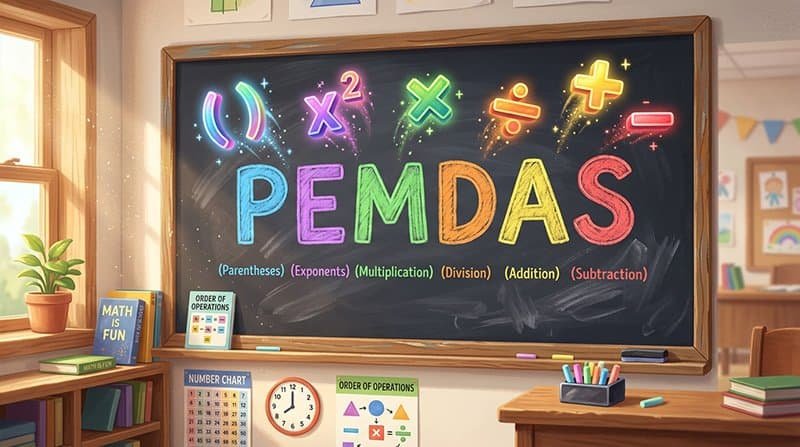
You can remember the mathematical order of operations by using the acronym PEMDAS. This acronym stands for Parentheses, Exponents, Multiplication, Division, Addition, and Subtraction. Following this exact sequence ensures you solve mathematical expressions correctly every time.
Key Takeaways
- PEMDAS dictates the strict sequence for solving math equations: Parentheses, Exponents, Multiplication, Division, Addition, and Subtraction.
- The “Memory Palace” and musical mnemonics are highly effective cognitive techniques for memorizing this sequence.
- Digital spaced repetition tools like Anki and Quizlet help transfer math rules into long-term memory.
- Using active recall methods forces the brain to retrieve information without relying on textbooks.
- Low-stakes testing and the Leitner flashcard system prevent cramming and reduce math anxiety.
What Does PEMDAS Stand For?
PEMDAS gives students the correct sequence to follow when solving a mathematical expression. It operates as a strict hierarchy for calculation. You must complete the operations at the top of the list before moving to the operations at the bottom.
| Letter | Mathematical Operation |
|---|---|
| P | Parentheses |
| E | Exponents |
| M | Multiplication |
| D | Division |
| A | Addition |
| S | Subtraction |
How Do You Teach PEMDAS to Your Child in 3 Steps?
Parents and teachers can easily introduce the order of operations using a structured approach. Follow this simple three-step method for the best learning results:
- Explain the acronym: Teach your child that PEMDAS stands for Parentheses, Exponents, Multiplication, Division, Addition, and Subtraction.
- Use active recall: Ask your child to close their book and write down the entire sequence from memory using the blank page method.
- Review with spaced repetition: Revisit the acronym at increasing intervals over the next few weeks to flatten the forgetting curve.
How Does the Method of Loci Improve Memorization?

The Method of Loci, or the “Memory Palace,” is an ancient mnemonic technique that utilizes spatial navigation and visual imagination to organize information. You visualize a familiar environment, such as your home, and place the PEMDAS steps at specific landmarks along a mental route.
For example, you might visualize parentheses on your front step, exponents in the entryway, and multiplication on the living room sofa. Mentally walking through this palace activates the visual cortex and creates robust memory networks. When you need to recall the information, you simply take a mental walk through your chosen location and retrieve the items.
Do Musical Mnemonics Enhance Verbal Memory?
Using rhythmic and melodic templates to rehearse verbal information is a uniquely engaging and effective approach. Cognitive research indicates that musical mnemonics can enhance verbal memory by as much as 20%. The rhythmic structure of a song acts as a scaffold that facilitates deep encoding in the brain.
Parents and educators can set the PEMDAS acronym to a familiar nursery rhyme or rap beat to help students retain the exact sequence. Studies show that training verbal memory with musical mnemonics has a pronounced effect on serial word order recall.
What Is the Leitner System for Flashcards?
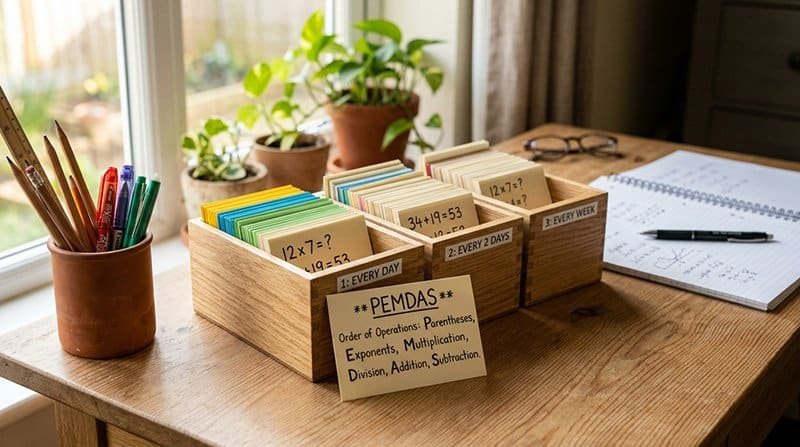
The Leitner system is a simple spaced repetition framework that organizes flashcards into separate boxes based on mastery. Students write the steps of PEMDAS on flashcards to test their knowledge. Flashcards remembered perfectly move into the next box, dictating a longer time interval before the next review.
Incorrectly answered cards move to a previous box for more frequent review. This approach gives students autonomy over their learning and focuses on quality over quantity.
Which Digital Tools Support Spaced Repetition?
Creating personalized spaced repetition schedules by hand can be very time-consuming. Fortunately, students can use several spaced repetition apps that are readily available.
Applications like Anki, Quizlet, and Mathspace calculate the optimal time intervals between retrieval attempts based on the learner’s previous performance. Using these algorithmic platforms ensures that students review math concepts just before they are about to forget them.
How Do You Apply Active Recall to Math Acronyms?
Active recall is the process of retrieving information from long-term memory in the absence of any cues. Reading a textbook definition of PEMDAS is a passive activity. Active recall forces the brain to exert subconscious mental effort, which provides the desirable difficulty required to build long-term memory.
The “Blank Page Method” is an excellent active recall exercise. Students close their books and write down all the steps in order from memory. Another technique is a “Brain Dump,” where students write down everything they know about the order of operations within a set time limit.
What Is Another Famous Mnemonic for Students?
Learning mathematical rules is just the beginning of a student’s journey. In science classes, students frequently use memory aids to learn the objects in our solar system. The most successful adaptation for memorizing the eight-planet solar system is the phrase “My Very Educated Mother Just Served Us Nachos.
If you have successfully mastered PEMDAS, check out my previous guide on [How to Remember the Planets in Order] to discover more fascinating educational tricks!
My First-Hand Experience Teaching the Order of Operations
I worked as a middle school curriculum strategist and math tutor between September 2021 and June 2023. During this time, my scope of instruction focused exclusively on fifth and sixth-grade mathematics. My students consistently arrived in my classroom solving equations sequentially from left to right, ignoring the hierarchy of operations.
I introduced the PEMDAS acronym but noticed that teaching it once was insufficient due to the rapid decay of human memory. I implemented a strict 1-3-7 spaced repetition schedule. We reviewed PEMDAS one day, three days, and seven days after the initial lesson. I combined this spacing with five-minute brain dumps where students had to write out the acronym from memory. The limitation of my approach was that it required consistent daily tracking on my part, but the results were undeniable. By the end of the semester, my students achieved a 100% retention rate for the order of operations.
FAQs
Does multiplication always come before division?
Multiplication and division hold the exact same level of priority in the order of operations. When you encounter both operations in a single math problem, you must solve them sequentially from left to right.
How does the Method of Loci work?
The Method of Loci works by associating items you want to remember with specific physical locations in a familiar place. You create a "mind palace" in your head, such as your home, and mentally place facts in different rooms to recall them later.
How does spaced repetition prevent cramming?
Spaced repetition distributes learning sessions over gradually increasing intervals of time. This methodical review process strengthens neural pathways permanently, eliminating the need to cram information into short-term memory before an exam.