


/
The Milky Way’s Place in the Universe
What the Milky Way Is
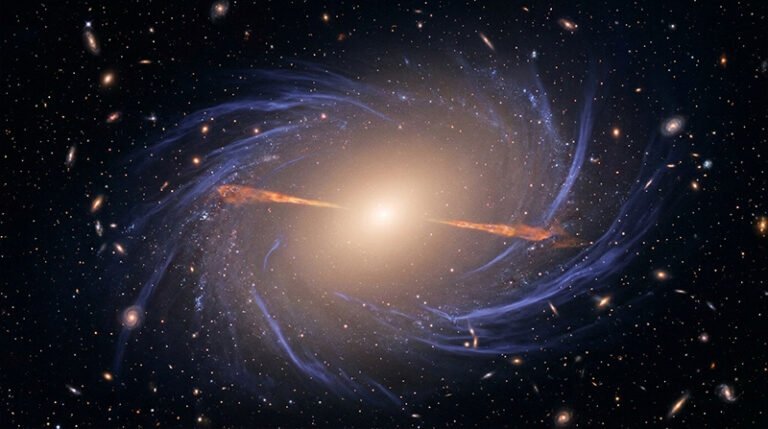
- A barred spiral galaxy with a rotating disk and spiral arms
- Contains 100-400 billion stars in a disk ~100,000 light-years across
- Houses a supermassive black hole (Sagittarius A*) at its center with 4.1 million solar masses
- We’re located in a minor arm called the Orion-Cygnus Spur, 27,000 light-years from the center
Key Comparisons
vs. Andromeda (our closest large neighbor)
- Andromeda has more stars (~1 trillion) and a larger visible disk (220,000 light-years)
- BUT: The Milky Way may equal or exceed Andromeda in total mass due to dark matter
- The Milky Way is more active, forming 1.65-8 new stars yearly vs. Andromeda’s 0.4-1
- They will collide in 4.5 billion years, merging into an elliptical galaxy nicknamed “Milkomeda”
vs. Giant Galaxies
- Supergiant galaxies like IC 1101 dwarf us—it’s 4 million light-years across with up to 100 trillion stars
- The Milky Way is “large” but nowhere near the biggest
vs. Other Galaxy Types
- Irregular galaxies: Chaotic, no organized structure (e.g., Magellanic Clouds)
- Elliptical galaxies: “Red and dead”—old stars, no gas, no new star formation (e.g., M87)
- The Milky Way is actively forming stars and maintains an ordered structure
vs. Extreme Active Galaxies
- Starburst galaxies: Form stars hundreds of times faster (temporary phase)
- Quasars: Black holes so active they outshine entire galaxies; our Sgr A* is essentially dormant
- The Milky Way had a more active past (evidence: Fermi Bubbles from a past outburst)
Our Cosmic Address
- Member of the Local Group (~80 galaxies), which is a quiet “galactic suburb”
- Part of the larger Virgo Supercluster (110+ million light-years across)
- Our peaceful location allowed us to maintain our spiral structure—galaxies in dense clusters get stripped of gas and become “red and dead”
Bottom Line
The Milky Way is fortunate and representative—a healthy, mature spiral galaxy in its prime, not the biggest or most extreme, but blessed with a quiet neighborhood that allowed it to preserve its beauty and sustain steady star formation for billions of years.