

New NASA Observations of Dark Matter and the Early Universe
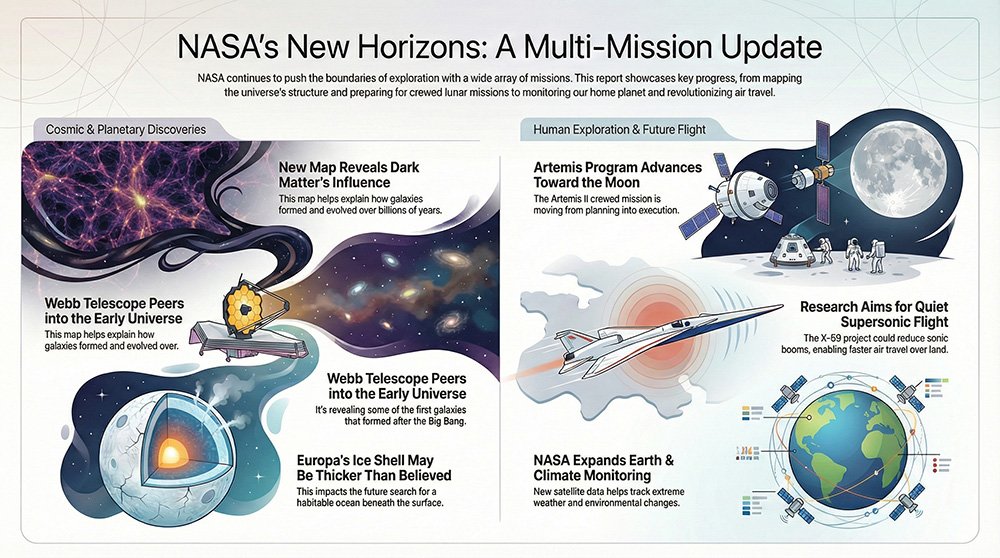
NASA scientists have recently unveiled a new high-resolution map of dark matter based on observations of distant galaxy clusters. By analyzing how massive objects bend light from background galaxies, researchers are gaining a clearer picture of how dark matter influences the large-scale structure of the universe. This work provides important context for understanding how galaxies formed and evolved over billions of years.
At the same time, the James Webb Space Telescope continues to extend humanity’s view deeper into cosmic history. Webb’s observations are revealing galaxies that formed shortly after the Big Bang, offering new evidence about the earliest stages of star and galaxy formation and helping refine models of the young universe.
Artemis Program Advances Toward the Moon
NASA is making steady progress toward its next crewed lunar mission under the Artemis program. Preparations for Artemis II include major system tests of the Space Launch System rocket and the Orion spacecraft, which will carry astronauts on a mission around the Moon. These steps mark a key phase in NASA’s long-term plan to establish a sustained human presence beyond low Earth orbit.
NASA has also shared more details about the Orion spacecraft itself, highlighting life-support systems, crew safety features, and design changes informed by previous test flights. Together, these developments signal that Artemis II is moving from planning into execution.
Expanding Earth Science and Climate Monitoring
NASA’s Earth science teams continue to release new data products that support environmental research and decision-making. Recent updates include high-resolution imagery and three-dimensional terrain models that can be used for land monitoring, disaster response, and climate studies. These datasets are part of NASA’s effort to make satellite data more accessible to scientists, governments, and the public.
In addition, NASA satellites recently captured detailed views of a major winter storm system affecting large portions of the United States. Such observations demonstrate how space-based monitoring plays a crucial role in tracking extreme weather and understanding its broader impacts.
New Insights Into Europa’s Ice Shell
NASA’s Juno mission has provided new estimates of the thickness of the ice shell covering Jupiter’s moon Europa. The findings suggest the ice may be thicker than previously believed, a result that has important implications for future missions searching for signs of habitability beneath the surface.
Understanding Europa’s ice structure is critical for upcoming exploration efforts, as it affects how scientists interpret surface features and assess the likelihood of a subsurface ocean interacting with the moon’s exterior.
NASA Aeronautics and Supersonic Research
Beyond space exploration, NASA continues to invest in aeronautics research. The agency has added a modified F-15 aircraft to its research fleet to support flight testing of the X-59 quiet supersonic jet. The X-59 project aims to reduce the loud sonic booms traditionally associated with supersonic flight, potentially enabling faster air travel over land in the future.
This research reflects NASA’s broader role in advancing aviation technology alongside its planetary and space science missions.
Sources
- NASA
- NASA Jet Propulsion Laboratory (JPL)
- NASA Earth Observatory
- The Week
- Live Science
- Space.com
- Gizmodo