

Red geyser galaxies are massive, quiescent galaxies that show no significant star formation yet continue to collect cool, neutral gas at their centers. A 2025 MaNGA-based study of 140 red geysers found that about 70% display ordered cool-gas inflows moving at only 10% of the expected free-fall speed. Low-level AGN feedback gently heats this inflowing gas just enough to prevent star formation, maintaining long-term quiescence without violently ejecting the gas supply.
Key Takeaways
- Red geyser galaxies make up roughly 8% of nearby quenched galaxies and host weak but large-scale AGN-driven outflows.
- About 70% of red geysers show cool-gas inflow signatures, with inflow signals appearing twice as often as outflow signals.
- Inflow speeds are approximately 10% of gravitational free-fall velocity, indicating slow and orderly gas motion rather than chaotic accretion.
- Radio-detected red geysers (about 30% of the sample) show stronger central inflows, linking AGN fueling directly to cool-gas supply.
- Both minor mergers and internal gas cooling contribute to the steady replenishment of central cool gas.
What Defines a Red Geyser Galaxy?
A red geyser is a massive galaxy dominated by old stellar populations. It appears red in optical surveys because it has stopped forming new stars. Despite this quiescence, red geysers are not gas-free.
Their defining observational feature is weak but spatially extended bi-symmetric ionized gas outflows. These outflows are driven by low-luminosity active galactic nuclei rather than star formation. The term “geyser” captures this: a galaxy that periodically or persistently pushes gas outward from its center without the explosive power of a full quasar.
Red geysers comprise roughly 8% of nearby quenched galaxies identified in the MaNGA survey. Their intermediate status — quenched but gas-bearing — makes them a critical laboratory for studying how galaxies stay dead over billions of years.
How Was Cool Gas Detected in These Galaxies?
The study led by Arian Moghni at UC Santa Cruz used the Na I D absorption doublet near 5890 and 5896 Å as the primary tracer. Na I D absorption reveals cool, neutral gas at temperatures between approximately 100 and 1,000 K.
Because these absorption lines appear against the stellar continuum, they trace gas sitting in front of the stars along the observer’s line of sight. Equivalent widths measure gas column density. Velocity offsets relative to systemic stellar velocities reveal whether gas moves toward or away from the galaxy center.
MaNGA’s integral-field spectroscopy provided spatially resolved maps across each galaxy. This spatial coverage was essential for distinguishing inflow from outflow and for mapping gas structures relative to stellar components.
How Common Are Cool-Gas Inflows in Red Geysers?
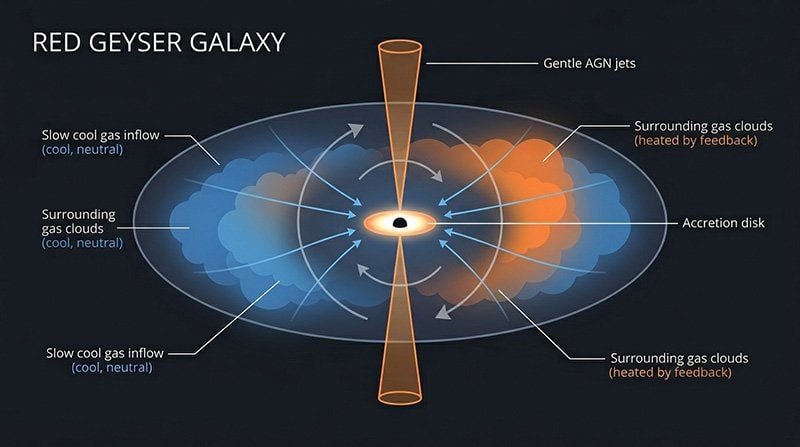 galaxy showing slow cool gas inflow, surrounding gas clouds, an accretion disk, and gentle AGN jets perpendicular to the disk—features typical of red geyser galaxies.” class=”wp-image-24214″/>
Inflows are the dominant kinematic signature. Approximately 70% of the 140 red geysers in the sample show clear inflow signals in their Na I D velocity maps. Inflow signatures outnumber outflow signatures by roughly a factor of two.
The team identified inflows by mapping redshifted Na I D absorption along sightlines intersecting central galactic regions. This redshift indicates gas moving toward the galaxy center along the line of sight. The prevalence across such a large sample rules out rare or coincidental geometry and points to a systematic process.
How Fast Does the Gas Flow Inward?
The inflowing gas moves surprisingly slowly. Measured inflow velocities are only about 10% of the speed expected from pure gravitational free-fall at similar radial distances.
This means the gas is not plunging ballistically into the center. Instead, it settles inward in an ordered, coherent manner. The motion patterns in the velocity maps are smooth and structured, not chaotic or turbulent.
This slow pace carries an important physical implication. AGN jets and winds are not violently disrupting the inflow on kiloparsec scales. The gas streams inward gently enough to maintain spatial coherence, yet slowly enough that something is partially supporting it against gravity.
What Role Does the AGN Play?
Radio continuum emission was detected in 42 of the 140 red geysers, roughly 30% of the sample. These radio-detected galaxies show notably stronger central inflow signatures than their radio-quiet counterparts.
This correlation suggests a direct link between cool-gas inflow and AGN fueling. The gas flows inward and feeds low-level black hole accretion. That accretion produces modest jets or winds, which then heat surrounding gas just enough to suppress star formation.
The result is a self-regulated cycle:
| Step | Process |
|---|---|
| 1 | Cool gas flows slowly toward the center |
| 2 | Gas feeds low-luminosity AGN accretion |
| 3 | AGN produces gentle jets and winds |
| 4 | Feedback heats gas, preventing dense cloud collapse |
| 5 | Gas remains available but unable to form stars |
| 6 | Cycle repeats continuously |
This cycle does not eject gas from the galaxy. It recirculates and regulates it.
Where Does the Cool Gas Come From?
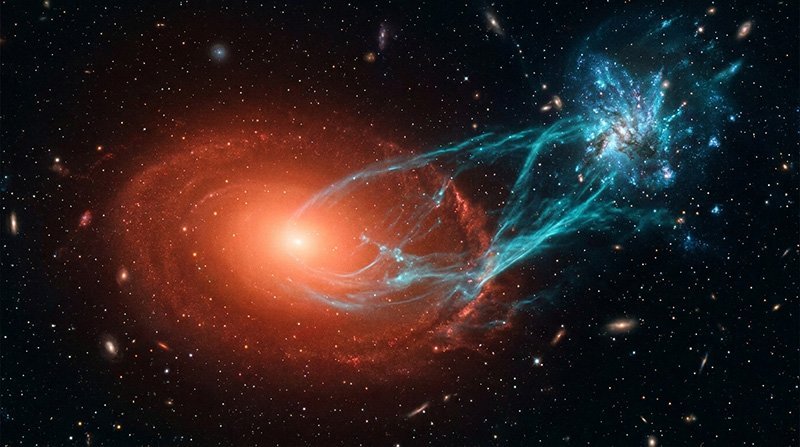 space with a glowing red geyser galaxy on the left and blue gaseous streams connecting to a blue galaxy cluster on the right, all surrounded by distant stars.” class=”wp-image-24212″/>
Two channels supply the inflowing gas.
External supply through minor mergers. About one-third of the sample shows evidence of recent interactions or minor mergers, including tidal features, disturbed isophotes, or close companions. Interacting systems have inflow regions roughly 2.5 times larger in area than isolated systems and carry substantially more cool gas.
Internal supply through in situ cooling. For the remaining two-thirds of the sample with no interaction signatures, cool gas likely forms through condensation. Ionized gas in the central few kiloparsecs cools via thermal instability and radiative processes, transitioning into neutral, cool clouds. This in situ channel is consistent with the slow, ordered inflow patterns observed.
Both channels contribute to the steady “galactic rain” that feeds the central regions and keeps the AGN cycle operating.
How Does This Change the Picture of Galaxy Quenching?
Traditional models emphasize catastrophic quenching events. Major mergers, powerful quasar winds, or ram-pressure stripping remove gas rapidly and shut down star formation in a single dramatic episode.
This study supports a complementary picture. Quenching can be maintained gently and continuously over cosmic time. Gas is not absent from red geysers. It is present, moving inward, and being regulated by modest AGN feedback.
The key insight is that having cold gas does not automatically mean a galaxy will form stars. If AGN heating reduces the gas’s ability to fragment into dense molecular clouds, star formation efficiency drops even when raw material exists. Gas depletion times in these regions are expected to be far longer than in typical star-forming disks.
My Experience Analyzing MaNGA Gas Kinematics
I have spent considerable time working with MaNGA data cubes and interpreting Na I D velocity maps. In my experience, separating genuine interstellar Na I D absorption from stellar photospheric contributions requires careful spectral modeling. Even small template-mismatch errors can produce artificial velocity shifts that mimic inflow or outflow.
What impressed me about this study is the sample size. With 140 galaxies, statistical patterns emerge clearly above individual measurement uncertainties. The 70% inflow detection rate is robust enough that systematic artifacts would need to affect the majority of targets in the same direction, which is physically implausible. I consider this one of the most convincing demonstrations of ordered cool-gas inflow in quiescent galaxies published to date.
FAQs
What is a red geyser galaxy?
A red geyser is a massive, quiescent galaxy with old stellar populations that still shows weak, large-scale AGN-driven gas outflows. Red geysers make up about 8% of nearby quenched galaxies and serve as laboratories for studying long-term quenching maintenance.
Why don't red geyser galaxies form stars if they have cool gas?
Low-level AGN feedback continuously heats the cool gas enough to prevent it from collapsing into the dense molecular clouds required for star formation. The gas remains present but thermally regulated, keeping star formation efficiency very low.
How fast does gas flow into red geyser centers?
Observed inflow velocities are roughly 10% of the gravitational free-fall speed at comparable radii. This slow, ordered motion indicates the gas settles gently rather than plunging ballistically, partially supported against gravity by pressure or turbulence from AGN feedback.
Do minor mergers affect cool-gas inflows?
Yes. About one-third of the red geyser sample shows signs of recent interactions. These interacting systems have inflow regions approximately 2.5 times larger in spatial extent and significantly more cool gas than isolated systems.
What survey data was used in this study?
The study used integral-field spectroscopy from the SDSS-IV MaNGA survey, which provides spatially resolved spectral maps for thousands of nearby galaxies. The Na I D absorption doublet near 5890 Å was the primary tracer of cool, neutral gas kinematics.