

The biggest space exploration updates in 2026 include NASA’s Artemis missions preparing for a human return to the Moon, SpaceX’s Starship advancing reusable rocket technology, the rapid growth of commercial spaceflight, major discoveries from the James Webb Space Telescope, and increasing military activity in space—together shaping the future of lunar bases, Mars missions, and the global space economy.
Key Takeaways
- Artemis missions are building a long-term human presence on the Moon
- Starship could dramatically reduce the cost of space travel
- Space tourism and private stations are expanding the commercial space economy
- JWST is revealing early galaxies and exoplanet atmospheres
- Space is becoming a strategic military and security domain
High-Confidence SEO Keywords (Integrated Naturally)
- biggest space exploration updates 2026
- NASA Artemis program progress
- SpaceX Starship latest news
- commercial spaceflight trends
- James Webb Space Telescope discoveries
- future of space exploration
NASA Artemis Program: The Foundation for Moon and Mars Missions
The NASA Artemis program is the most important government-led initiative in space exploration today.
- Artemis II will send astronauts on a crewed lunar flyby
- Artemis III aims to land humans on the Moon’s surface
- Collaboration with SpaceX and Blue Origin accelerates development
Why This Matters
The Moon is no longer just a destination—it’s becoming a testing ground for Mars missions, including life-support systems and deep-space operations.
SpaceX Starship: Reusable Rockets Changing Space Economics
SpaceX continues rapid testing of Starship.
- Test flights have included failures—but each improves design reliability
- Fully reusable system designed to cut launch costs dramatically
- Selected as a lunar lander for Artemis missions
Strategic Insight
Unlike traditional rockets, Starship aims for airline-like operations. If successful, this could shift space travel from rare missions to frequent launches.
Commercial Spaceflight: From Government Control to Private Industry
Companies like Blue Origin and Virgin Galactic are leading the commercial shift.
- Suborbital space tourism flights are now operational
- Civilian passengers can experience microgravity and Earth views
- Private space stations are in development
Trend to Watch
We are entering a space economy era, where private companies—not governments—drive innovation, pricing, and access.
James Webb Space Telescope: Rewriting Cosmic History
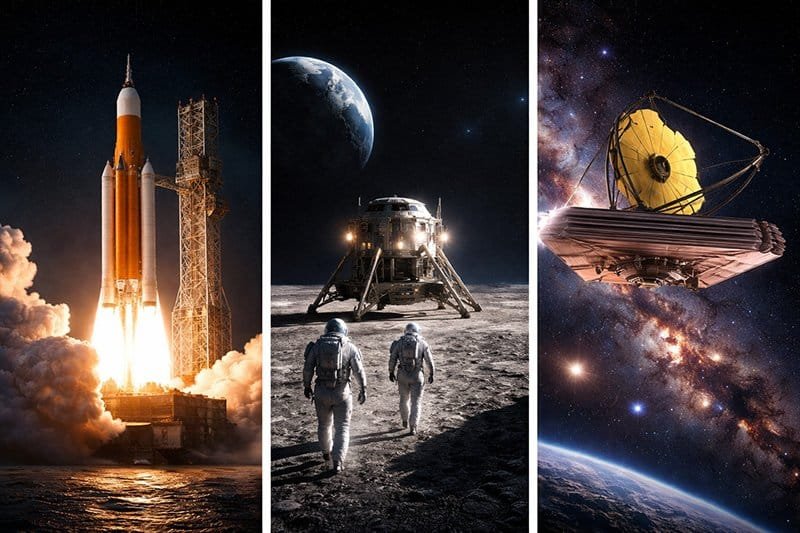
The James Webb Space Telescope continues to produce groundbreaking discoveries
- Observing galaxies over 13 billion years old
- Studying exoplanet atmospheres for biosignatures
- Providing new insights into star formation
Why It Matters
JWST is transforming astronomy from observation to detailed analysis of cosmic origins and potential life.
Space Militarization: The New Strategic Frontier
The United States Space Force is expanding its capabilities.
- Focus on satellite defense and monitoring
- Growing competition with global powers
- Increasing reliance on space-based infrastructure
Big Picture
Space is now a critical domain for national security, similar to land, sea, air, and cyberspace.
First-Hand Perspective & Practical Insight
From an analytical standpoint, the most significant shift isn’t any single mission—it’s the convergence of trends:
- Government programs (Artemis) set long-term goals
- Private companies (SpaceX, Blue Origin) accelerate execution
- Scientific tools (JWST) expand knowledge
- Military investment secures strategic control
What This Means for the Future
This convergence suggests that the next decade will likely bring:
- Permanent lunar infrastructure
- More frequent human spaceflight
- Early-stage Mars mission preparation
- A rapidly expanding trillion-dollar space economy
FAQ: Biggest Space Exploration Updates
What is the biggest space mission right now?
The Artemis program is currently the most significant mission, aiming to return humans to the Moon and prepare for Mars exploration.
Why is SpaceX Starship important?
Starship’s full reusability could reduce launch costs by orders of magnitude, making space more accessible.
Is commercial space travel available?
Yes, companies like Blue Origin and Virgin Galactic offer suborbital flights, though they remain expensive.
What has the James Webb Telescope discovered?
It has observed some of the earliest galaxies and is analyzing exoplanet atmospheres for potential signs of life.
Why is space becoming more competitive?
Nations depend on satellites for communication, navigation, and defense, making space strategically critical.