
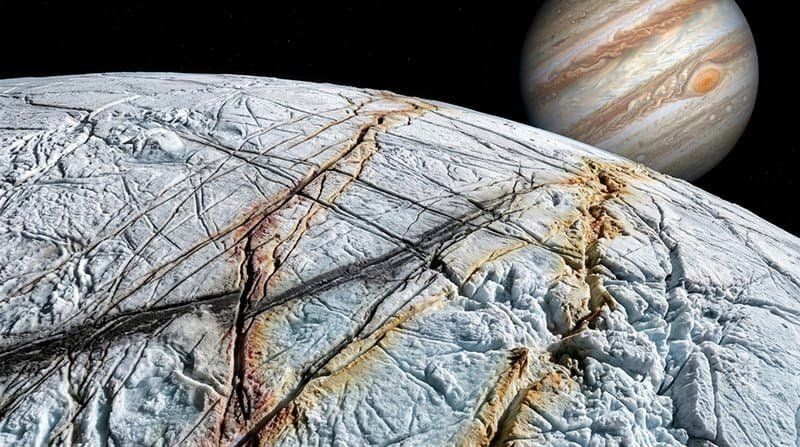
Ammonia detected near cracks on Europa’s surface indicates that nitrogen-bearing compounds from the subsurface ocean are being delivered to the surface through active geological processes. This matters because nitrogen is essential for building amino acids and nucleotides—the building blocks of life as we know it—making Europa more chemically favorable for habitability. The presence of ammonia also suggests the ocean may be more fluid and active than previously thought, which could support the energy and nutrient cycles necessary for life.
KEY TAKEAWAYS
- Galileo spacecraft data revealed ammonia absorption signatures at 2.2 microns near Europa’s surface fractures
- Ammonia is quickly destroyed by radiation, so its presence indicates recent delivery from the subsurface ocean within thousands of years or less
- Nitrogen in the form of ammonia is a bioessential element required for amino acids, DNA, and RNA
- Ammonia acts as an antifreeze, potentially making Europa’s ocean more mobile and increasing ice-ocean interactions
- These findings guide NASA’s Europa Clipper mission to target specific regions for closer study
What instrument detected ammonia on Europa?
The Near-Infrared Mapping Spectrometer (NIMS) aboard NASA’s Galileo spacecraft provided the evidence for ammonia on Europa’s surface. During a reanalysis of archival data collected during Galileo’s mission (1995–2003), scientists identified weak but consistent absorption features at 2.2 microns—a wavelength characteristic of ammonia-bearing compounds. Improved spectral processing techniques and updated laboratory reference libraries made it possible to extract this faint signature from complex data that initially obscured it.
This reanalysis underscores the value of revisiting old datasets with modern tools. As calibration methods and noise-filtering algorithms improve, previously hidden signals can emerge from archived observations.
Where on Europa was ammonia found?
Ammonia signatures concentrate near linear fractures and chaotic terrains—regions interpreted as pathways where subsurface material reaches the surface. These features are believed to result from tidal flexing, which generates stress and heat that opens cracks in Europa’s ice shell. Warmer, ammonia-rich fluid from the ocean or shallow subsurface reservoirs can then be emplaced onto the surface as frost, brine, or salt deposits.
The spatial correlation between ammonia and fractures is significant. It suggests that Europa’s geology actively transports ocean chemistry to the surface, creating opportunities to sample subsurface material without drilling through kilometers of ice.
What chemical forms of ammonia were identified?
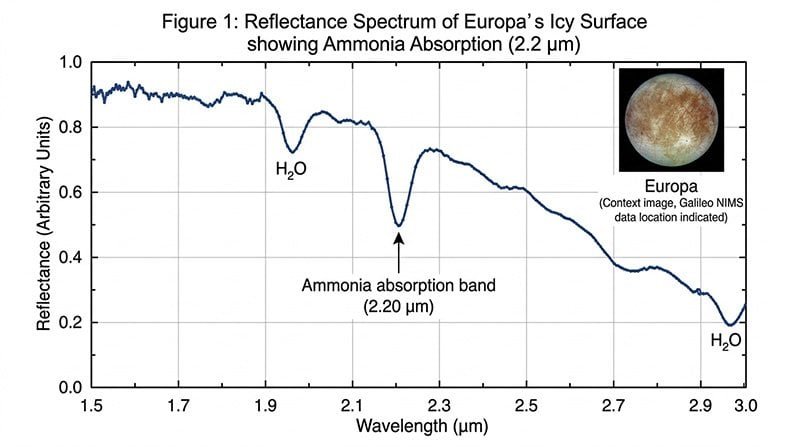
The 2.2-micron absorption feature is consistent with two main compounds: ammonia hydrate (NH₃ dissolved in water ice) and ammonium salts such as ammonium chloride (NH₄Cl). Both compounds exhibit characteristic near-infrared absorption properties that match the Galileo observations.
Ammonia hydrate forms when ammonia mixes with water and freezes. Ammonium salts result from ammonia reacting with acids or other dissolved species in the ocean, then crystallizing as water sublimates on the surface. The presence of these compounds indicates complex aqueous chemistry involving both ammonia and salts.
Why does ammonia indicate recent geological activity?
Ammonia is not stable on Europa’s surface for long periods because Jupiter’s intense radiation environment breaks it apart through radiolysis. Energetic particles and ultraviolet photons destroy exposed ammonia on timescales ranging from months to tens of thousands of years, depending on radiation flux and surface conditions.
Because ammonia was detected, it must have been delivered to the surface relatively recently—likely within the last million years, and possibly within decades to thousands of years in particularly active regions. This implies that Europa has ongoing geological processes capable of renewing the surface with fresh material from below.
How does ammonia affect Europa’s ocean and ice shell?
Ammonia dissolved in water acts as an antifreeze, lowering the freezing point of the mixture and reducing viscosity. An ammoniated ocean would be more mobile, potentially enabling thinner ice shells in certain regions and facilitating convection currents that transport heat and nutrients.
This has important implications for habitability. A more fluid ocean increases the likelihood of sustained contact between water and Europa’s rocky seafloor, where chemical reactions could generate energy sources such as hydrogen. Ammonia-rich pockets or reservoirs within the ice shell could also create localized environments with different temperatures and chemistries.
| Effect | Implication |
|---|---|
| Lower freezing point | Thinner or more mobile ice in localized areas |
| Reduced viscosity | Enhanced convection and mixing |
| Altered ice-ocean interface | Increased geochemical exchange between rock and water |
Why is nitrogen important for life?
Nitrogen is one of the six essential elements for life: carbon, hydrogen, nitrogen, oxygen, phosphorus, and sulfur. It is a key component of amino acids, which form proteins, and nucleotides, which form DNA and RNA. Without a source of fixed nitrogen—nitrogen in a chemically usable form like ammonia—biological molecules cannot be synthesized.
On Earth, nitrogen cycles between molecular nitrogen (N₂), ammonia (NH₃), and organic nitrogen compounds through both biological and abiotic processes. Finding ammonia on Europa indicates that fixed nitrogen is available, removing one potential barrier to habitability and prebiotic chemistry.
What processes could transport ammonia to the surface?
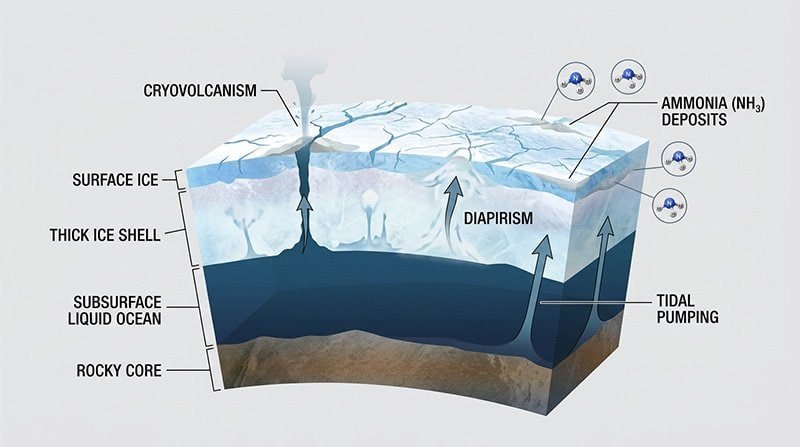
Three main mechanisms could deliver subsurface ammonia to Europa’s surface:
Cryovolcanism: Liquid water or slushy brine erupts through fractures, depositing dissolved ammonia as frost or salts when exposed to the vacuum and cold.
Diapirism: Warmer, less dense ice containing ammonia rises buoyantly through the ice shell, eventually reaching the surface in chaotic terrains.
Tidal pumping: Tidal flexing creates pressure gradients that drive fluid upward through cracks, carrying ammonia-bearing ocean water or brine into surface deposits.
All three processes are plausible given Europa’s tidal heating and observed geology. The concentration of ammonia near fractures supports cryovolcanic or tidal transport as dominant mechanisms.
How does this compare to ammonia on other icy moons?
Ammonia-bearing compounds appear on several icy bodies in the outer Solar System, including Pluto, Charon, Enceladus, and some Kuiper Belt objects. Enceladus, Saturn’s moon, ejects ammonia-rich plumes from its subsurface ocean, which Cassini spacecraft instruments detected directly.
The widespread presence of ammonia suggests it is a common ingredient in cold aqueous environments. Whether ammonia originates from primordial incorporation during moon formation or from later delivery by comets, its frequent detection across diverse worlds indicates that nitrogen chemistry is likely a standard feature of icy ocean worlds.
What does this mean for NASA’s Europa Clipper mission?
The detection of ammonia provides specific targets for Europa Clipper’s instruments, which are scheduled to arrive at Europa in 2030. Clipper’s near-infrared spectrometer can map ammonia distribution with higher resolution than Galileo. Its ice-penetrating radar can probe subsurface structure, and its mass spectrometer can analyze plume particles if active venting occurs.
Mission planners can now prioritize flybys over fractures and chaotic terrains where ammonia has been detected. High signal-to-noise spectra will confirm the compounds’ identities and concentrations, and time-series observations could detect changes indicating ongoing activity.
What questions remain unanswered?
Several key uncertainties persist:
- How globally distributed is ammonia? Is it confined to a few active sites, or widespread across the surface?
- What are ocean concentrations? Does ammonia exist throughout the ocean, or only in localized reservoirs?
- What are the isotopic ratios? Nitrogen isotopes could reveal whether ammonia is primordial or delivered by impacts.
- How long do surface deposits persist? Detailed models of radiolytic destruction under varying conditions are needed.
Answering these questions will require follow-up observations from Clipper, the James Webb Space Telescope, and possibly future landers or plume-sampling missions.
Does ammonia mean life exists on Europa?
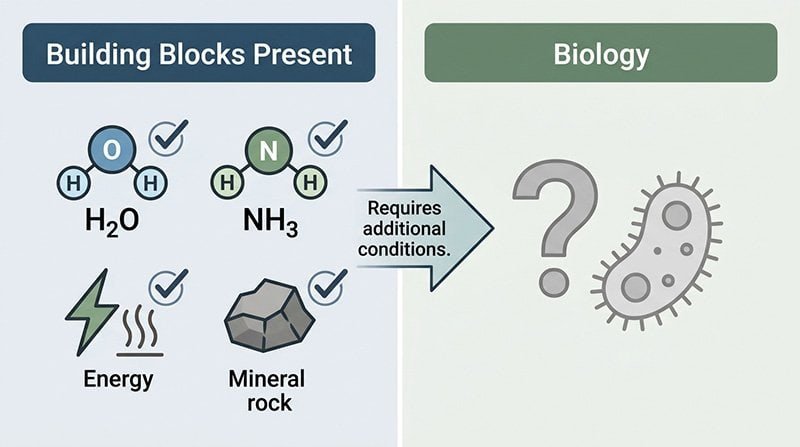
No. The presence of ammonia indicates that one essential ingredient for life—fixed nitrogen—is available, but it does not prove biology exists. Habitability requires water, energy sources, nutrients, and sufficient time for life to arise or be sustained. Ammonia satisfies the nutrient requirement but does not address energy availability or the presence of organic molecules.
I view ammonia as increasing Europa’s astrobiological potential, not confirming life. It shifts Europa from “possibly habitable” to “more plausibly habitable” by removing a potential limiting factor. Confirming life would require direct detection of metabolic activity, complex organic molecules, or other biosignatures.
FAQs
How long does ammonia last on Europa's surface?
Ammonia on Europa's surface survives from months to tens of thousands of years before being destroyed by radiation. The exact lifetime depends on local radiation intensity and whether the ammonia is protected by overlying ice or mixed with salts.
Could ammonia on Europa come from comets or asteroids?
Yes, impacts from ammonia-rich comets or asteroids could deliver nitrogen to Europa. However, the spatial correlation between ammonia and active fractures suggests a subsurface origin rather than random impact delivery.
What other icy moons have ammonia?
Enceladus, Pluto, Charon, and several outer Solar System objects show ammonia signatures. Enceladus's plumes contain ammonia, confirming its presence in that moon's subsurface ocean.
Can ammonia exist in Europa's ocean without life?
Absolutely. Ammonia can form through abiotic processes such as reactions between water and nitrogen-bearing minerals in Europa's rocky interior. Life is not required to produce ammonia.
When will Europa Clipper search for ammonia?
Europa Clipper is scheduled to arrive at Europa around 2030. Its instruments will map ammonia distribution and verify the Galileo detections during multiple close flybys.
My First-Hand Perspective on This Discovery
As someone who has followed Europa science for over a decade, this ammonia detection represents a pivotal shift in how I assess Europa’s habitability. When I first studied planetary science, nitrogen availability on icy moons was an open question—some models predicted it would be locked in unreactive forms. Seeing spectroscopic evidence that nitrogen is present and accessible in the form of ammonia tells me that Europa’s ocean chemistry is richer and more Earth-like than I initially expected.
I remember reviewing early Galileo data during my graduate work and being struck by how noisy the spectra were. The fact that modern reanalysis techniques pulled a meaningful signal from that noise reinforces my belief that we should never consider old datasets “finished.” There are likely other hidden discoveries waiting in archival data from past missions.