
Jupiter is the biggest planet in our solar system. Its equatorial diameter spans 142,984 kilometers — making it 11 times wider than Earth and large enough to hold 1,321 Earths by volume. Beyond our solar system, the exoplanet HAT-P-67 b currently holds the record as the largest planet ever discovered, measuring roughly 2.14 times the radius of Jupiter.
Key Takeaways
- Jupiter is the largest planet in our solar system, with a volume that could contain 1,321 Earths.
- HAT-P-67 b is the largest planet ever discovered in the universe, with a radius 2.14 times that of Jupiter.
- A planet cannot grow indefinitely — quantum mechanics causes added mass to compress the planet rather than expand it.
- Objects exceeding 13 Jupiter masses cross the deuterium-burning limit and become brown dwarfs, not planets.
- Newly forming protoplanets often appear larger than they really are due to surrounding dust and gas disks.
What is the biggest planet in the solar system?
Jupiter is the biggest planet in our solar system by every meaningful measure — diameter, volume, and mass.
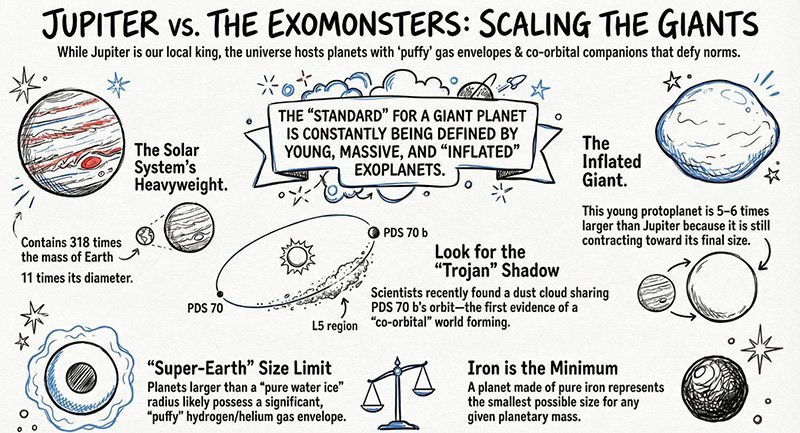
The gas giant accounts for 71.1 percent of the combined mass of all eight planets. Its mass is 317.8 times greater than Earth‘s, and its equatorial diameter of 142,984 kilometers makes it roughly 11 times wider than our home planet. By volume, 1,321 Earths could fit inside Jupiter with room to spare.
Jupiter is composed primarily of hydrogen and helium — the same chemical makeup as the Sun itself. Had Jupiter accumulated approximately 80 times more mass, gravitational pressure would have ignited nuclear fusion at its core, and it would have become a star rather than a planet.
Jupiter also hosts the largest family of moons in the solar system, with 92 confirmed satellites. Its largest moon, Ganymede, spans 5,268 kilometers in diameter — bigger than the planet Mercury. If Ganymede orbited the Sun directly, it would qualify as a dwarf planet.
How big is Jupiter compared to other planets?
To put Jupiter’s size in perspective:
| Planet | Diameter (km) | Comparison to Earth |
|---|---|---|
| Jupiter | 142,984 | 11× wider |
| Saturn | 116,460 | 9× wider |
| Uranus | 50,724 | 4× wider |
| Neptune | 49,244 | 3.9× wider |
| Earth | 12,742 | — |
What is the biggest planet in the universe?
Beyond our solar system, the largest known planet by physical radius is HAT-P-67 b, an exoplanet located approximately 1,200 light-years from Earth.
HAT-P-67 b has a radius roughly 2.14 times that of Jupiter. Despite its enormous size, it has a surprisingly low mass — between 0.34 and 0.45 Jupiter masses — making it one of the least dense planets ever found. Astronomers describe its density as similar to expanded polystyrene foam.
This extreme “puffiness” is caused by intense radiation from its host star, an F-type star that HAT-P-67 b orbits in just 4.8 days. The heat causes the planet’s upper atmosphere to expand dramatically outward, inflating its physical radius far beyond what its mass alone would suggest.
Is there a physical limit to how big a planet can get?
Yes — and the reason is rooted in quantum physics.
When a gas giant accumulates mass beyond Jupiter’s size, the gravitational pressure inside the planet becomes so extreme that hydrogen and helium atoms lose their electrons through a process called pressure ionization. At this point, a phenomenon known as electron degeneracy pressure takes over.
The Pauli exclusion principle — a rule of quantum mechanics — prevents two electrons from occupying the same quantum state simultaneously. This creates an outward pressure that resists further compression. The result is counterintuitive: adding more mass to a gas giant beyond a certain threshold does not make it physically larger. The planet simply becomes denser, compressing inward rather than expanding outward.
This is why HAT-P-67 b, despite being exceptionally large, is a rare outlier. Its size is sustained not by mass, but by the enormous heat it receives from its nearby star.
What is the difference between a planet and a brown dwarf?
The line between the largest planets and the smallest stars runs through a class of objects called brown dwarfs.
When an object’s mass exceeds approximately 13 to 14 times the mass of Jupiter, it crosses what astronomers call the deuterium-burning limit. At this mass threshold, internal temperatures and pressures become high enough to fuse deuterium — a heavy isotope of hydrogen. Objects above this limit are classified as brown dwarfs, not planets.
Brown dwarfs are sometimes called “failed stars” because they lack the mass needed to sustain the fusion of ordinary hydrogen, which requires approximately 75 to 80 Jupiter masses. They sit in an intermediate category: too massive to be planets, not massive enough to shine as true stars.
What are the largest known exoplanets?
Astronomers have confirmed several exoplanets and protoplanets with extraordinary dimensions. The rankings shift depending on whether size is measured by physical radius or by total mass.
| Exoplanet | Radius (Jupiter Radii) | Mass (Jupiter Masses) | Classification |
|---|---|---|---|
| HAT-P-67 b | 2.08 – 2.14 | 0.34 – 0.59 | “Puffy” Hot Jupiter |
| AB Aurigae b | 2.75 | 4 – 12 | Protoplanet |
| ROXs 42Bb | 2.1 – 2.5 | 9 – 13 | Gas Giant / Brown Dwarf border |
| PDS 70 b | 1.96 | 3 – 7 | Protoplanet |
ROXs 42Bb sits at an interesting edge case — its mass places it on the borderline between a massive gas giant and a brown dwarf, and its classification remains debated among astronomers.
Why do forming planets appear larger than they really are?
Protoplanets — planets still in the process of forming inside circumstellar dust disks — often appear far larger than their actual physical bodies.
When observed through modern telescopes, a protoplanet is surrounded by glowing envelopes of gas and circumplanetary disks. These structures emit their own infrared radiation, which inflates the apparent size of the planetary body in telescope measurements.
A clear example is HD 100546 b. Early observations suggested it had a radius 6.9 times that of Jupiter — nearly as large as the Sun. Follow-up analysis revealed the measurement was dominated by the surrounding disk material rather than the planet itself. Correcting for this effect brought the estimated size down considerably.
How do astronomers measure the size of distant planets?
Three primary methods are used to determine the physical dimensions of exoplanets.
The transit method is the most widely used and most accurate for measuring physical radius. Astronomers monitor the dip in a star’s brightness as a planet passes in front of it. The depth of the dip directly corresponds to the planet’s size relative to the star.
Direct imaging is used for large, young planets orbiting far from their host stars, where they emit enough infrared light to be detected separately.
Radial velocity measures how a planet’s gravity causes its star to wobble. This technique reveals mass rather than physical size, and works best for large planets with short orbital periods.
Each method has limitations. The transit method, for instance, can be misled by thick atmospheric hazes. The planet Kepler-51d has a density comparable to cotton candy — its puffed-up atmosphere artificially inflates its observed radius.
FAQs
Is ROXs 42Bb the largest planet?
ROXs 42Bb has a radius estimated between 2.1 and 2.5 Jupiter radii, making it one of the physically largest candidates. However, its mass of 9 to 13 Jupiter masses places it on the edge of the brown dwarf category, and its classification as a planet remains contested.
Do more massive gas giants have larger physical sizes?
Not necessarily. Once a gas giant exceeds roughly one Jupiter mass, additional mass triggers electron degeneracy pressure, which compresses the planet's interior rather than expanding its radius. The most massive gas giants are often smaller in physical size than mid-mass counterparts.
What defines a brown dwarf?
A brown dwarf is an object exceeding approximately 13 Jupiter masses — enough to fuse deuterium in its core. Brown dwarfs are heavier than planets but lack the mass (around 75 to 80 Jupiter masses) needed to sustain ordinary hydrogen fusion like a true star.