

Antibiotics once felt unstoppable.
You got sick, took a prescription, and trusted it would work.
That confidence is disappearing.
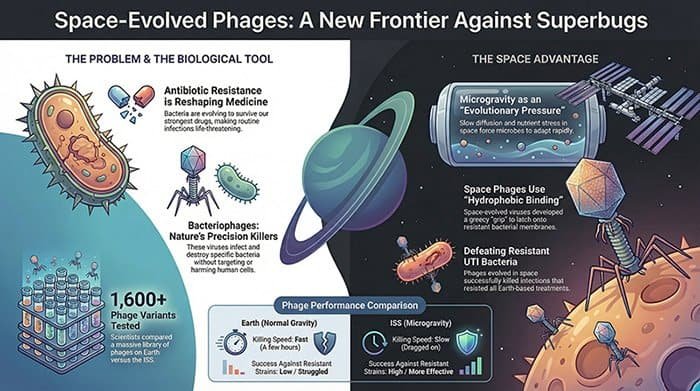
Around the world, bacteria are learning how to survive our strongest drugs. Infections that were once routine are becoming harder—and sometimes impossible—to treat. Antibiotic resistance isn’t a distant threat anymore. It’s already reshaping modern medicine.
So when scientists recently suggested that space might help us fight this problem, the idea sounded almost absurd.
But it turns out, it’s not.
A different kind of weapon: bacteriophages
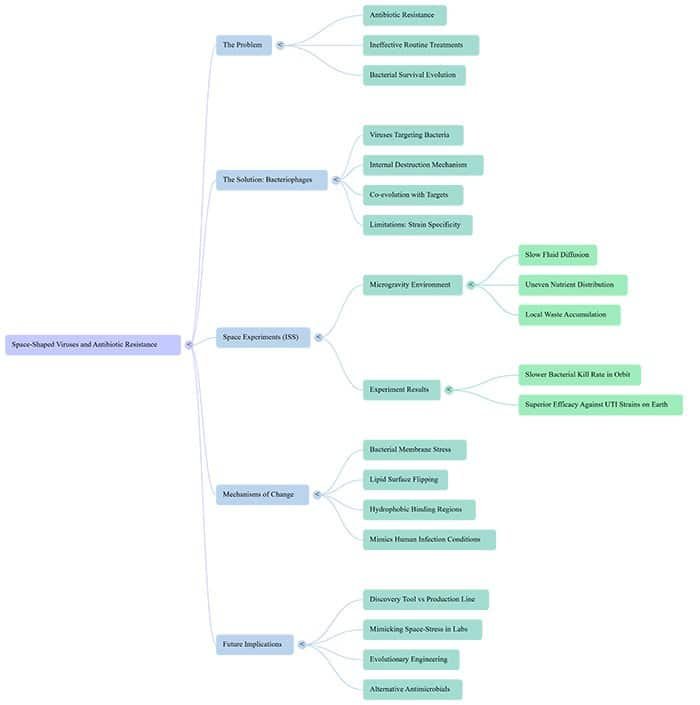
Bacteriophages—usually just called phages—are viruses that infect bacteria. They don’t target human cells. They don’t cause colds or flu. Their entire job is to find bacteria, hijack them, and destroy them from the inside.
Phages have been doing this long before humans ever thought about antibiotics.
That’s why researchers are revisiting phage therapy as antibiotic resistance grows. Phages kill bacteria in ways antibiotics can’t, and they can evolve alongside their targets.
Still, there’s a catch.
Why phage therapy isn’t easy
Phages are picky.
A phage that wipes out one strain of bacteria might be useless against another, even if they look similar under a microscope. That precision can be a strength—but it also makes therapy complicated.
To work reliably, phages often need to be carefully selected or combined into cocktails. And as bacteria change, phages have to keep up.
That raises an interesting question:
What if we could guide phage evolution instead of waiting for it to happen by chance?
Why researchers looked to space
That question led a team from the University of Wisconsin–Madison to try something unconventional. They sent a diverse library of bacteriophages to the International Space Station (ISS).
Not because space is magical—but because it’s different.
- Fluids don’t mix the way they do on Earth
- Cells rely on slow diffusion instead of constant movement
- Nutrients become unevenly distributed
- Waste products accumulate locally
Put simply, microbes in space live under unusual stress.
And when microbes are stressed, evolution tends to speed up—sometimes in strange ways.
What happened on the ISS
The researchers started with over 1,600 phage variants and ran the same experiment in two places:
- One set on Earth
- One set aboard the ISS
Both groups were allowed to infect E. coli bacteria and compete over time.
At first glance, the space experiment looked worse.
Phages in orbit took much longer to kill bacteria. On Earth, bacteria were wiped out in a few hours. In space, the process dragged on.
That didn’t sound like progress at all.
But what happened next caught the researchers off guard.
The unexpected advantage of space-evolved phages
When the scientists brought the space-evolved phages back to Earth and tested them against antibiotic-resistant urinary tract infection (UTI) bacteria, the results flipped.
Phages evolved on Earth struggled.
Phages evolved in space succeeded—killing bacterial strains that resisted antibiotics and other phages.
Slower evolution in space had produced more effective killers in the real world.
Why space changed the outcome
The key wasn’t speed. It was surface chemistry.
In the stressful environment of the ISS, bacteria altered their outer membranes. Certain lipids flipped outward, changing how the bacterial surface felt and behaved.
The winning phages adapted accordingly.
Instead of relying mainly on electrical charge to attach to bacteria—a common strategy on Earth—the space-evolved phages developed more hydrophobic binding regions. These allowed them to latch onto bacteria with altered, lipid-exposed surfaces.
Here’s the crucial connection:
Bacteria inside the human body—especially during infections like UTIs—often experience similar stress and show similar membrane changes.
In other words, the phages shaped in space were already adapted to conditions found inside real patients.
Does this mean medicine will move to orbit?
Probably not.
Space experiments are expensive, limited in scale, and difficult to repeat frequently. No hospital is going to wait for the next rocket launch to treat an infection.
But that’s not the point.
Space didn’t magically create a new medicine—and honestly, that would’ve been too easy.
What it did was reveal evolutionary paths we don’t usually select for on Earth.
Why this still matters on the ground
This research suggests new ways forward:
- Designing lab environments that mimic space-like stress
- Letting evolution do part of the engineering work
- Matching phage development to real infection conditions
- Expanding options against drug-resistant bacteria
Space becomes a discovery tool, not a production line.
The bigger picture
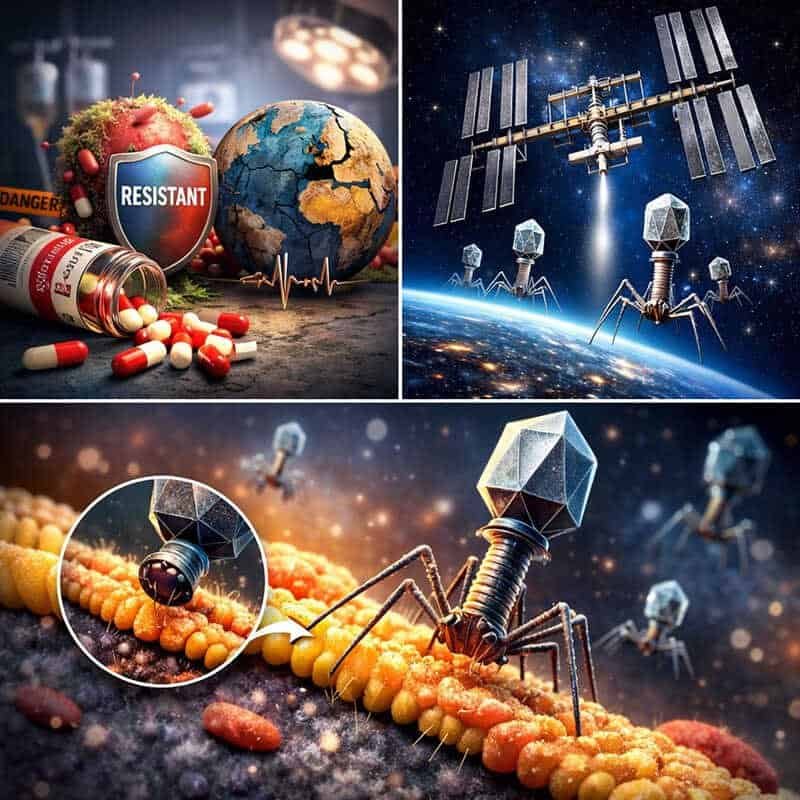
Antibiotic resistance won’t be solved by a single breakthrough.
It will take:
- Smarter antibiotic use
- New drugs
- Better diagnostics
- Vaccines
- And alternatives like phage therapy
Space-evolved phages aren’t a cure-all. But they show that when we change the rules of evolution, we sometimes uncover solutions hiding just outside our usual assumptions.
And that’s why this study stuck with me.
Final takeaway
Put organisms in an environment they’re not built for, and evolution starts taking paths we rarely see in the lab.
In a world where bacteria keep adapting faster than our drugs, that kind of perspective shift might matter more than we think.
Bacteriophage Space Evolution Research Table
| Experiment Location | Bacteriophage Target (Bacteria) | Key Environmental Stressors | Bacteriophage Evolution Outcome | Primary Binding Mechanism | Efficacy Against Antibiotic-Resistant Strains | Evolutionary Advantages Identified (Inferred) | Source |
|---|---|---|---|---|---|---|---|
| International Space Station (ISS) | E. coli | Microgravity, lack of fluid mixing, slow diffusion, uneven nutrient distribution, local waste accumulation | Slower evolution and reproduction; bacterial lysis period significantly extended compared to Earth | Hydrophobic binding regions | Success (Effective against antibiotic-resistant and phage-resistant clinical UTI strains) | Adapted to bacterial membrane changes (lipid flipping) typical of clinical infection environments | [1] |
| Earth | E. coli | Not in source | Rapid evolution and reproduction; bacterial population eliminated within hours | Electrical charge | Failure (Ineffective against antibiotic-resistant clinical UTI strains) | Optimized for rapid replication in high-nutrient, well-mixed environments | [1] |
[1] Can Viruses Shaped in Space Help Us Fight Antibiotic Resistance? – The Universe Episodes