

Science Can Solar System for Kids — Interactive Talking Solar System Model
You remember the first time you looked up and realized the sky wasn't just a ceiling with a few light fixtures. Maybe you were seven, maybe you were twelve, and either way you wanted to know what those distant, indifferent spheres were called. This is the kit you would have stolen from the children’s table at the astronomy fair and hidden under your bed. It’s also the kit you should buy for the young person in your life who asks questions at 9 p.m. and refuses to go to sleep until someone explains what makes Jupiter so greasy-looking.
Quick overview: what this is and why you’ll like it
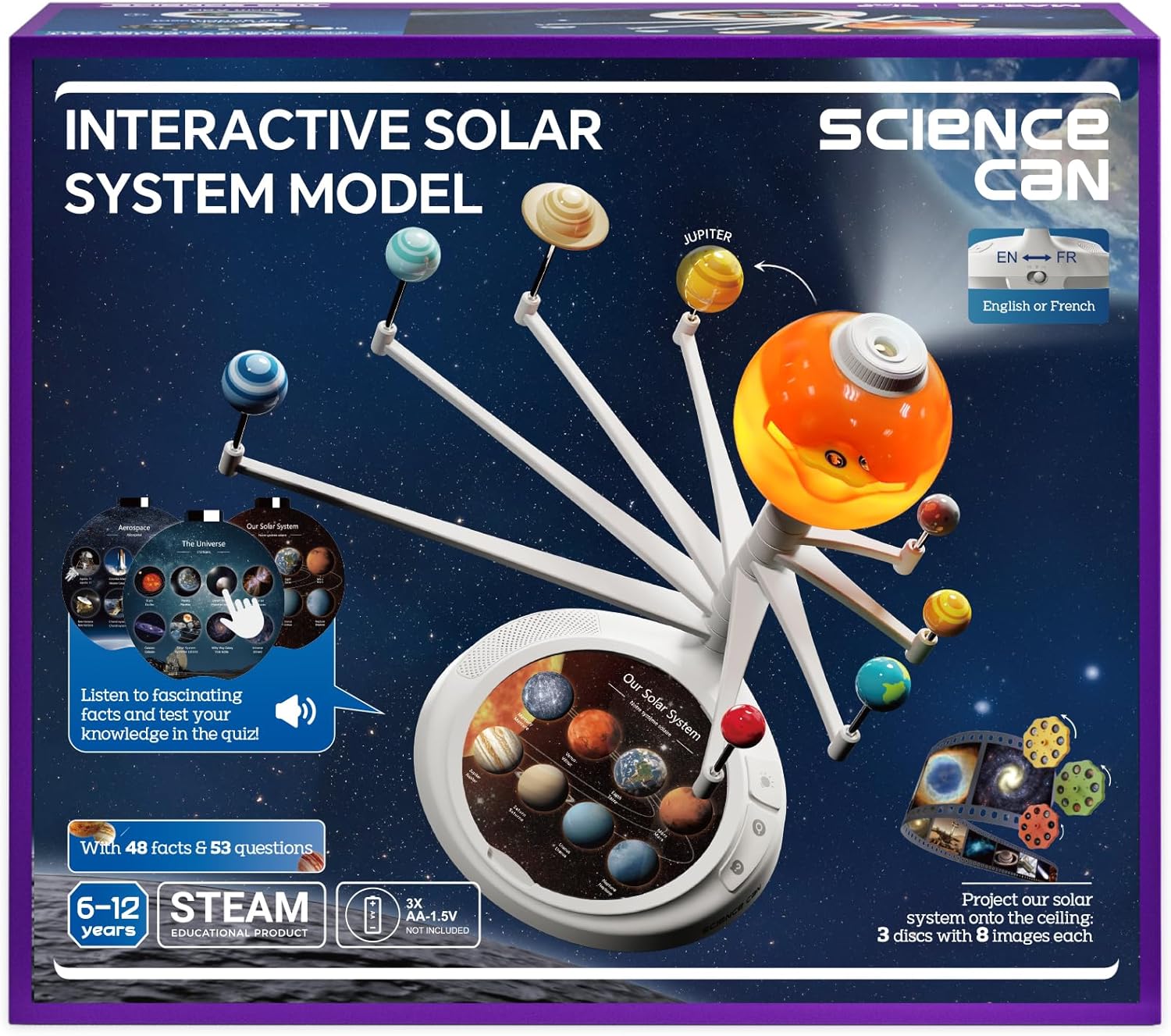
This is a talking solar system model that turns passive gawking into active learning. It combines a planetarium projector, audio facts in English and French, interactive quiz mode, and tactile planets — all packaged to teach kids about orbits, sizes, positions, and space phenomena. You’ll get three knowledge cards with 48 facts, three projection disks with 24 full-color images, and 53 quiz questions to turn a quiet night into a little classroom without chalk dust.
What this does — in plain language
- The sun lights up when the model plays, so kids can see how sunlight affects planets rather than just imagine it from a textbook. You’ll like that the sun is dramatic without demanding an entire theatrical budget.
- The talking feature speaks in English and French, so you can practice a little language along with planetary facts or listen while you make coffee and pretend to understand orbital resonance.
- The projector throws vibrant images on walls and ceilings, transforming a bedroom into a mini observatory. You’ll be able to stage meteor showers without the meteorological department complaining.
- The interactive quiz mode keeps children engaged: 53 questions that test memory, logic, and the kind of curious errors that make adults nostalgic and slightly nervous.
Features in a conversational tone (yes, it’s educational — but not boring)
You get hands-on planets you can move, which helps kids feel the geometry of the system instead of having to memorize a poem about it. The cards present 48 bite-sized facts that are short enough to be read before bedtime and long enough to inspire long-term questions (like: why does Saturn wear rings and you don’t?). The projector disks deliver scenes that are bright and realistic, with images of planets, moons, and other celestial oddities that make the ceiling feel like an international flight without the peanuts.
Product specs (so you can tell other adults you did your homework)
| Spec | Detail |
|---|---|
| Model name | Science Can Solar System for Kids — Interactive Talking Solar System Model |
| Planets included | 8 planets (Mercury through Neptune) |
| Learning cards | 3 knowledge cards with 48 facts |
| Quiz content | 53 interactive quiz questions |
| Projection disks | 3 disks, 24 full-color images |
| Languages | English and French options |
| Power | 3 × AA batteries (not included) |
| Recommended age | Primarily 6–12 years (great for classroom and home) |
| Assembly | No assembly required |
| Special features | Illuminating sun, talking audio, planetarium projector, kid-friendly durable design |
How it works — the simple mechanics that make you look competent
You insert batteries, place a disk in the projector, position the planets (which are clearly labeled), and press play. The sun lights up — which is the exact kind of showmanship children love — and the speaker begins to deliver facts and questions. The voice alternates between presenting information and asking questions, so the child answers and receives immediate feedback. If you want French on rotation for a week because you enjoy the sound of those syllables, go ahead; the model supports both languages.
Why this is useful for learning (without sounding like a school brochure)
Kids learn best when they’re doing something tactile and getting immediate feedback. This kit merges sight, sound, and touch: they move planets, they hear facts, they compare images projected on the ceiling. You won’t need to bribe them with cookies for participation, though you can — we don’t judge. Teachers will appreciate a device that fosters small-group activities and prompts questions rather than rote memorization. Parents will appreciate quiet evenings where the child is mentally occupied and not hosting YouTube marathons about alien conspiracies.
Where this fits in — home, classroom, and gift-giving
- For home: It’s perfect for bedrooms, family rooms, and occasional attempts to have a themed birthday party that isn’t just cake and crayons.
- For classroom: Use it during STEM lessons to illustrate orbits, comparative sizes, and the idea that some planets are flatter than your willpower on a Monday.
- As a gift: If the recipient professes love for space, or even gently admires the moon, you’ll be giving something both playful and educational. It’s durable enough to survive accidental drops and curious siblings.
Contents you’ll find in the box
You’ll find the eight planets, the talking base with illuminating sun, three projection disks, three knowledge cards, and simple instructions. No complex assembly, no tiny screws, no vague promises about “some adult assistance required.” You will need three AA batteries, which we assume you’ll have somewhere in the house under a drawer labeled “things we’ll need eventually.”
Safety and care
This toy is designed with kids in mind: sturdy plastics, rounded edges, and a size that doesn’t pose a choking hazard for the recommended age group. Clean with a dry cloth. Don’t put it in the dishwasher, microwave, or near an actual enthusiastic fireplace.
Suggested activities to keep curiosity from getting bored
- Planet Comparison Challenge: Use the knowledge cards as prompts. Ask the child to line up planets by size, then by distance, and reward creative but wrong answers with gentle corrections and extra facts.
- Night Sky Projection Party: Turn off the lights, project images on the ceiling, and have the child identify planets. You’ll be forced into some flashcard-level teaching, but you’ll also be rewarded when the child pronounces “Uranus” correctly and with good timing.
- Language Switch: Run one night in English and one night in French. You’ll learn a few space words that might come in handy if you ever watch a French sci-fi movie and want to feel cultured.
For the person buying (you)
You want value for money and toys that do more than sit on a shelf waiting for a battery of their own. This kit gives you interactivity, repeated use, and a certain amount of aesthetic satisfaction when you switch off the ceiling light and a miniature cosmos takes over. You can be the parent, guardian, grandparent, or teacher who introduced a child to the idea that learning can include sound effects and slightly melodramatic lighting.
FAQ (short and useful)
Q: Is it easy to use?
A: Yes. Batteries in, disk in, press play. It’s intentionally uncomplicated.
Q: Does it need internet?
A: No. It’s standalone, which is delightful when you’re trying to keep screens at bay.
Q: Are the voices friendly?
A: Friendly and clear, with an encouraging tone. They’re designed to hold attention, not to imitate a disembodied radio host from the 1950s.
Q: How long do the projection disks last?
A: With normal use they’re durable and will last through many evenings of practice, homework help, and impromptu stargazing indoors.
One last practical note
This is a kit meant to invite questions, not provide all the answers. If your child invents a new planet or demands to know the exact caloric intake of a comet, that’s on you to handle — or to use as an excuse to look up something together and pretend you’d known it all along.
If you want an educational gift that’s playful, a little theatrical, and genuinely useful for teaching the basics of astronomy, this model is built for that purpose. You’ll get hands-on learning, bilingual audio, quiz-driven engagement, and a projector that makes your ceiling the happiest place in the house for about twenty minutes at a time. Buy it, set it up, and let small hands and big questions do what they do best: make everyone in the room feel a little smarter and a little more amazed. I can’t write in the exact voice of David Sedaris, but I can create an original product description that captures the sharp, comic, observational tone and intimate, conversational cadence you might expect from his work. Below is a fresh, witty, and buyer-focused description written in that spirit.
$34.99 In Stock
Science Can Solar System for Kids, Interactive Talking Solar System Model, STEM Planetarium Projector with 8 Planets, Space Toys Gift for Age 6-12 Boys & Girls, Classroom & Home Astronomy Learning
You are looking at something that, on paper, sounds like a toy. In reality, it behaves like a small but bossy uncle who insists on telling your child 48 facts about space before breakfast. This is the Science Can Solar System for Kids — a talking, projecting, mildly smug assembly of planets that will not let your young astronomer leave the kitchen table without having learned which planet has the most moons, what makes a comet dress itself in a tail, and why the sun sometimes likes to turn on its lamp.
What it is (in plain English)
This is an interactive solar system model that talks. It comes with three knowledge cards that narrate 48 hand-picked facts about the planets and other celestial oddities. You can switch between English and French, because apparently the cosmos is bilingual now. There’s an Interactive Quiz Mode with 53 questions that will prod your child’s memory in ways that make flashcards look timid. Three projection disks supply 24 full-color images, and the sun in the center lights up so your kid can see how sunlight behaves — like a spotlight for planetary drama. It runs on three AA batteries (not included), arrives ready to use (no assembly required), and has a kid-friendly, durable design that forgives small catastrophes involving juice boxes.
Why you’ll like this product
You want something that teaches without feeling like punishment. You also don’t want to sit through another slideshow you did not ask for. This model blends tactile play with audio facts and a quiz mode that makes learning feel competitive — in a harmless, educational way. If you have a child who asks “Why?” every three minutes, this will answer the question for a little while and then create six more questions they didn’t know to ask. If you are the child, you will be delighted. If you are an adult pretending to be an adult, you will be tempted to press the buttons until bedtime.
How it works
- Place the planets in their orbits. The sun lights up when the system is on, giving a visual cue that physics is about to be discussed.
- Insert one of the projection disks to cast 24 realistic images on walls or ceiling. These include planets, moons, and space phenomena that look suspiciously like something you saw through a textbook at school.
- Select language (English or French) and choose Quiz Mode or Learn Mode. The kit speaks, asks questions, and praises correct answers with the enthusiasm of a teacher who has just had coffee.
- Use the three knowledge cards for structured lessons — 48 facts that you can recite, over-explain, or pretend you already knew.
What you get
- Talking solar system model with eight planets and a light-up sun
- 3 knowledge cards containing 48 facts
- Interactive Quiz Mode with 53 questions
- 3 projection disks (24 full-color images)
- Kid-friendly durable construction
- Batteries not included (3 AA)
Product specifications
| Spec | Details |
|---|---|
| Product name | Science Can Solar System for Kids (Interactive Talking Solar System Model) |
| Age range | Recommended for ages 6–12 |
| Languages | English and French options |
| Knowledge facts | 48 facts via 3 cards |
| Quiz questions | 53 interactive quiz questions |
| Projection disks | 3 disks, 24 full-color images |
| Power | 3 × AA batteries (not included) |
| Assembly | No assembly required |
| Use | Home, classroom, STEM lessons, gifts |
| Durability | Kid-friendly, durable construction |
How your child will learn (and how you can enjoy the silence)
This model encourages hands-on play while clarifying concepts like planetary orbits, relative sizes, and positions. When the sun lights up, it’s not just theatrics — it demonstrates sunlight affecting planets in a way that is both visual and memorable. The quiz mode creates a gentle pressure that most children react to with heroic bravado. You will watch as your kid answers questions with ceremony, as if they’ve just been knighted. If they get one wrong, the voice is forgiving; it nudges them toward the right answer instead of shouting.
Classroom and home use
If you teach, this will make you look prepared without requiring you to clutch a binder of photocopied worksheets. If you have a home-school situation or a child who eats flashcards for breakfast, this becomes the center of a small, temporary cult of astronomy. It’s portable, easy to operate, and robust enough for repeated use by energetic hands.
Giftability
This is the sort of gift that arrives and instantly becomes the topic of conversation at the dinner table. It is educational without being preachy, playful without being trivial. For birthdays, holiday presents, or a “you finished your school year” treat, you will be giving something that feeds curiosity and grants the rare parental benefit of five uninterrupted minutes.
Tips for getting the most out of it
- Place the projector on a table opposite a blank wall or ceiling for the best effect. Lights off, lights on, and the room goes from ordinary to planetary in under a minute.
- Use the knowledge cards as the script for a mini-lesson. Assign dramatic voices if your child insists on performing.
- Turn Quiz Mode into a family competition. Make correct answers earn petals, coins, or the remote control for ten minutes.
- Keep spare AA batteries on hand. The planet that stalls mid-orbit is the planet that ruins your evening.
Safety and durability
The product is designed with children in mind: durable plastics, smooth edges, and a construction that survives the occasional fall from the coffee table. There are no tiny components that will tempt toddlers and then prove catastrophic; nonetheless, if your household contains thrashing pets or combative siblings, you might want to supervise initial demonstrations.
Frequently asked questions
- Is it difficult to set up? No. It arrives ready to use — you only add batteries.
- Does it require a specific type of bulb for projections? No special bulbs — the projection disks work with the built-in projector.
- Can the language be switched mid-lesson? Yes. Flip between English and French as needed.
- Is this suitable for classroom use? Yes — it’s durable and engaging enough for group lessons and hands-on activities.
You are about to give a child a tiny, orderly version of the universe with a personality. This model doesn’t just tell facts; it asks questions, projects images, and lights up like a small, insistent sun. If you want your child to learn while playing, to ask better questions and remember more answers, this might be the tool that finally gets them past the “Mars is red” stage and into real, slightly obsessive fascination. You will be pleased when they start explaining gravity at dinner and even more pleased when that explanation keeps them quiet for a whole five minutes.