

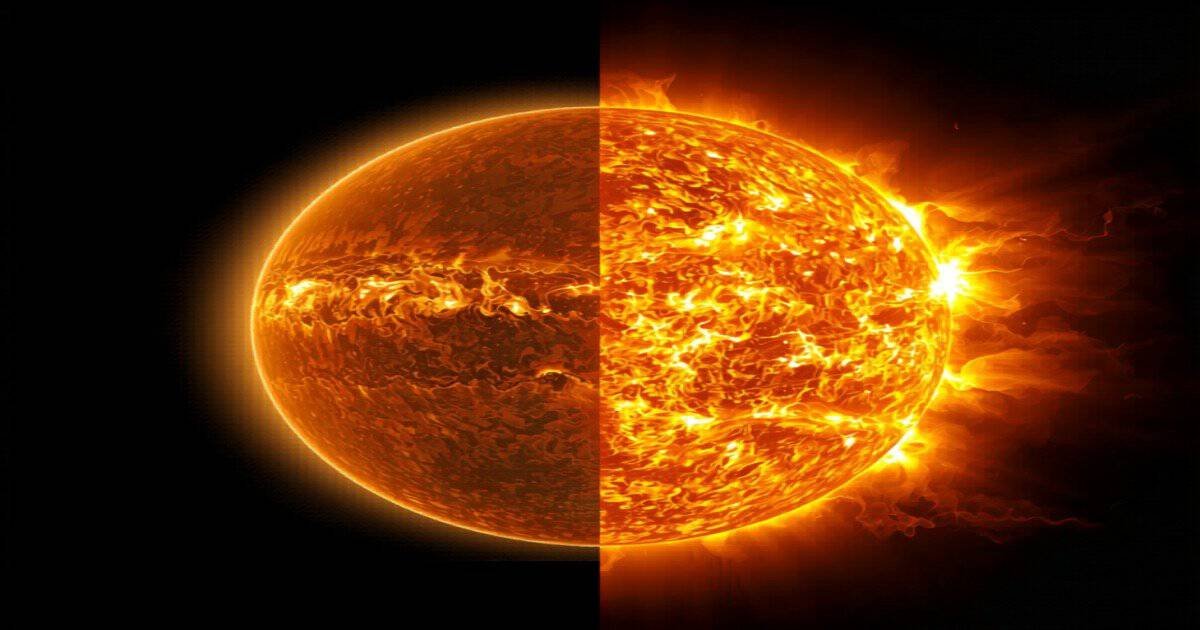
No — Venus is not hotter than the Sun. Venus’s surface temperature is 465°C (869°F), which makes it the hottest planet in the solar system. But the Sun’s surface (photosphere) reaches 5,500°C (9,932°F) — nearly 12 times hotter than Venus. The Sun’s core exceeds 15,000,000°C. Venus gets all of its heat from the Sun in the first place.
Quick Temperature Comparison
| Object | Temperature (°C) | Temperature (°F) |
|---|---|---|
| Sun’s core | 15,000,000°C | 27,000,000°F |
| Sun’s surface (photosphere) | 5,500°C | 9,932°F |
| Sun’s corona (outer atmosphere) | 1,000,000°C+ | 1,800,000°F+ |
| Mercury (daytime max) | 430°C | 806°F |
| Venus (average surface) | 465°C | 869°F |
| Earth (average surface) | 15°C | 59°F |
How Hot Is Venus Compared to the Sun?
Venus is 12× cooler than the Sun’s surface
Venus’s surface temperature of 465°C sounds extreme — and it is, for a planet. But it is nowhere near the Sun’s temperature. The Sun’s photosphere (visible surface) is about 5,500°C, making it roughly 11.8 times hotter than Venus. The Sun’s corona — the outer atmosphere — paradoxically reaches over 1,000,000°C due to magnetic heating effects that scientists still don’t fully understand. And at the Sun’s core, where nuclear fusion takes place, temperatures reach around 15,000,000°C.
To put it another way: if Venus were placed next to the Sun, the Sun would instantly vaporize Venus’s entire atmosphere, oceans (had they existed), and rock surface. Venus’s heat is impressive by planetary standards, but negligible on the scale of stellar temperatures.
Why Is Venus So Hot If It’s Not Near the Sun’s Level?
The runaway greenhouse effect
Venus reaches 465°C not because of its distance from the Sun, but because of its atmosphere. Venus’s atmosphere is 96.5% carbon dioxide — over 2,000 times more CO₂ than Earth’s atmosphere. This creates a runaway greenhouse effect: sunlight passes through the cloud layers and heats the surface, but the CO₂ traps the heat and prevents it from escaping back into space. The result is a permanent oven with no day-night temperature variation — Venus is 465°C everywhere, all the time.
For comparison, Mercury — which is closer to the Sun than Venus — has almost no atmosphere. Its daytime temperature reaches 430°C, but at night it drops to −180°C. Venus stays at 465°C day and night, making it hotter than Mercury on average despite being farther from the Sun.
Could Venus Ever Be as Hot as the Sun?
No — not through any natural planetary process. The Sun generates heat through nuclear fusion, fusing hydrogen atoms into helium under immense gravitational pressure in its core. A planet like Venus has no mechanism to produce fusion — it is simply too small and lacks the mass required. The minimum mass for a star to sustain nuclear fusion is about 80 times the mass of Jupiter. Venus is far smaller than Jupiter. No matter how thick Venus’s atmosphere became, it could never reach stellar temperatures through greenhouse heating alone.
Is Venus the Hottest Object in the Solar System?
Among planets, yes — Venus has the hottest surface of any planet. But within the solar system as a whole, the Sun is by far the hottest object. The Sun’s photosphere is 5,500°C, its corona exceeds 1,000,000°C, and its core reaches 15,000,000°C. Venus’s 465°C is impressive for a rocky planet but represents less than 0.01% of the Sun’s core temperature.
Key Facts About Venus’s Temperature
- Average surface temperature: 465°C (869°F) — the same day and night
- Atmospheric pressure: 92 times Earth’s — equivalent to being 900 meters underwater
- Atmosphere composition: 96.5% CO₂, 3.5% nitrogen
- Cloud layers: Thick sulfuric acid clouds at 45–70 km altitude
- Hottest planet: Yes — despite Mercury being closer to the Sun
- Hotter than the Sun: No — the Sun’s surface is ~5,500°C, nearly 12× hotter
For more on Venus and planetary temperatures, see What Is the Hottest Planet in the Solar System? and How Far Is Venus from the Sun?
FAQs
Is Venus hotter than the Sun?
No. Venus's surface temperature is 465°C (869°F), which is the hottest of any planet. But the Sun's surface (photosphere) is about 5,500°C — nearly 12 times hotter than Venus. The Sun's core reaches 15,000,000°C. Venus cannot be hotter than the Sun because the Sun is the source of Venus's heat.
How hot is Venus compared to the Sun?
Venus's surface is 465°C. The Sun's photosphere (visible surface) is about 5,500°C — roughly 12 times hotter. The Sun's corona exceeds 1,000,000°C and the core reaches 15,000,000°C. Venus's temperature is impressive for a planet but negligible compared to the Sun.
Why is Venus so hot if it's not close to the Sun?
Venus is hot because of a runaway greenhouse effect. Its atmosphere is 96.5% carbon dioxide — over 2,000 times more CO₂ than Earth. Sunlight enters through the clouds and heats the surface, but the CO₂ traps the heat and prevents it from escaping. The result is a constant 465°C surface temperature, day and night, everywhere on the planet.
Is Venus hotter than Mercury?
Yes. Venus averages 465°C while Mercury's daytime maximum is 430°C — and Mercury drops to −180°C at night. Venus stays at 465°C constantly due to its greenhouse atmosphere. Despite Mercury being closer to the Sun, Venus is the hotter planet.
What is the hottest temperature on Venus ever recorded?
Venus's surface temperature is remarkably consistent at around 465°C (869°F) across the entire planet, day and night. Unlike Earth or Mercury, Venus has almost no temperature variation due to its thick CO₂ atmosphere distributing heat evenly. Soviet Venera probes measured surface temperatures between 457°C and 470°C at various landing sites.