

Uranus is an average of 1.8 billion miles (2.87 billion kilometers) from the Sun — roughly 19.2 astronomical units (AU). Because Uranus follows an elliptical orbit, this distance ranges from about 1.70 billion miles at its closest to 1.87 billion miles at its farthest. Sunlight takes approximately 2 hours and 40 minutes to travel from the Sun to Uranus.
Key Takeaways
- Uranus orbits the Sun at an average distance of 19.2 AU (1.8 billion miles / 2.87 billion km).
- Its elliptical orbit means the distance varies — closest at 18.3 AU (perihelion), farthest at 20.1 AU (aphelion).
- Sunlight takes about 2 hours and 40 minutes to reach Uranus.
- Uranus is the 7th planet from the Sun and takes 84 Earth years to complete one orbit.
- Its extreme 97.77° axial tilt — possibly caused by a massive ancient collision — creates the most dramatic seasons in the solar system.
What Is an Astronomical Unit, and Why Does It Matter?
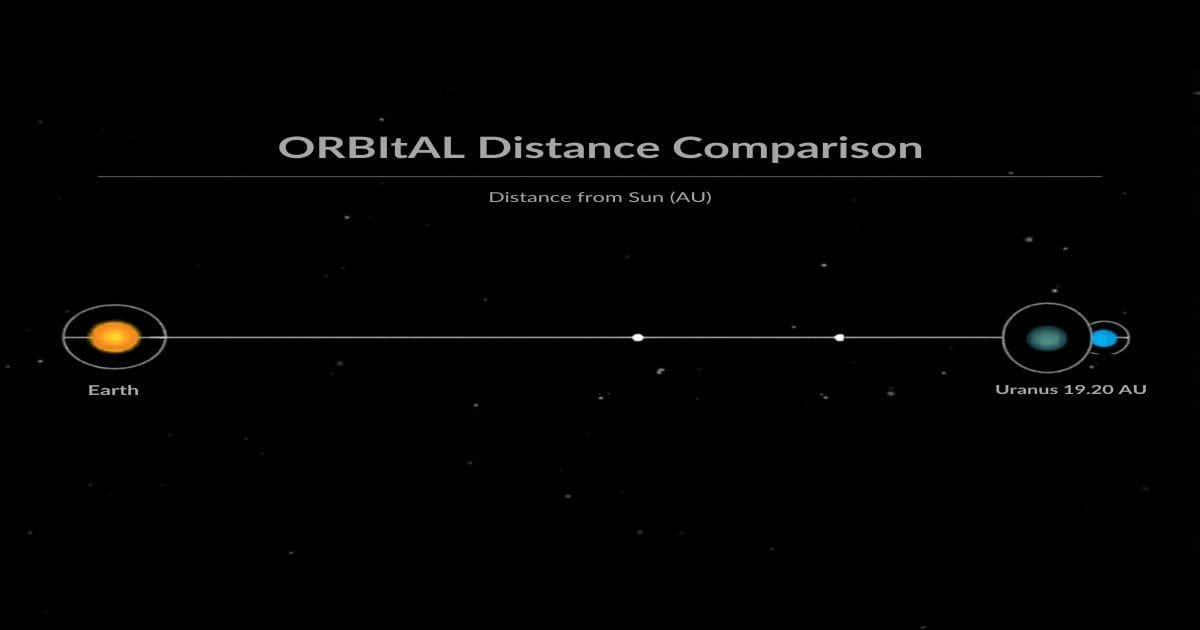
An astronomical unit (AU) is the average distance between Earth and the Sun — roughly 93 million miles (150 million kilometers). Scientists use AU to describe distances within the solar system because the numbers are more manageable than billions of miles.
Saying Uranus is 19.2 AU away is far easier to grasp than 2,870,972,200 kilometers. It also gives immediate context: Uranus is about 19 times farther from the Sun than we are. Jupiter, by comparison, sits at only 5.2 AU.
How Does Uranus’s Distance Change Over Time?
No planet follows a perfect circle. Uranus travels an elliptical path around the Sun, which means its distance constantly changes throughout its 84-year orbit.
| Position | Distance (AU) | Distance (km) |
|---|---|---|
| Average | 19.2 AU | 2.87 billion km |
| Perihelion (closest) | 18.3 AU | 2.74 billion km |
| Aphelion (farthest) | 20.1 AU | 3.00 billion km |
The difference between perihelion and aphelion for Uranus is about 1.8 AU — the largest variation of any planet in the solar system. This wide swing is one of the many things that makes Uranus unusual among the eight planets.
How Long Does Light Take to Reach Uranus from the Sun?
Light travels at 186,000 miles per second (299,792 km/s) — the fastest speed in the universe. Even so, sunlight takes about 2 hours and 40 minutes to reach Uranus from the Sun, according to NASA. By comparison, sunlight reaches Earth in just about 8 minutes.
This means that if Uranus suddenly vanished, we wouldn’t know for nearly three hours. It also means any signal sent by a spacecraft at Uranus would take the same time to reach Earth — making real-time communication with probes impossible.
Why Is Uranus So Far from the Sun?
Uranus didn’t always orbit where it does today. Scientists believe it formed closer to the Sun about 4.5 billion years ago and migrated outward over time due to gravitational interactions with Jupiter and Saturn. This process, sometimes called planetary migration, is common across solar systems.
The outer solar system is dominated by ice giants like Uranus and Neptune because temperatures there were cold enough for water, ammonia, and methane to freeze during the planet’s formation — giving them the icy composition that defines them today.
What Effect Does Uranus’s Distance Have on Its Temperature?
Because sunlight intensity decreases with the square of distance, Uranus receives roughly 1/400th the sunlight Earth does. This makes it extraordinarily cold — cloud-top temperatures drop to around −224°C (−371°F), making it the coldest planet in the solar system, even colder than more distant Neptune.
One reason for this is that Uranus appears to emit very little internal heat. Unlike the other giant planets, it releases almost no excess energy from its core — a mystery that planetary scientists are still working to understand.

What Makes Uranus Unique Beyond Its Distance?
Uranus is not just remarkable for where it sits in the solar system. Its axial tilt of 97.77 degrees means it orbits the Sun completely on its side. Scientists believe a massive collision with an Earth-sized object about 4 billion years ago knocked it over. As a result, each pole spends 42 years in direct sunlight followed by 42 years in complete darkness — the most extreme seasonal cycle of any planet.
Uranus is also an ice giant — distinct from the gas giants Jupiter and Saturn. Its interior is composed of a slushy mix of water, methane, and ammonia ices, rather than mostly hydrogen and helium gas. It has 13 known rings (far dimmer than Saturn’s) and 28 confirmed moons, most named after characters from Shakespeare’s plays.
Has Any Spacecraft Visited Uranus?
Only one spacecraft has ever visited Uranus: NASA’s Voyager 2. It flew past the planet on January 24, 1986, after nearly a decade of travel. During its six-hour close approach, Voyager 2 captured thousands of images, discovered 11 new moons, and confirmed two additional rings.
No mission has returned since. As of 2025, NASA’s Planetary Science Decadal Survey identified a Uranus orbiter and probe as the top priority for the next large-class mission — meaning a dedicated Uranus spacecraft could launch in the 2030s. That would be the first new data from this distant world in nearly 40 years.
Explore the full series: How Far Is Saturn from the Sun?, How Far Is Neptune from the Sun?, How Far Is Jupiter from the Sun?.
FAQs
How far is Uranus from the Sun in miles?
Uranus is about 1.8 billion miles from the Sun on average. Its exact distance varies between approximately 1.70 billion miles at its closest and 1.87 billion miles at its farthest due to its elliptical orbit.
How far is Uranus from Earth?
The distance between Uranus and Earth varies depending on where both planets are in their orbits. It ranges from about 1.6 billion miles (2.57 billion km) at its closest to approximately 1.98 billion miles (3.19 billion km) at its farthest.
How long would it take to travel to Uranus?
Voyager 2 took about 9.5 years to reach Uranus after launching in 1977. With modern propulsion and optimal launch windows, a dedicated spacecraft could potentially reach Uranus in 10–15 years. A crewed mission is not currently feasible.
Is Uranus the farthest planet from the Sun?
No. Uranus is the 7th planet from the Sun. Neptune is the 8th and farthest planet, sitting at an average distance of about 30 AU — nearly 11 AU farther than Uranus.
Can you see Uranus from Earth without a telescope?
Yes, but barely. Uranus is just bright enough to be visible to the naked eye under very dark skies — it appears as a faint blue-green point of light. It was actually observed multiple times before William Herschel officially discovered it in 1781, but astronomers mistook it for a star.A: