
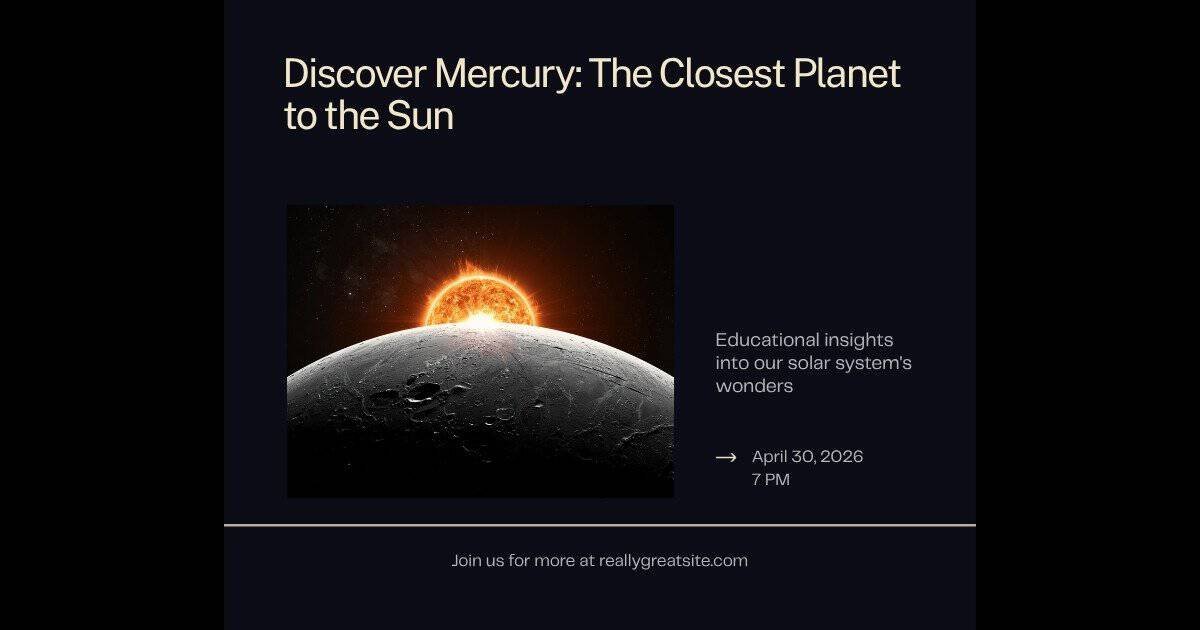
Mercury is an average of 36 million miles (57.9 million kilometers) from the Sun — about 0.39 astronomical units (AU). It is the closest planet to the Sun. Because Mercury follows a highly elliptical orbit, its distance ranges from 28.5 million miles at its closest to 43.5 million miles at its farthest. Sunlight takes just 3.2 minutes to reach Mercury — compared to 8.3 minutes for Earth.
Key Takeaways
- Mercury is 0.39 AU from the Sun on average — the closest planet.
- Distance ranges from 28.5 million miles (perihelion) to 43.5 million miles (aphelion).
- Sunlight reaches Mercury in just 3.2 minutes.
- Mercury’s orbit is the most elliptical of all 8 planets — distance varies by ~52%.
- Despite being closest to the Sun, Mercury is not the hottest planet — Venus is.
Mercury’s Distance from the Sun — Full Numbers
| Measurement | Miles | Kilometers | AU |
|---|---|---|---|
| Average distance | 36 million mi | 57.9 million km | 0.387 AU |
| Closest (perihelion) | 28.5 million mi | 46.0 million km | 0.307 AU |
| Farthest (aphelion) | 43.5 million mi | 69.8 million km | 0.467 AU |
What Does 0.39 AU Actually Mean?
Mercury’s position in the solar system
One AU is the average Earth-Sun distance — about 93 million miles. Mercury at 0.39 AU is less than two-fifths of the way between the Sun and Earth. To put that in perspective: Mercury is so close to the Sun that it completes an entire orbit in just 88 Earth days. From Mercury’s surface, the Sun appears roughly 2.5 times larger in the sky than it does from Earth — and nearly 7 times brighter.
How Does Mercury’s Distance Compare to Other Planets?
All 8 planets — distance from the Sun
| Planet | Avg Distance (AU) | Avg Distance (km) | Sunlight Travel Time |
|---|---|---|---|
| Mercury | 0.39 AU | 57.9 million km | 3.2 min |
| Venus | 0.72 AU | 108.2 million km | 6 min |
| Earth | 1.00 AU | 149.6 million km | 8.3 min |
| Mars | 1.52 AU | 227.9 million km | 12.7 min |
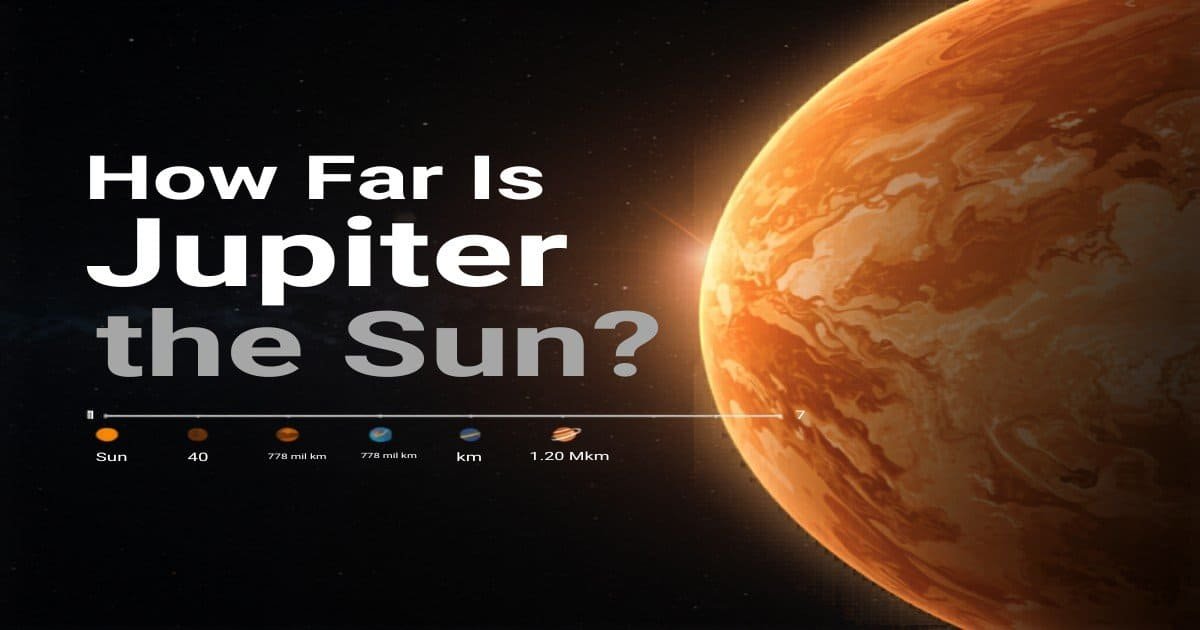
| Jupiter | 5.20 AU | 778.5 million km | 43 min |
| Saturn | 9.58 AU | 1,432 million km | 80 min |
| Uranus | 19.2 AU | 2,871 million km | 160 min |
| Neptune | 30.1 AU | 4,495 million km | 252 min |
Why Mercury’s Orbit Is So Elliptical
Mercury has the most eccentric (elongated) orbit of any planet — its distance from the Sun varies by about 52% between perihelion and aphelion. This extreme orbit is due to gravitational influences from the Sun and other planets over billions of years. It also makes Mercury’s orbit one of the most fascinating to study: Einstein’s theory of general relativity was first confirmed by explaining the unusual precession of Mercury’s orbit, which Newtonian physics couldn’t fully account for.
How Long Does Sunlight Take to Reach Mercury?
At Mercury’s average distance of 36 million miles, sunlight takes about 3.2 minutes to arrive — faster than any other planet. At perihelion (28.5 million miles), that drops to just 2.6 minutes. For comparison, sunlight takes 8.3 minutes to reach Earth, 13 minutes to reach Mars, and 43 minutes to reach Jupiter. This means Mercury receives solar radiation roughly 6.7 times more intense than Earth does.
Is Mercury the Hottest Planet Because It’s Closest to the Sun?
No. Despite being the closest planet to the Sun, Mercury is not the hottest planet. Venus holds that title with a surface temperature of 465°C — hotter than Mercury’s daytime high of 430°C. The reason: Mercury has almost no atmosphere to trap heat. At night, temperatures plummet to −180°C. Venus, with its thick CO₂ atmosphere, maintains 465°C day and night. Being close to the Sun matters — but atmosphere matters more.
How Far Is Mercury from Earth?
Mercury’s distance from Earth varies between about 48 million miles at closest approach and 137 million miles when on opposite sides of the Sun. On average, Mercury is about 77 million miles from Earth. Explore the full series: How Far Is Venus from the Sun?, How Far Is Mars from the Sun?, and How Far Is Jupiter from the Sun?
How far is Mercury from the Sun?
Mercury is an average of 36 million miles (57.9 million km) from the Sun — about 0.39 AU. Its elliptical orbit means the distance ranges from 28.5 million miles at closest to 43.5 million miles at farthest.
How long does sunlight take to reach Mercury?
Sunlight takes approximately 3.2 minutes to travel from the Sun to Mercury at average distance. At closest approach, this drops to about 2.6 minutes.
Is Mercury the closest planet to the Sun?
Yes. Mercury is the closest planet to the Sun, orbiting at an average distance of 0.39 AU (36 million miles). It completes one orbit every 88 Earth days.
Why is Mercury not the hottest planet if it's closest to the Sun?
Mercury has almost no atmosphere to trap heat. Temperatures reach 430°C in the day but drop to −180°C at night. Venus, despite being farther away, maintains 465°C constantly due to its thick CO₂ atmosphere creating a greenhouse effect.
How many AU is Mercury from the Sun?
Mercury orbits at an average distance of 0.387 AU from the Sun. At perihelion it is 0.307 AU, and at aphelion it reaches 0.467 AU — the most elliptical orbit of any planet.