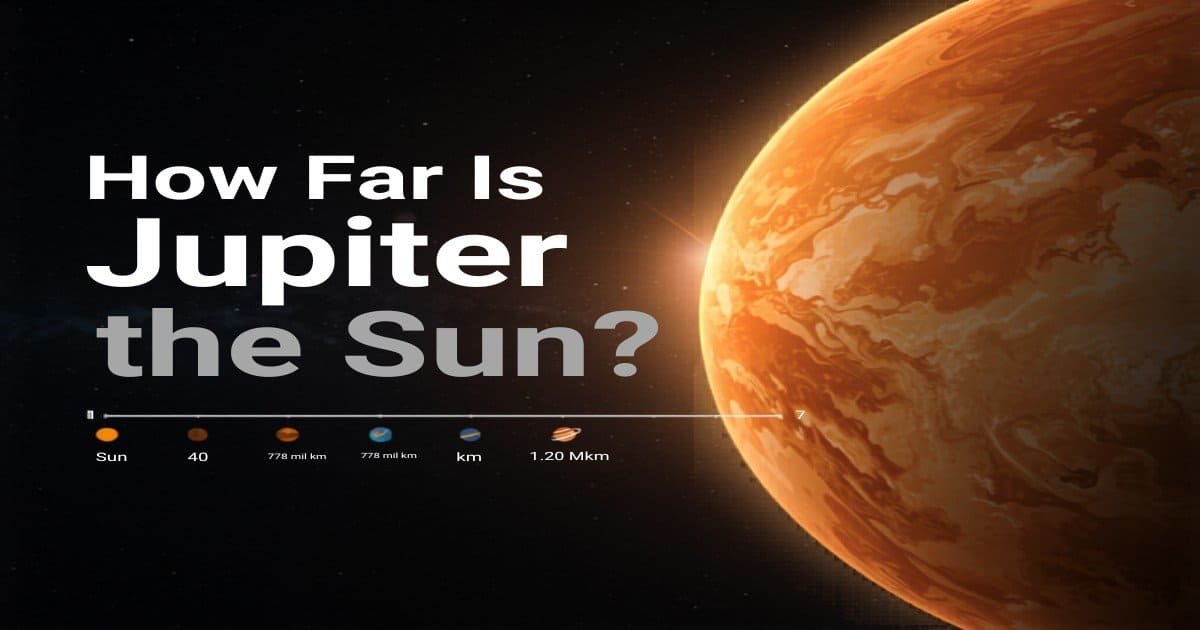
Jupiter is an average of 484 million miles (778 million kilometers) from the Sun — roughly 5.2 astronomical units (AU). Because Jupiter follows an elliptical orbit, that distance ranges from about 460 million miles at its closest point to 507 million miles at its farthest. Sunlight takes approximately 43 minutes to travel from the Sun to Jupiter.
Key Takeaways
- Jupiter orbits the Sun at an average of 5.2 AU (484 million miles / 778 million km).
- Its elliptical orbit means the distance ranges from 460 million miles (perihelion) to 507 million miles (aphelion).
- Sunlight takes 43 minutes to reach Jupiter — compared to 8 minutes for Earth.
- Jupiter is 5.2× farther from the Sun than Earth.
- One Jupiter year lasts 11.86 Earth years — the time it takes to complete one orbit.
Jupiter’s Distance from the Sun — Full Numbers
| Measurement | Miles | Kilometers | AU |
|---|---|---|---|
| Average distance | 484 million mi | 778 million km | 5.20 AU |
| Closest (perihelion) | 460 million mi | 741 million km | 4.95 AU |
| Farthest (aphelion) | 507 million mi | 817 million km | 5.46 AU |
What Does 5.2 AU Actually Mean?
Putting Jupiter’s distance in perspective
One astronomical unit (AU) is the average distance from Earth to the Sun — about 93 million miles (150 million km). Jupiter sits at 5.2 AU, meaning it is 5.2 times farther from the Sun than Earth. To visualize this: if Earth were at the 1-yard line on a football field, Jupiter would be at the 5.2-yard line. For reference, Mars is at 1.52 AU and Saturn is at 9.5 AU — so Jupiter falls roughly halfway between the inner and outer solar system.
| Planet | Average Distance from Sun (AU) | Average Distance (km) |
|---|---|---|
| Mercury | 0.39 AU | 58 million km |
| Venus | 0.72 AU | 108 million km |
| Earth | 1.00 AU | 150 million km |
| Mars | 1.52 AU | 228 million km |
| Jupiter | 5.20 AU | 778 million km |
| Saturn | 9.58 AU | 1,432 million km |
| Uranus | 19.2 AU | 2,871 million km |
| Neptune | 30.1 AU | 4,495 million km |
How Does Jupiter’s Distance Change Over Its Orbit?
Elliptical orbit: perihelion vs aphelion
Like all planets, Jupiter doesn’t follow a perfect circle — it travels in an ellipse. At perihelion (closest approach to the Sun), Jupiter comes within 460 million miles (741 million km). At aphelion (farthest point), it reaches 507 million miles (817 million km). That’s a difference of about 47 million miles across its orbit — significant, but far less extreme than Mercury’s orbit, which varies by over 40% between closest and farthest points.
Jupiter completes one full orbit every 11.86 Earth years — so a year on Jupiter lasts nearly 12 of our years. In that time, Jupiter travels roughly 4.9 billion miles (7.9 billion km) around the Sun at an average speed of about 29,236 mph (47,051 km/h).
How Long Does Sunlight Take to Reach Jupiter?
Light travels at 186,000 miles per second (299,792 km/s). At Jupiter’s average distance of 484 million miles, sunlight takes about 43 minutes to arrive. That compares to 8 minutes for Earth, 13 minutes for Mars, and 80 minutes for Saturn. This means that if the Sun were to suddenly go out, Jupiter wouldn’t “know” for 43 minutes — and anyone on Jupiter would see the Sun disappear 43 minutes after it happened.
How Far Is Jupiter from Earth?
Distance changes constantly as both planets orbit
Jupiter’s distance from Earth varies dramatically because both planets are moving. When Earth and Jupiter are on the same side of the Sun (opposition), Jupiter can be as close as 365 million miles (588 million km). When they are on opposite sides of the Sun (conjunction), the distance grows to about 601 million miles (968 million km). On average, Jupiter is about 484 million miles from Earth — roughly the same as its average distance from the Sun, since Earth’s distance adds or subtracts relatively little.
How Long Would It Take to Travel to Jupiter?
NASA’s Juno spacecraft, launched in 2011, took 5 years to reach Jupiter, arriving in July 2016. It traveled at an average speed of about 78,000 mph. The Voyager 1 probe reached Jupiter in just 546 days, using a more direct trajectory at higher speed. A hypothetical crewed mission would take roughly 600 days one-way using current propulsion technology — one reason Jupiter remains a destination for robotic spacecraft rather than humans.
We cover the distances of other planets in our series: How Far Is Mars from the Sun?, How Far Is Saturn from the Sun?, and How Far Is Uranus from the Sun?
How far is Jupiter from the Sun?
Jupiter is an average of 484 million miles (778 million kilometers) from the Sun — about 5.2 astronomical units (AU). Its distance ranges from 460 million miles at closest to 507 million miles at farthest due to its elliptical orbit.
How long does it take sunlight to reach Jupiter?
Sunlight takes approximately 43 minutes to travel from the Sun to Jupiter. This compares to 8 minutes for Earth and 13 minutes for Mars.
How far is Jupiter from Earth?
Jupiter's distance from Earth varies between about 365 million miles (at closest approach) and 601 million miles (when on opposite sides of the Sun). On average, Jupiter is roughly 484 million miles from Earth.
How many AU is Jupiter from the Sun?
Jupiter orbits the Sun at an average distance of 5.2 AU (astronomical units). One AU equals the average Earth-Sun distance of about 93 million miles or 150 million kilometers.
How long does it take to travel to Jupiter?
NASA's Juno spacecraft took about 5 years to reach Jupiter using a fuel-efficient trajectory. Faster probes like Voyager 1 made it in about 546 days. A direct crewed mission would take roughly 600 days one-way using current propulsion technology.