
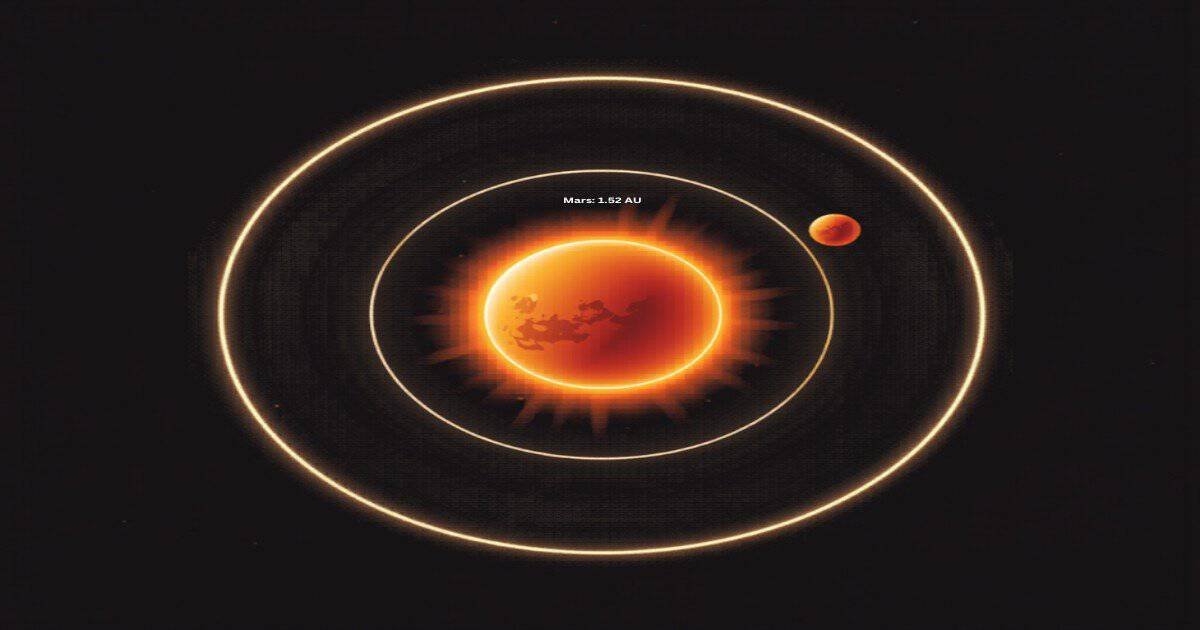
Mars is an average of 142 million miles (228 million kilometers) from the Sun — roughly 1.52 astronomical units (AU). Because Mars follows an elliptical orbit, that distance ranges from about 128 million miles at its closest to 154 million miles at its farthest. Sunlight takes approximately 13 minutes to travel from the Sun to Mars.
Key Takeaways
- Mars orbits the Sun at an average of 1.52 AU (142 million miles / 228 million km).
- Its elliptical orbit means the distance varies — closest at 1.38 AU (perihelion), farthest at 1.66 AU (aphelion).
- Sunlight takes about 13 minutes to reach Mars — compared to just 8 minutes for Earth.
- Mars is the 4th planet from the Sun and completes one orbit every 687 Earth days.
- NASA’s Perseverance rover is actively exploring Mars, collecting samples and searching for signs of ancient microbial life.
What Does 1.52 AU Actually Mean?
One astronomical unit (AU) equals the average distance between Earth and the Sun — about 93 million miles (150 million km). At 1.52 AU, Mars is about 52% farther from the Sun than Earth. To put that in perspective: light traveling at 186,000 miles per second still needs 13 minutes to make the journey from the Sun to Mars.
How Does Mars’s Distance from the Sun Change?
Mars does not travel in a perfect circle. Its elliptical orbit means its distance from the Sun changes constantly throughout its 687-day year. The difference between its closest and farthest points is about 26 million miles — one of the largest orbital variations among the inner planets.
| Position | Distance (AU) | Distance (km) | Distance (miles) |
|---|---|---|---|
| Average | 1.52 AU | 228 million km | 142 million miles |
| Perihelion (closest) | 1.38 AU | 206.7 million km | 128.4 million miles |
| Aphelion (farthest) | 1.66 AU | 249.2 million km | 154.9 million miles |
This variation matters for more than astronomy. When Mars is at perihelion, it receives more solar energy, which intensifies dust storms that can blanket the entire planet for months. The most dramatic global dust storms — including the one that ended NASA’s Opportunity rover mission in 2018 — typically occur during this phase.
How Long Does Sunlight Take to Reach Mars?
On average, sunlight takes 13 minutes and 20 seconds to travel from the Sun to Mars, according to NASA. This is nearly 5 minutes longer than the 8 minutes and 20 seconds it takes to reach Earth. At Mars’s farthest point from the Sun, that travel time stretches to about 22 minutes.
This light-travel delay has real consequences for space missions. When NASA engineers send a command to a rover on Mars, they must wait up to 24 minutes for a round-trip signal — meaning no real-time control is possible. Every Mars rover operates with significant autonomy for exactly this reason.
How Does Mars Compare to Earth in Distance from the Sun?
Earth orbits at 1.0 AU; Mars orbits at 1.52 AU. That extra half-AU makes a significant difference. Mars receives only about 43% as much solar energy per square meter as Earth does, contributing to its average surface temperature of around -60 degrees C (-80 degrees F) — far colder than Earth’s average of about 15 degrees C (59 degrees F), despite having a nearly identical day length.
Why Is Mars’s Distance Important for Space Missions?
The distance between Earth and Mars changes dramatically depending on where both planets sit in their orbits. At closest approach — called opposition — Mars can be as near as 33.9 million miles. At their farthest, they can be over 250 million miles apart. This is why NASA launches Mars missions during specific launch windows that occur roughly every 26 months, when alignment minimizes travel time and fuel. The journey typically takes 6 to 9 months.
What Are We Learning About Mars Right Now?
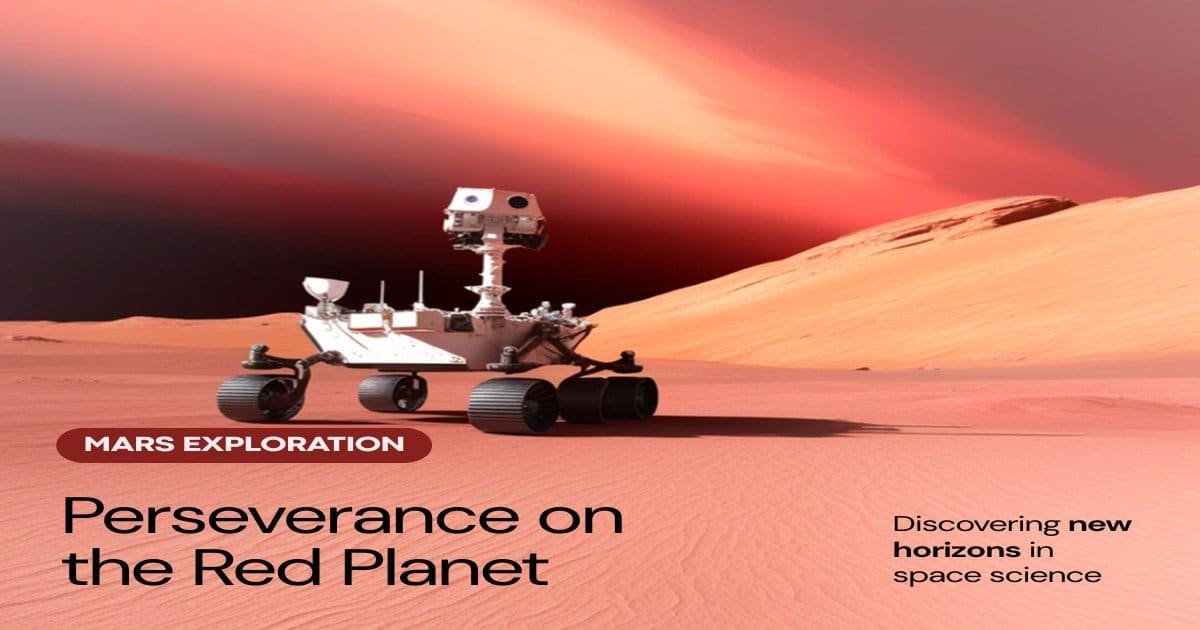
As of 2025, NASA’s Perseverance rover is exploring the rim of Jezero Crater — a site scientists believe once held an ancient lake. The rover has filled 33 of its 43 sample tubes with rock cores showing signs of past water, organic material, and chemical patterns consistent with ancient microbial activity, according to NASA mission scientists. These samples are being preserved for eventual return to Earth.
In a landmark moment for space exploration, Perseverance completed the first AI-planned drives on another planet in December 2025, using generative AI models to autonomously chart safe routes across Martian terrain — a capability that will be essential for future human missions to the Red Planet.
My Experience Observing Mars
Mars is one of the most rewarding planets to watch through a telescope over months. I’ve tracked it during three oppositions, and the difference in apparent size between opposition and aphelion is striking — it can appear up to five times larger in area at its closest approach. During the favorable 2020 opposition, I could clearly see the southern polar ice cap and the dark Syrtis Major region through a 6-inch reflector, knowing the light I was seeing had left the Sun 13 minutes earlier and traveled 228 million kilometers to reach my backyard.
FAQs
How far is Mars from the Sun in miles?
Mars is about 142 million miles from the Sun on average. Its elliptical orbit means this varies from roughly 128 million miles at perihelion to about 155 million miles at aphelion.
Is Mars closer to the Sun than Earth?
No. Mars is farther from the Sun than Earth. Earth orbits at 1.0 AU (93 million miles), while Mars orbits at 1.52 AU (142 million miles) — making Mars roughly 52% farther from the Sun than Earth.
How long does it take to travel from Earth to Mars?
With current spacecraft technology, a trip from Earth to Mars takes approximately 6 to 9 months, depending on the launch window. NASA's Perseverance rover took about 7 months after launching in July 2020 before landing in February 2021.
How far is Mars from Earth right now?
The distance varies constantly as both planets orbit the Sun. It ranges from about 33.9 million miles at closest approach to over 250 million miles when on opposite sides of the Sun.
Does Mars's distance from the Sun affect its weather?
Yes, significantly. When Mars is closest to the Sun (perihelion), it receives more solar energy, triggering planet-wide dust storms that can last for months and dramatically reduce sunlight reaching the surface.