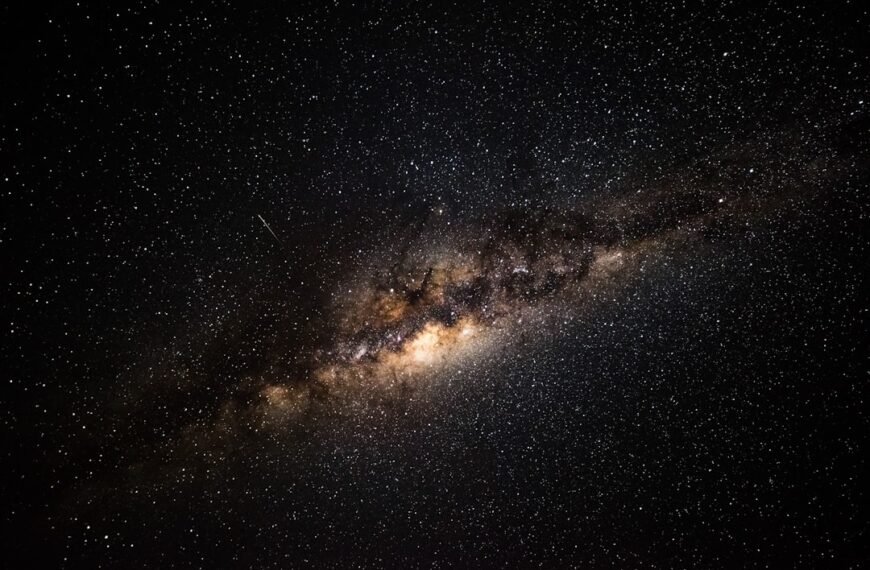

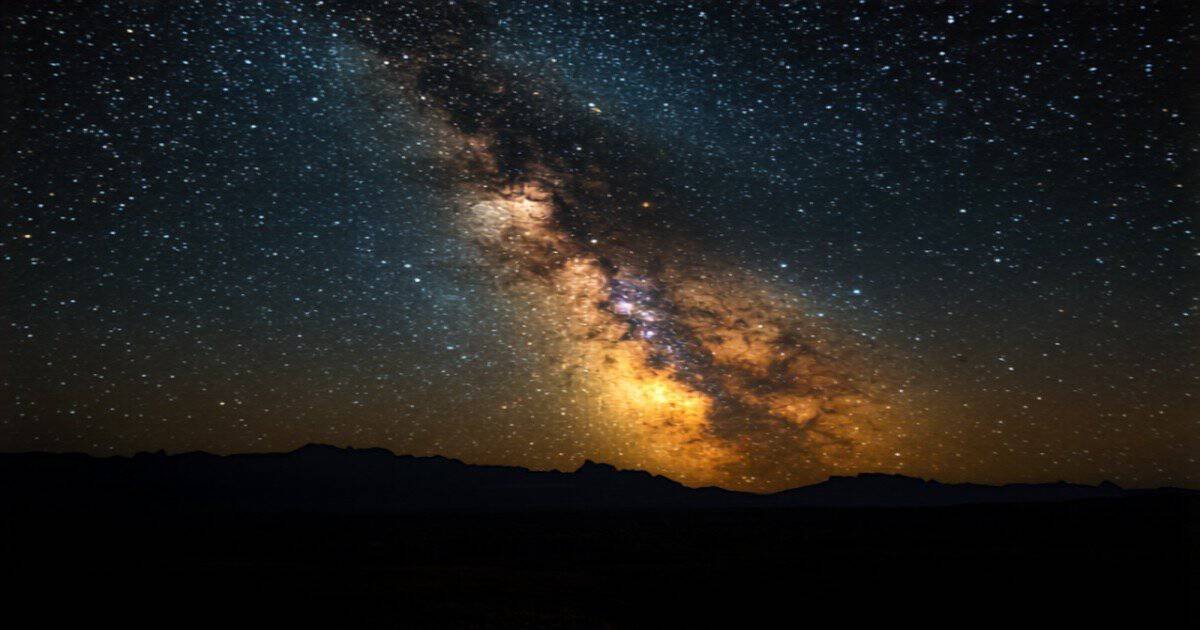
From Earth, the Milky Way appears as a faint, glowing band of white light arching across the night sky. You are seeing the edge-on view of our own galaxy’s disk — billions of stars so distant they blur together into a hazy stripe. With dark skies and no moonlight, this band stretches from horizon to horizon, passing through constellations like Sagittarius and Scorpius.
Key Takeaways
- The Milky Way looks like a soft, milky arc of light because we are inside it, viewing its disk edge-on.
- Earth sits roughly 26,000 light-years from the galaxy’s center, in one of its spiral arms.
- The best time to see it is on a moonless summer night, far from city lights.
- More than one-third of people on Earth can never see the Milky Way due to light pollution.
- In April 2026, the Artemis II crew photographed our galaxy from deep space — a striking reminder of how rare this view really is.
Why Does the Milky Way Look Like a Band of Light?
The short answer: you are inside the galaxy looking outward. The Milky Way is a spiral galaxy — a flat, rotating disk of stars, gas, and dust spanning more than 100,000 light-years. Our solar system sits about halfway between the galaxy’s center and its outer edge, embedded in one of those spiral arms. When you look up at night, you are peering along the flat plane of this disk. The stars are packed so densely and lie so far away that your eyes cannot resolve them individually. Instead, they merge into a continuous glow — the band we call the Milky Way.
This is fundamentally different from how you would see the galaxy from outside. Viewed from far above, the Milky Way would appear as a stunning pinwheel of stars with sweeping arms. From our position inside it, we only ever get this side view — like standing inside a room and trying to see the full shape of the building around you.
What Exactly Are You Looking at When You See the Milky Way?
The glowing band you see in the night sky is the combined light of hundreds of millions of stars in the galaxy’s disk. But you are only seeing a tiny fraction of what is actually there. According to NASA, the Milky Way contains between 200 and 400 billion stars. Of those, only about 5,000 to 8,000 are individually visible to the naked human eye from Earth — and you can only see roughly half of those at any one moment. The stars you can resolve as individual points of light represent just 0.000003% of the total stellar population.
The bright, dense region near the constellation Sagittarius marks the direction of the galactic center — the core of our galaxy, located about 26,000 light-years away. At the very heart of that core sits Sagittarius A*, a supermassive black hole with a mass roughly four million times greater than our Sun. You cannot see it with the naked eye, but in dark skies that region of the sky glows noticeably brighter than the rest of the band.

Can You Actually See the Milky Way from Earth?
Yes — but only under the right conditions. The biggest obstacle is light pollution. Wikipedia’s research notes that more than one-third of Earth’s population lives under skies so bright that the Milky Way is permanently invisible to them. If you have spent your entire life in or near a major city, you may never have seen it at all. To be visible, the sky needs to be darker than about 20.2 magnitude per square arcsecond — a technical way of saying you need genuinely dark skies with no artificial glow on the horizon.
When conditions are right, it is unmistakable: a broad, irregular stripe of pale light cutting across the entire sky, brighter and wider near Sagittarius in the south, narrower and dimmer as it arcs toward the north. Dark lanes of dust create gaps and irregular edges that give it texture even without binoculars.
When and Where Is the Best Time to See the Milky Way?
The galactic core — the brightest, most dramatic part of the Milky Way — is only visible from the Northern Hemisphere between roughly March and October, with June, July, and August being the peak months. In summer, the core rises high enough in the south to clear the horizon haze and display its full brightness. In winter, the core is on the other side of the Earth (on the daytime side), so you only see the fainter outer arm of the galaxy.
For the best view, follow these four rules:
- Go far from city lights. Even a 90-minute drive from a major urban area can transform the sky dramatically. National parks, rural farmland, and coastal areas are good starting points.
- Choose a moonless night. The full Moon outshines the Milky Way completely. The best nights fall in the week before and after the new Moon.
- Let your eyes adjust. Full dark adaptation takes 20–30 minutes. Even a few seconds of phone screen light resets the process.
- Face south. The galactic core rises in the southeast and transits due south at its highest point. In the Northern Hemisphere, this is where the view is brightest.
If you want a step-by-step guide to planning your first night under dark skies, our Astronomy for Beginners: How to Start Stargazing Tonight covers everything you need to get started.

What Did the Artemis II Crew See in April 2026?
On April 7, 2026, the crew of NASA’s Artemis II mission captured a photograph of the Milky Way from deep space — offering a perspective that very few humans in history have witnessed firsthand. NASA described the image as showing the galaxy’s elegant spiral structure, dominated by two main arms wrapping off the ends of a central bar of stars. Spanning more than 100,000 light-years, the photo places our tiny solar system in humbling context: a single dot somewhere along one of those arms, about halfway between the core and the outer edge.
This is what the Milky Way actually looks like from the outside — or at least from far enough away to see its shape. From Earth’s surface, we will never see this view. The Artemis II image is a rare reminder of just how extraordinary the universe looks the moment you leave the atmosphere behind.
How Far Is Earth from the Center of the Milky Way?
Earth — along with the rest of our solar system — sits approximately 26,000 light-years from the galactic center. This places us roughly halfway between the center and the outer rim. We orbit the galaxy’s center at about 515,000 mph (828,000 km/h), but because the galaxy is so enormous, one complete orbit takes about 240 million years. That span of time is called a galactic year or cosmic year. In the entire history of Earth (about 4.5 billion years), our planet has completed only about 18 to 20 full orbits around the Milky Way.
Want to put the scale of our galaxy in even starker perspective? We explored its full size and structure in detail in our piece on Exploring the Milky Way Galaxy.
Why Can’t We See the Whole Milky Way at Once?
Because the Milky Way encircles us completely, it actually occupies a full 360° band around the sky — but you can only face one direction at a time, and the Earth itself blocks the other half. Even on a perfect night from a perfect location, you will see roughly half the galactic band at any moment. Photographs of the “full” Milky Way are almost always stitched panoramas, composed from multiple images taken throughout the night as the galaxy rotates overhead with Earth’s spin.
Much of the galaxy’s disk is also permanently hidden by interstellar dust. The thick clouds of gas and dust that fill the plane of the galaxy block visible light from stars on the far side. Infrared telescopes like the James Webb Space Telescope can see straight through this dust, but to our eyes the inner galaxy remains largely opaque.
What Constellation Is the Milky Way In?
The Milky Way passes through 30 constellations. The brightest, most detailed section — the galactic bulge — lies in the direction of Sagittarius, with the neighboring constellation Scorpius just to its right. This is where the supermassive black hole at the galaxy’s center is located (though invisible to the naked eye). From Sagittarius, the band sweeps north through Aquila, Cygnus, and Cassiopeia, then south again through Perseus, Auriga, and Orion, completing the full arc back around. The Northern Cross asterism in Cygnus lies almost exactly along the Milky Way’s band and is easy to spot on summer nights.
FAQs
Can you see the Milky Way with the naked eye?
Yes, the Milky Way is visible to the naked eye under dark skies on a moonless night. From areas with low light pollution, it appears as a wide, faint band of light stretching across the entire sky. In cities and suburbs, artificial light washes it out completely.
Why does the Milky Way look like a band of light instead of a galaxy?
Because Earth is inside the Milky Way, not outside it. You are looking along the flat plane of the galaxy's disk, so all the stars in that disk blur together into a stripe. If you could view it from far outside, it would look like a spiral pinwheel of stars.
What is the best month to see the Milky Way?
June, July, and August offer the best views from the Northern Hemisphere. During summer, the bright galactic core rises high in the southern sky after dark. The core is on the daytime side of Earth in winter, so only the fainter outer arm is visible.
Where is Earth located in the Milky Way?
Earth is located in the Orion Arm, a minor spiral arm of the Milky Way. We sit about 26,000 light-years from the galactic center and roughly the same distance from the outer edge, placing us about halfway out from the core.
How long does it take for Earth to orbit the Milky Way?
Earth takes approximately 240 million years to complete one full orbit around the center of the Milky Way. This is called a galactic year or cosmic year. In Earth's 4.5-billion-year history, we have completed roughly 18 to 20 of these orbits.