
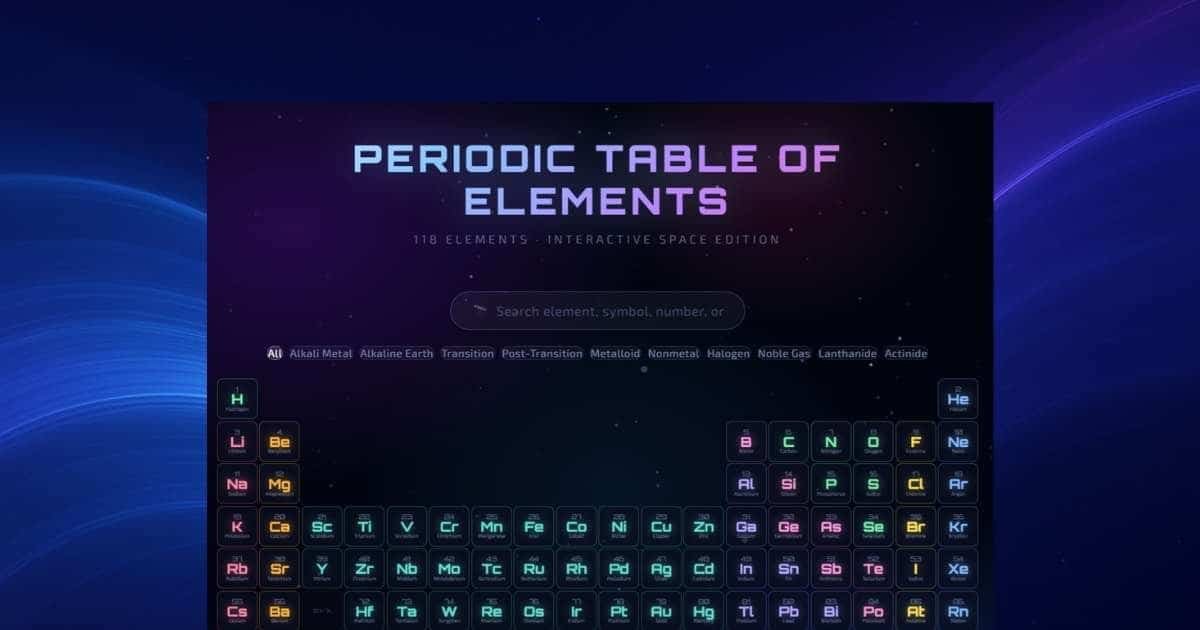
Explore All 118 Elements — Interactive Periodic Table
Every element mentioned in this article — hydrogen, helium, carbon, iron, gold, uranium — is in this interactive table. Click any element to see its melting point, boiling point, density, electronegativity, discovery year, discoverer, and main uses. Use the search bar or category filters to explore by element group.
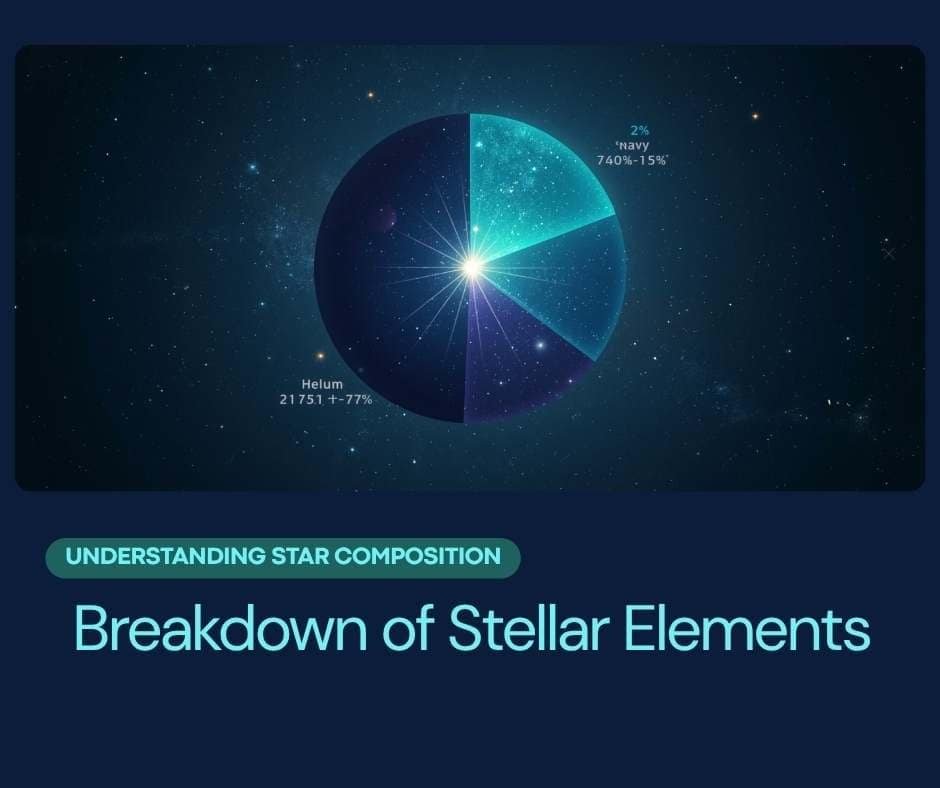
The two main elements in stars are hydrogen and helium. Hydrogen makes up roughly 73% of a star’s mass, while helium accounts for about 25%. Together they fuel the nuclear fusion reactions that make stars shine — and, over billions of years, forge every heavier element in the universe.
Key Takeaways
- Hydrogen (~73% by mass) is the primary fuel of every main-sequence star, including our Sun.
- Helium (~25%) builds up in the core as hydrogen fuses, and becomes the next fuel source.
- Together these two elements account for 96–99% of a star’s total mass.
- Every other element — carbon, oxygen, iron, gold — was forged inside stars from these two building blocks.
- Hydrogen and helium still make up about 99% of all atoms in the observable universe today.
Why Are Stars Made Mostly of Hydrogen and Helium?
It starts with the Big Bang. In the first three minutes after the universe was born, the extreme heat and density were perfect for one process: Big Bang nucleosynthesis. Protons and neutrons fused rapidly, producing hydrogen nuclei and a smaller amount of helium-4, plus trace amounts of lithium. By the time the universe cooled enough for fusion to stop, it was already about 75% hydrogen and 25% helium by mass — and that ratio has barely changed since.
When gravity pulled those primordial clouds of gas together to form the first stars, the universe essentially handed them a pre-mixed fuel tank of hydrogen and helium. That’s why every star you’ve ever seen — from our Sun to the most distant quasar — starts its life with the same two ingredients.
What Exactly Happens to Hydrogen Inside a Star?
Deep in a star’s core, temperatures reach 15 million degrees Celsius and pressures become extreme enough to overcome the natural repulsion between protons. Four hydrogen nuclei fuse together through a chain of reactions to form one helium-4 nucleus. This is called the proton–proton chain, and it’s the dominant energy source in 90% of all stars, including the Sun.
The key detail: the mass of four hydrogen nuclei is slightly greater than one helium nucleus. That tiny 0.7% mass difference is converted directly into energy — the light and heat that reaches Earth eight minutes after leaving the Sun’s surface. Every second, the Sun converts roughly 600 million tonnes of hydrogen into 596 million tonnes of helium, with the leftover 4 million tonnes becoming pure radiated energy.
Where Do All the Other Elements Come From?
This is where stars become the universe’s forge. Once a star exhausts its core hydrogen, it begins burning helium into carbon and oxygen. More massive stars continue up the chain — carbon fuses into neon, then magnesium, silicon, and finally iron. Each stage runs faster and hotter than the last.
As the most common stars age and die, they scatter these newly created elements into space via stellar winds and supernova explosions. Elements heavier than iron — gold, platinum, uranium — require even more violent conditions: the collision of two neutron stars. Astronomers confirmed in 2017 that neutron star mergers (kilonovae) are the primary source of gold in the universe. Every gold atom on Earth was forged in such a collision long before our solar system formed.
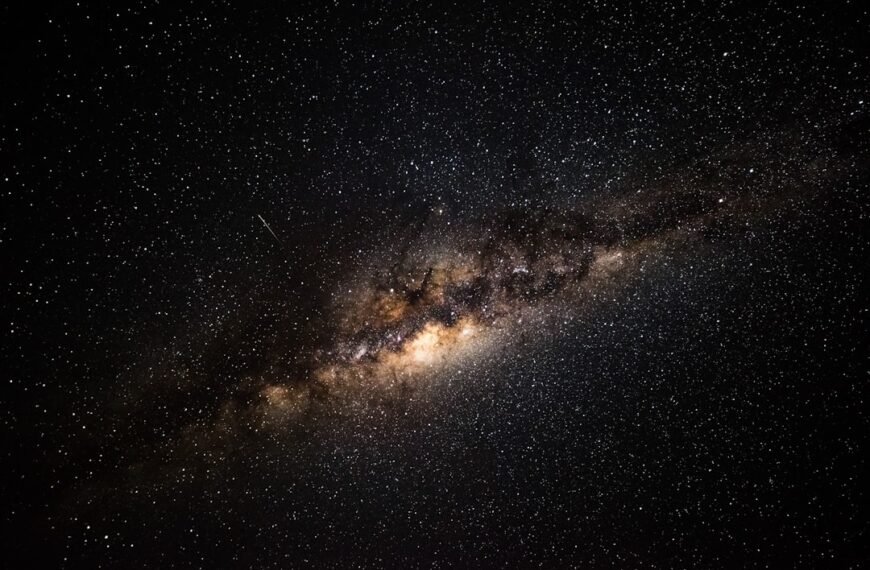
This means the stars in the Milky Way didn’t just light up the sky — they built the entire periodic table, one element at a time, starting always from hydrogen and helium.
How Do We Know What Stars Are Made Of?
We can’t visit a star, but we can read its light. When starlight passes through a spectrograph, it breaks into a pattern of bright and dark lines — a chemical fingerprint called an absorption spectrum. Each element absorbs light at specific, unique wavelengths. Hydrogen leaves a distinctive pattern (the Balmer series), helium leaves its own set of lines, and so on for every element in the periodic table.
In the 1920s, astronomer Cecilia Payne-Gaposchkin used stellar spectra to show that stars are overwhelmingly hydrogen and helium — a conclusion so surprising it was initially rejected by the scientific establishment. She was right. Her work remains one of the most important discoveries in astrophysics history.
Why Does This Matter — What Can You Take Away?
Understanding that stars run on hydrogen and helium answers some of the biggest questions in science:
- Where did we come from? Every carbon atom in your body was fused inside a star that died before our Sun was born. We are, literally, made of stardust.
- How old is a star? The ratio of hydrogen to heavier elements (metallicity) tells astronomers precisely when and where a star formed.
- Will a star have planets? Higher-metallicity stars are statistically more likely to host planetary systems — including potentially habitable ones.
- How long will the Sun last? The Sun has enough hydrogen fuel to burn for another ~5 billion years. When it runs out, it will swell into a red giant that engulfs Mercury and Venus.
- What elements can exist? Every element heavier than helium was built step by step inside stars — which is exactly why the interactive table below starts with H and He.
From the Editors
When we built the Interactive Periodic Table of Elements on this page, we noticed something immediately: of 118 known elements, only hydrogen and helium predate the first stars. Every other element — from lithium all the way to oganesson — was forged in a stellar core or a catastrophic explosion. Click any element in the table below to see its discovery year, who found it, melting point, density, and more. It’s a chemistry reference and a map of cosmic history at the same time.
FAQs
What are the two main elements found in stars?
The two main elements in stars are hydrogen and helium. Hydrogen makes up about 73% of a star's mass, and helium accounts for roughly 25%. Together they represent 96–99% of all stellar material.
Why do stars contain so much hydrogen and helium?
Hydrogen and helium were the primary products of the Big Bang. In the first three minutes of the universe, extreme temperatures fused protons and neutrons into hydrogen and helium nuclei. Stars formed from these primordial clouds, so they start their lives predominantly composed of these two elements.
What happens to hydrogen inside a star?
In a star's core, hydrogen nuclei fuse together through the proton–proton chain to produce helium-4. This nuclear fusion releases enormous energy — the light and heat that powers the star. The Sun converts about 600 million tonnes of hydrogen into helium every second.
Do all stars have the same elemental composition?
Most main-sequence stars are primarily hydrogen and helium, but their exact ratios vary. Older Population II stars have very little of any element other than hydrogen and helium, while younger stars like the Sun contain small amounts of heavier elements forged by previous stellar generations.
Where do heavier elements like gold and iron come from?
Heavier elements are forged inside stars through successive fusion reactions. Stars create elements up to iron in their cores. Elements heavier than iron — including gold, platinum, and uranium — are produced in supernova explosions and neutron star collisions, then scattered across the universe.