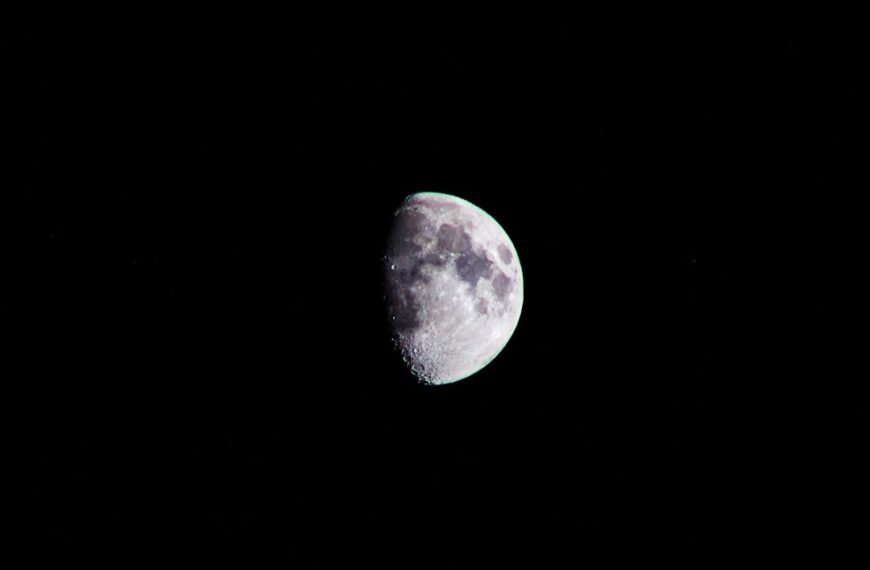

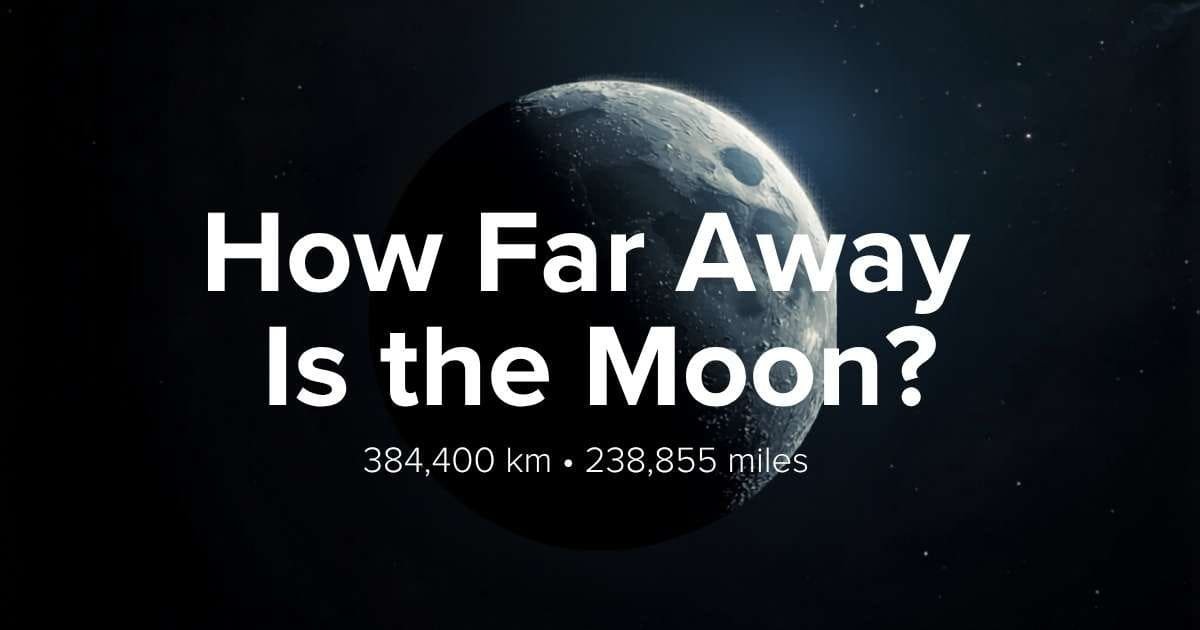
The Moon is, on average, 384,400 kilometers (238,855 miles) from Earth — a distance light covers in just 1.28 seconds. But that number is never truly fixed. Because the Moon follows an elliptical orbit, its distance swings from about 356,500 km at its absolute closest to over 406,700 km at its farthest, a monthly variation of more than 50,000 km.
Key Takeaways
- Average Earth-Moon distance: 384,400 km (238,855 miles)
- Closest approach (perigee): ~363,104 km (225,623 miles) — produces a Supermoon when it coincides with a full moon
- Farthest point (apogee): ~405,696 km (252,088 miles) — produces a Micromoon
- Light takes 1.28 seconds one way; the Apollo missions took about 3 days
- The Moon is slowly moving away from Earth at 3.83 cm per year
What Is the Average Distance from Earth to the Moon?
The standard figure used by scientists and space agencies worldwide is 384,400 km (238,855 miles). This is the semi-major axis of the lunar orbit — essentially the long radius of the ellipse the Moon traces around Earth.
There is a subtle but interesting nuance here. If you measured the Moon’s distance at equal time intervals throughout its orbit and averaged those readings, you would get a slightly higher figure — around 385,001 km. That small difference exists because the Moon moves more slowly near apogee than near perigee, so it spends proportionally more time on the far side of its orbit.
For everyday reference, 384,400 km is the number to remember. It equals roughly 30 Earth diameters stacked end to end.
| Measurement | Kilometers | Miles |
|---|---|---|
| Average (semi-major axis) | 384,400 | 238,855 |
| Closest (typical perigee) | 363,104 | 225,623 |
| Farthest (typical apogee) | 405,696 | 252,088 |
| Extreme minimum ever recorded | 356,353 | 221,427 |
| Extreme maximum ever recorded | 406,720 | 252,724 |
Why Does the Moon’s Distance Change Every Month?
The Moon orbits Earth in an ellipse, not a perfect circle. Its orbital eccentricity is about 0.0549, which means one end of the orbit (perigee) is significantly closer than the other (apogee). Every month, the Moon’s distance swings by more than 42,000 km — a range greater than three times Earth’s diameter.
The Sun’s gravity adds another layer of complexity. Through a mechanism called evection, the Sun periodically aligns with the long axis of the Moon’s ellipse and either stretches or compresses the orbit. This cycle repeats every 31.8 days and can push extreme apogee distances beyond 406,700 km. The result is that the Moon’s distance can change at a rate of up to 75 meters per second, shifting by over 1,000 km within a single six-hour window.
This monthly oscillation is why we see Supermoons and Micromoons. When a full moon coincides with perigee, the Moon appears up to 14% larger and 30% brighter than an average full moon. Conversely, a full moon at apogee — a Micromoon — looks noticeably smaller and dimmer. As of May 6, 2026, the Moon is at approximately 405,285 km, just past its monthly apogee, making this a Micromoon phase.
How Far Is the Moon in Light-Seconds?
Light travels at exactly 299,792,458 meters per second. At the Moon’s average distance of 384,400 km, a photon takes approximately 1.28 seconds to complete the one-way journey. The round-trip time is about 2.5 seconds.
That fact is the backbone of the Lunar Laser Ranging (LLR) program, which has been running continuously since the Apollo missions placed retroreflector arrays on the lunar surface in 1969. Ground stations fire short laser pulses — each only about 100 picoseconds long — at those reflectors and measure exactly how long the reflected photons take to return. From just a handful of detected photons per pulse, scientists can calculate the Moon’s distance to millimeter-level precision.
So when you look at the Moon tonight, you are seeing it exactly as it was 1.28 seconds ago — a reminder that even our nearest neighbor exists in our past, if only barely.
How Long Does It Take to Travel to the Moon?
Travel time to the Moon is not a fixed number — it depends entirely on the type of trajectory and propulsion system used. There is a fundamental trade-off between speed and fuel efficiency.
Direct transfers are the fastest option. The Apollo missions used a high-energy burn called translunar injection to reach the Moon in about three days. Apollo 8 holds the crewed speed record, entering lunar orbit in 69 hours and 8 minutes. Apollo 11 took 75 hours and 49 minutes to land on the surface. NASA’s Artemis I uncrewed mission used a similar approach, arriving after roughly 5 days.
Low-energy transfers — known as Ballistic Lunar Transfers (BLT) — use the combined gravity of Earth, Moon, and Sun to capture the spacecraft into lunar orbit with far less fuel. The trade-off is time. Japan’s SLIM lander took 4 months; ESA’s SMART-1, using an ion engine, took 13.5 months. South Korea’s KPLO Danuri orbiter took about 130 days via this route.
The outright speed record belongs to NASA’s New Horizons probe, which crossed the Moon’s orbital distance in just 8 hours and 35 minutes after its 2006 launch — though it was headed to Pluto, not the Moon.
| Mission | Trajectory | Transit Time |
|---|---|---|
| New Horizons (flyby) | Direct hyperbolic | 8.5 hours |
| Apollo 8 (orbit) | Direct transfer | 69 hours |
| Apollo 11 (landing) | Direct transfer | ~75 hours |
| Artemis I (orbit) | Direct transfer | ~5 days |
| KPLO Danuri (orbit) | BLT / WSB | ~130 days |
| SLIM (landing) | Low energy | ~4 months |
| SMART-1 (orbit) | Ion propulsion | 13.5 months |
Could All the Planets Fit Between Earth and the Moon?
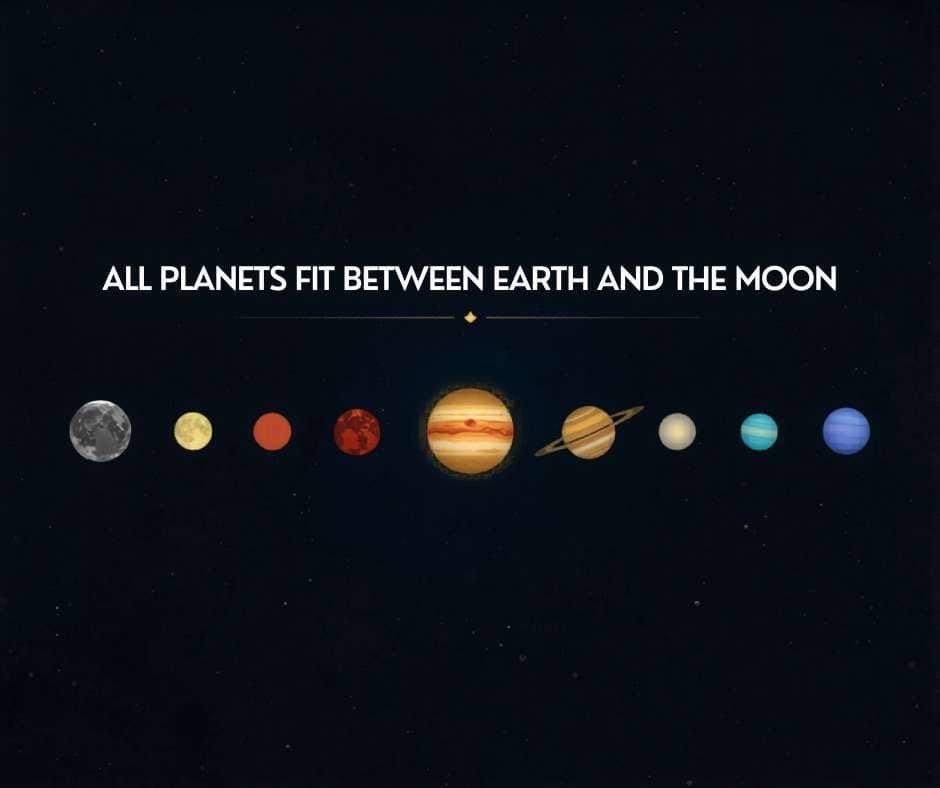
One of the most counterintuitive facts about the Earth-Moon distance is that all seven other planets in the solar system can fit between Earth and the Moon — and it is mathematically verified.
The combined diameter of Mercury, Venus, Mars, Jupiter, Saturn, Uranus, and Neptune adds up to approximately 384,766 km. At the Moon’s average distance of 384,400 km, they would overflow by just 366 km. But when the Moon is near apogee at ~405,696 km, all seven planets plus Pluto fit comfortably, with over 18,000 km to spare.
| Planet | Diameter (km) | Running Total (km) |
|---|---|---|
| Mercury | 4,880 | 4,880 |
| Venus | 12,104 | 16,984 |
| Mars | 6,780 | 23,764 |
| Jupiter | 139,820 | 163,584 |
| Saturn | 120,536 | 284,120 |
| Uranus | 51,118 | 335,238 |
| Neptune | 49,528 | 384,766 |
This visualization is one of the most effective ways to grasp the true scale of the solar system. What feels like an enormous distance in everyday terms is, cosmically speaking, almost nothing — just enough room to park all the outer giants.
Is the Moon Getting Farther Away from Earth?
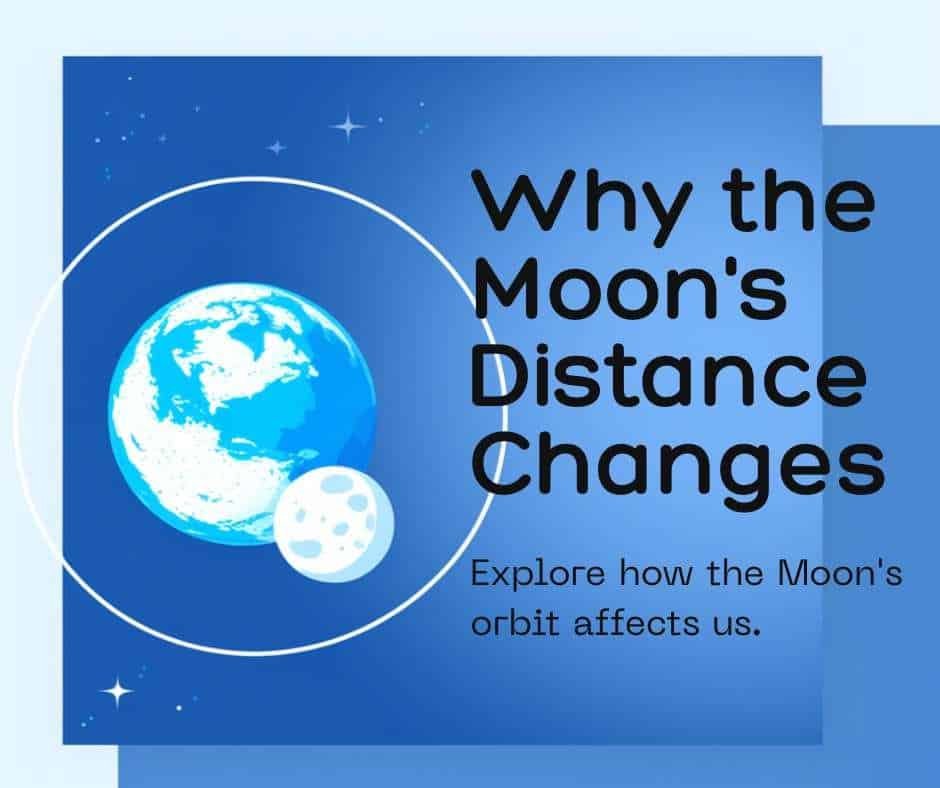
Yes — and we can measure it with extraordinary precision. LLR data confirms the Moon is drifting away from Earth at a current rate of 3.83 centimeters per year (about 1.5 inches). This process is called lunar recession.
The mechanism is tidal friction. The Moon’s gravity raises tidal bulges in Earth’s oceans and crust. Because Earth rotates faster than the Moon orbits, the rotating Earth carries those bulges slightly ahead of the Moon’s position. This leading bulge exerts a forward gravitational pull on the Moon, transferring angular momentum from Earth’s spin to the Moon’s orbit. The Moon gains energy and rises to a higher orbit; Earth’s rotation slows, lengthening the day by roughly 2.4 milliseconds per century.
This rate has not been constant throughout history. Data from 635-million-year-old sedimentary tidal deposits indicates the recession rate was only about 2.17 cm per year at that time. The current rate is unusually high, likely because of a resonance in today’s ocean geometry that amplifies tidal energy dissipation.
In approximately 600 million years, the Moon will have receded far enough that its apparent size in the sky can no longer fully cover the Sun. At that point, total solar eclipses — events that have shaped human history and science for millennia — will no longer be possible on Earth. If you want to understand how the Moon currently governs Earth’s tides and seasons, our article on why the Moon changes shape explains the orbital dynamics in more detail.
How Was the Moon’s Distance First Measured?
The quest to measure the Moon’s distance spans over two millennia of scientific ingenuity. In approximately 270 BC, Aristarchus of Samos used the duration of lunar eclipses to estimate the Moon’s orbit. By measuring how long Earth’s shadow took to cross the Moon and comparing that to the Moon’s total orbital period, he estimated a distance of roughly 60 Earth radii — remarkably close to the modern value of 60.3.
Around 129 BC, Hipparchus refined the measurement using parallax — observing a solar eclipse from two geographically separated locations and triangulating the Moon’s position from the difference. His result of 62–73 Earth radii remained the gold standard for nearly 2,000 years.
Modern precision arrived with radar in the 1950s (accuracy ±1 km) and then laser ranging after the Apollo missions. Today, the LLR program achieves millimeter-level accuracy — measuring a distance of 384,400 km to within a few millimeters. It remains one of the most precise measurements in all of science. You can see a similar leap in measurement precision in the search for planets around other stars, much like how missions explored the distances from planets like Mars to the Sun.
FAQs
How far is the Moon from Earth in miles?
The Moon is approximately 238,855 miles (384,400 km) from Earth on average. At its closest point (perigee) it is about 225,623 miles away, and at its farthest (apogee) it reaches roughly 252,088 miles. The exact distance changes daily as the Moon moves along its elliptical orbit.
How long does it take to get to the Moon?
It depends on the spacecraft and trajectory. The Apollo missions used direct transfers and reached the Moon in about 3 days — Apollo 8 holds the crewed record at 69 hours. Low-energy transfers used by missions like Japan's SLIM take 3–4 months. The fastest any object has ever crossed the Moon's orbital distance is 8 hours and 35 minutes, achieved by the New Horizons probe in 2006.
How far is the Moon in light-seconds?
At its average distance of 384,400 km, light takes approximately 1.28 seconds to travel from Earth to the Moon. The round-trip time is about 2.5 seconds. Scientists use this fact in Lunar Laser Ranging experiments to measure the Moon's distance to millimeter precision.
Why does the Moon's distance change?
The Moon orbits Earth in an ellipse, not a perfect circle. This means its distance naturally varies between about 363,000 km at perigee (closest) and 406,000 km at apogee (farthest) each month — a swing of over 42,000 km. The Sun's gravity also perturbs the orbit, creating additional small variations.
Is the Moon getting farther from Earth?
Yes. Lunar Laser Ranging data confirms the Moon is moving away from Earth at 3.83 centimeters per year due to tidal friction. This process has been ongoing since the Moon formed 4.5 billion years ago, though the rate has varied over time. In about 600 million years, the Moon will be far enough away that total solar eclipses will no longer occur on Earth.
The Bottom Line
The Moon is 384,400 km (238,855 miles) from Earth on average — a distance light covers in 1.28 seconds and that the Apollo astronauts crossed in about three days. That number hides a dynamic, ever-changing relationship: the Moon swings 42,000 km closer and farther every month, recedes 3.83 cm every year, and will eventually move far enough away to end total solar eclipses on Earth. Understanding that distance — how it is measured, why it varies, and where it is headed — is one of the most elegant stories in all of planetary science.