

The Eta Aquarid meteor shower peaks on the night of May 5–6, 2026, with the best viewing in the predawn hours of May 6. These meteors are debris left behind by Halley’s Comet and travel at roughly 40 miles (64 km) per second across the sky. Under dark, clear skies, Southern Hemisphere observers can see up to 50–60 meteors per hour, while Northern Hemisphere viewers can catch 10–30 under ideal conditions.
Key Takeaways
- Peak night: May 5–6, 2026 — best in the predawn hours of May 6
- Source: Debris trail left by Halley’s Comet (returns to our skies in 2061)
- Speed: ~40 miles (64 km) per second — among the fastest of all meteor showers
- Best region: Southern Hemisphere; Northern Hemisphere participation is possible
- 2026 challenge: A waning gibbous moon will suppress fainter meteors — seek dark skies and block the moon
What Is the Eta Aquarid Meteor Shower?
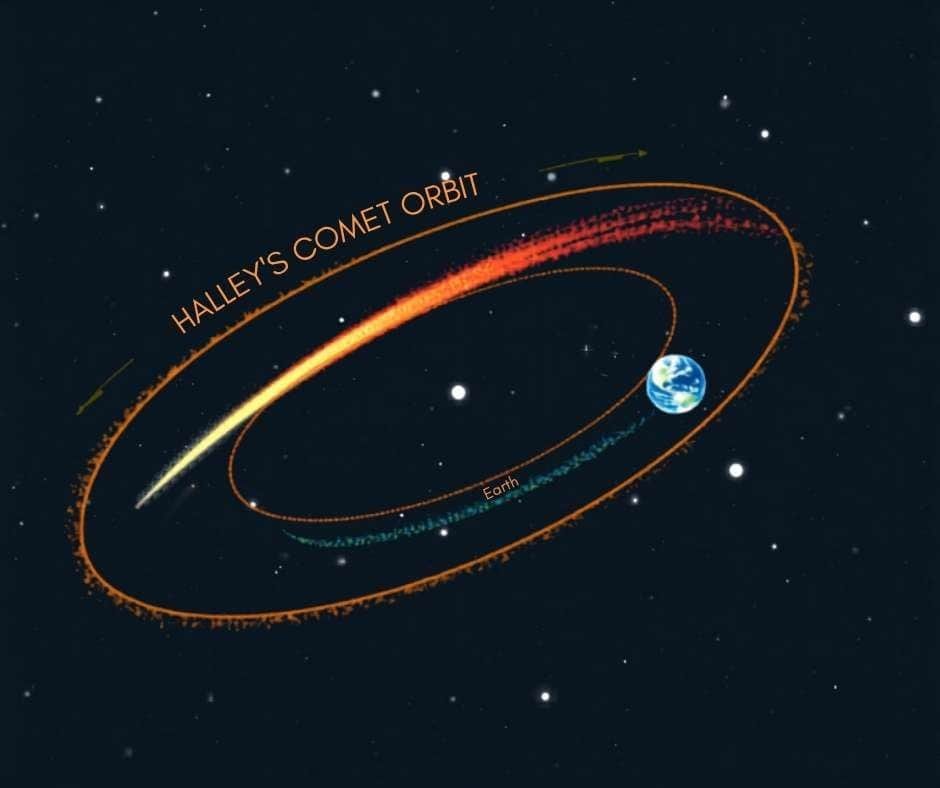
The Eta Aquarid meteor shower is one of two annual showers produced by Halley’s Comet — the other being the Orionid shower in October. As Halley sweeps through the inner solar system on its roughly 76-year orbit, its nucleus sheds ice and rock into space. Over millennia, these tiny particles spread along the comet’s path, forming a wide dust trail. Every spring, Earth passes through that trail, and the particles slam into our atmosphere at tremendous speed, burning up and creating the streaks of light we see as shooting stars.
The shower gets its name from its radiant — the point in the sky from which the meteors appear to originate. That point sits near the star Eta Aquarii in the constellation Aquarius, which is why astronomers call them the Eta Aquarids. You do not need to stare at that exact point; the meteors spread out across a wide area of sky and are visible anywhere overhead.
When Is the Best Time to Watch the Eta Aquarids in 2026?
The shower is active from April 19 through May 28, but the peak falls on the night of May 5–6. The American Meteor Society puts the predicted peak at approximately 3:51 UTC on May 5, meaning the best predawn window for most observers is the early morning of May 6, roughly between 3:00 and 5:00 a.m. local time, just before the sky begins to brighten.
In 2026, a waning gibbous moon — about 84% illuminated — will be present in the sky during the peak. This is the biggest obstacle for this year’s shower. The bright moonlight washes out dimmer meteors, cutting the visible rate significantly in the Northern Hemisphere from a potential 20–30 per hour to perhaps 5–10. To get around this, position yourself so a building, tree, or hill blocks the moon from your direct line of sight, and focus on the darkest part of the sky available.
How Many Meteors Can You Expect to See?
The Eta Aquarids are a genuinely strong shower — under perfect conditions, the zenithal hourly rate reaches 50–60 meteors per hour for observers in the Southern Hemisphere, where the radiant climbs high overhead. In the Northern Hemisphere, the radiant sits low on the southeastern horizon, which limits the visible count to roughly 10–30 per hour under a moonless, dark sky.
What the Eta Aquarids lack in sheer numbers (compared to the August Perseids, for example), they make up for in speed and quality. Traveling at 40 miles per second, these meteors are among the fastest of any annual shower. Fast meteors produce longer, brighter streaks and often leave glowing persistent trains — luminous trails that linger for a second or two after the meteor itself has vanished. Even a single well-placed Eta Aquarid is worth the wait.
How Do You Get the Best View of the Eta Aquarid Meteor Shower?
No telescope or binoculars needed — in fact, optical equipment narrows your field of view and makes things worse. Here is what actually helps:
- Go dark. Drive at least 30–40 minutes from city lights. Rural hilltops and open fields are ideal.
- Look southeast. Face the Aquarius constellation in the southeast and let your eyes roam freely across the sky.
- Give your eyes time. It takes about 20–30 minutes for human eyes to fully adapt to darkness. Avoid phone screens or any bright light during this time.
- Block the moon. In 2026 this is essential. Use a building, a hill, or even hold up your hand to shield the moon from your direct view.
- Lie back and be patient. Meteors come in bursts — there can be a quiet stretch of five minutes followed by three in a row. Give yourself at least one to two hours.
I always bring a sleeping bag or a reclining lawn chair when heading out for a meteor shower — you are going to be staring straight up for a long time, and neck strain is the enemy of patience. A warm drink helps on May mornings, which can still be surprisingly cold before dawn.
For more strategies on preparing for a night-sky event, see our full guide on how to watch the next meteor shower.
Can You See the Eta Aquarids from the Northern Hemisphere?
Yes — but you will see fewer meteors. The Eta Aquarid radiant rises low in the southeastern sky for Northern Hemisphere observers, meaning many meteors skim across the lower atmosphere rather than burning straight overhead. Observers at latitudes between 25°N and 45°N (covering most of the continental United States, Europe, and Japan) can realistically expect to see 10–20 meteors per hour under moonless, dark-sky conditions. Southern observers in Australia, South Africa, or South America have the best seats.
The shower is still worth watching from the north — the fast, long-trailed meteors are visually spectacular even in smaller numbers. Low-horizon meteors also tend to produce earthgrazers: meteors that travel almost horizontally across a wide arc of the sky, leaving exceptionally long, colorful trails.
What Else Is Happening in Space This Week? (May 2026)
The Eta Aquarids are not the only story in the sky this week. Here are two other significant developments unfolding right now.
NASA’s Psyche Spacecraft Makes a Mars Flyby
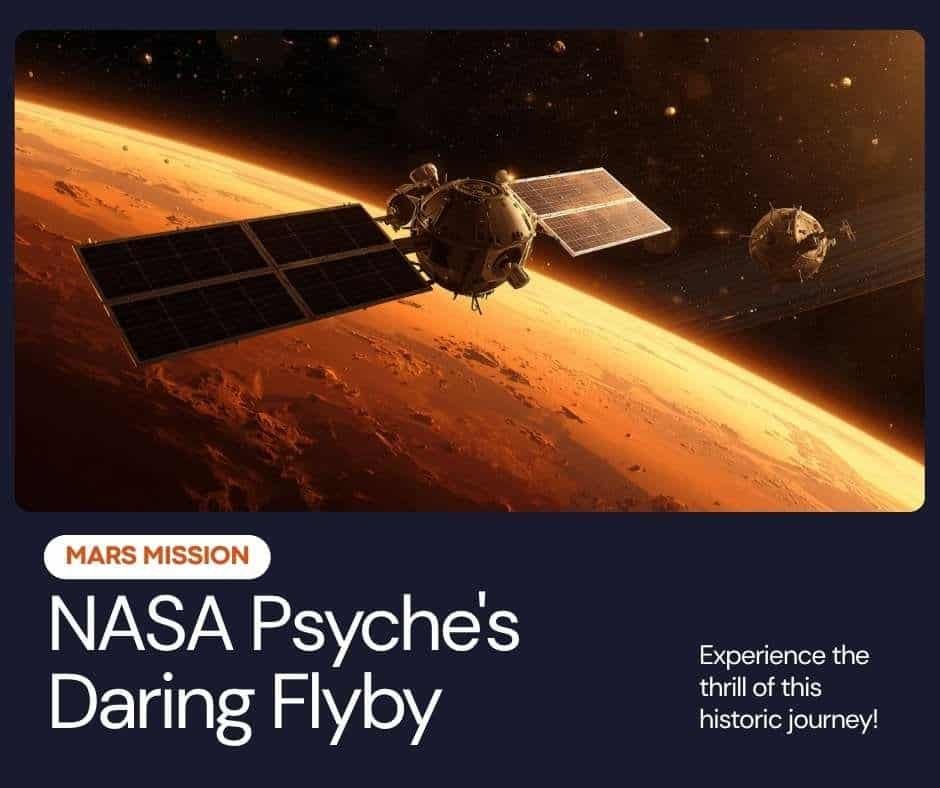
NASA’s Psyche spacecraft is executing a Mars gravity assist this month — a maneuver where the spacecraft flies close to Mars and uses the planet’s gravity to bend its trajectory and accelerate, all without burning extra fuel. Psyche will pass between approximately 1,900 and 2,700 miles (3,000–4,400 km) above the Martian surface, briefly powering down its ion thrusters to allow precise navigation, then restarting them for small course corrections called “trim maneuvers.”
Think of it like a skateboarder grabbing a lamppost to slingshot around a corner — same physics, vastly different scale. The spacecraft’s science instruments will stay active during the flyby, collecting calibration data near Mars before continuing toward its ultimate destination: asteroid 16 Psyche, a metal-rich body thought to be the exposed core of a protoplanet. Psyche is expected to begin orbiting the asteroid in August 2029.
Ireland Signs the Artemis Accords
On May 4, 2026, Ireland signed the Artemis Accords at NASA Headquarters in Washington, D.C., joining a growing coalition of nations committed to peaceful and transparent lunar exploration. The Accords establish shared principles for how countries should behave in space — covering everything from data sharing and interoperability to the protection of heritage sites on the Moon.
Ireland’s signing comes just weeks after the successful Artemis II lunar flyby in April, which sent astronauts around the Moon for the first time in over 50 years. For the broader context of the Artemis program, see our breakdown of what was happening in space in April 2026.
James Webb Telescope Reveals a Barren Super-Earth
Astronomers using the James Webb Space Telescope have directly analyzed the surface of a distant super-Earth — a planet larger than Earth but smaller than Neptune — and found it to be a dark, airless, Mercury-like world with no detectable atmosphere. This marks one of the first times scientists have been able to characterize the actual surface properties of a rocky planet outside our solar system. The finding matters because it helps researchers understand which types of worlds could potentially support atmospheres — and, eventually, life.
How Does a Gravity Assist Maneuver Work?
A gravity assist — also called a gravitational slingshot — is one of the most elegant tricks in spaceflight. When a spacecraft approaches a planet, the planet’s gravity pulls the spacecraft closer and accelerates it. If the geometry is right, the spacecraft swings around the planet and departs in a new direction, carrying the extra speed it gained. The planet loses an imperceptibly tiny amount of orbital energy in the process, but for the spacecraft, the boost can be enormous.
The technique has been used on nearly every mission to the outer solar system — Voyager 1 and 2, Cassini, New Horizons, and now Psyche. Without gravity assists, reaching the asteroid belt in a reasonable timeframe would require carrying far more fuel than most rockets can lift. It is, in essence, free propulsion courtesy of planetary physics.
FAQs
What causes the Eta Aquarid meteor shower?
The Eta Aquarid meteor shower is caused by tiny debris particles left behind in the orbital path of Halley's Comet. Each year in early May, Earth passes through this debris trail, and the particles burn up in our atmosphere at speeds of about 40 miles per second, creating streaks of light we see as meteors.
When is the exact peak of the Eta Aquarid meteor shower in 2026?
The 2026 Eta Aquarid meteor shower peaks on the night of May 5 into the morning of May 6, with the American Meteor Society placing the predicted peak at around 3:51 UTC on May 5. The best viewing window is in the predawn hours of May 6, roughly 3:00–5:00 a.m. local time.
How many Eta Aquarid meteors can you see per hour in 2026?
Under ideal dark-sky conditions, Southern Hemisphere observers can see 50–60 meteors per hour. In the Northern Hemisphere, the rate is typically 10–30 per hour under moonless skies. In 2026, a bright waning gibbous moon will reduce those numbers, but fast, bright meteors will still be visible from dark locations.
Can you see the Eta Aquarids without a telescope?
Yes — no equipment is needed at all. Telescopes and binoculars actually make it harder to see meteor showers because they narrow your field of view. The best approach is to find a dark location, lie back, and watch as much of the open sky as possible with the naked eye.
What is the Psyche spacecraft and what will it study?
NASA's Psyche spacecraft is on its way to asteroid 16 Psyche, a metal-rich body in the asteroid belt thought to be the exposed core of an ancient protoplanet. Scientists believe studying it could reveal clues about how rocky planets like Earth formed their metallic cores. Psyche is scheduled to arrive at the asteroid in August 2029.
Sources
- EarthSky — 2026 Eta Aquariid Meteor Shower
- Space.com — Eta Aquarid Meteor Shower 2026 Guide
- NASA Psyche Mission — Gravity Assist
- NASA Science — What’s Up: May 2026 Skywatching Tips