
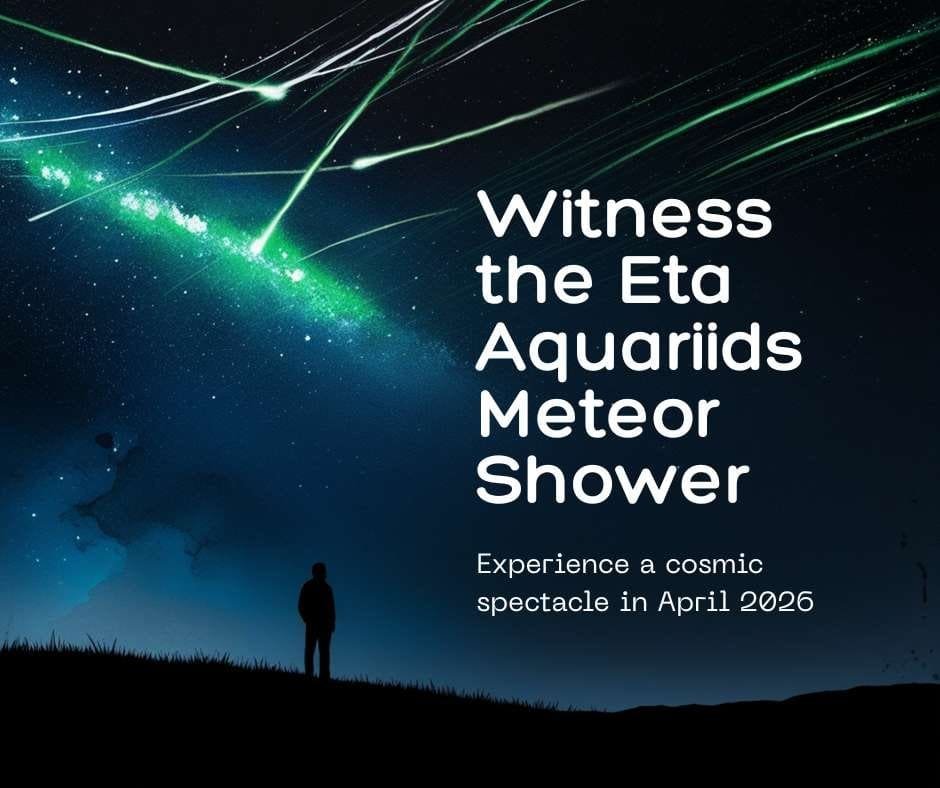
The Eta Aquariids is an annual meteor shower that peaks every year in early May, produced by Earth passing through debris left behind by Halley’s Comet. In 2026, the shower peaks before dawn on May 5–6, with up to 50 meteors per hour visible from the Southern Hemisphere and 10–30 per hour from the Northern Hemisphere. No telescope or special equipment is needed — just a dark sky and patience.
Key Takeaways
- Peak date: May 5–6, 2026, best viewed between 2:30 AM and dawn
- Source: Debris trail of Halley’s Comet (1P/Halley)
- Speed: 40.7 miles (65.4 km) per second — one of the fastest meteor showers of the year
- Hourly rates: Up to 50 per hour (Southern Hemisphere), 10–30 per hour (Northern Hemisphere)
- 2026 challenge: A waning gibbous moon will be in the pre-dawn sky, reducing visibility of faint meteors
What Causes the Eta Aquariids Meteor Shower?
The Eta Aquariids are caused by Earth passing through a trail of dust and debris shed by Halley’s Comet (officially known as 1P/Halley) over thousands of years. Each time Halley’s Comet swings close to the Sun, solar heat vaporizes part of its icy nucleus and releases tiny rock and dust particles into its orbital path. When Earth crosses that path every April and May, those particles slam into our atmosphere at high speed and burn up as bright streaks of light.
To understand why this happens every year, it helps to think of the comet’s debris trail as a permanent river of particles floating in space — one that Earth reliably intersects at the same point in its orbit. If you want a deeper look at how this process works for all meteor showers, Meteor Showers Explained: Why Meteors Happen breaks down the full science behind the phenomenon.
When Does the Eta Aquariids Peak in 2026?
The 2026 Eta Aquariids reach peak activity in the pre-dawn hours of May 5, with the American Meteor Society predicting a maximum around 3:51 UTC on May 5. For observers in North America, this translates to the early morning hours of May 5 — well before sunrise. The shower remains active from approximately April 19 through May 28, so the days immediately before and after the peak are also worth watching.
Unlike many meteor showers that have a sharp single peak, the Eta Aquariids have a broad, sustained maximum lasting roughly one week centered on May 5. This means you have several nights to catch a good show rather than missing it if clouds roll in on the exact peak night.
How Many Meteors Can You Expect to See?
Under ideal dark-sky conditions, Southern Hemisphere observers can see up to 50 meteors per hour at peak. Observers in the Northern Hemisphere typically see 10–30 per hour because the radiant point — the spot in the sky where meteors appear to originate — stays relatively low on the horizon. In 2026, a waning gibbous moon will brighten the pre-dawn sky at peak, which could cut visible rates down to around 10 per hour for northern observers as fainter meteors wash out.
The good news: Eta Aquariid meteors are known for leaving glowing “trains” — luminous trails of ionized gas that can persist in the sky for several seconds or even minutes after the meteor itself has vanished. Even in a bright sky, these lingering trails are hard to miss.

Why Are Eta Aquariid Meteors So Fast?
Eta Aquariid meteors enter Earth’s atmosphere at roughly 40.7 miles (65.4 km) per second — that’s about 146,000 miles per hour. This extreme speed comes from the geometry of the encounter: Earth and the debris trail are traveling toward each other in nearly opposite directions, so their velocities add together at impact. The faster a meteor enters the atmosphere, the more energy it releases, and the brighter and longer-lasting its trail tends to be.
This speed puts the Eta Aquariids among the fastest meteor showers of the year, alongside the Leonids in November. The difference is that the Eta Aquariids produce far more meteors per hour than the Leonids in most years, making them the better spectacle for casual stargazers.
Where Should You Look in the Sky?
The shower’s radiant — the point in the sky from which meteors appear to fan outward — lies near the star Eta Aquarii in the constellation Aquarius. The radiant rises after midnight and reaches its highest point just before dawn, which is why the pre-dawn window (roughly 2:30 AM to 4:30 AM local time) is consistently the best time to watch. However, you don’t need to stare directly at the radiant. Meteors can streak across any part of the sky, so your best strategy is to lie flat on your back, look straight up, and take in as much sky as possible.
For a step-by-step guide on setting up for any meteor shower — including what to bring, how to let your eyes dark-adapt, and where to set up your viewing area — see How to Watch the Next Meteor Shower: Peak Times, Best Direction, and a Simple Plan.
How Does the Moon Affect the 2026 Eta Aquariids?
In 2026, a waning gibbous moon is present in the pre-dawn sky during the shower’s peak. The moon rises after midnight and remains above the horizon through the prime viewing hours, flooding the sky with enough reflected light to wash out fainter meteors. The most practical workaround is to position yourself so that the moon is hidden behind a building, a tree line, or a hill — this keeps one section of the sky dark while still allowing you to see meteors across the rest of it.
Despite the moon, the shower is still worth watching. Bright Eta Aquariid meteors with persistent trains will cut through moonlit skies clearly, and the nights immediately before and after the peak (May 3–4 and May 7–8) may offer slightly better contrast depending on your local conditions.
Can You See Halley’s Comet Debris Twice in One Year?
Yes — and this is one of the most remarkable things about Halley’s Comet. Earth crosses the comet’s debris trail not once but twice every year, producing two completely separate meteor showers. The Eta Aquariids peak in early May, and the Orionids peak in late October (around October 21–22). Both showers originate from the same comet, but Earth hits different sections of the debris cloud each time.
What makes this even more striking is that Halley’s Comet itself won’t be visible from Earth again until 2061 — yet its remnants light up our sky twice a year, every year. The debris trail is so massive and so stable that it has been generating both showers for at least 2,000 years of recorded astronomical history. The meteoroids in the Eta Aquariids are also known to be in orbital resonance with Jupiter, meaning Jupiter’s gravity helps maintain the cloud’s structure and keeps it on a predictable path relative to Earth’s orbit.
What Is the Best Place to Watch the Eta Aquariids?
Location matters more than any other factor when watching a meteor shower. The Eta Aquariids favor the Southern Hemisphere because the radiant rises higher there, but observers anywhere on Earth can enjoy the show. The most important thing is light pollution: a truly dark rural site can easily triple the number of meteors you see compared to a suburban backyard. Leave city lights behind, drive at least 30–45 minutes from the nearest urban center, and give your eyes 20–30 minutes to fully dark-adapt after turning off all white lights.
Early May also brings mild weather across most of the Northern Hemisphere, so this is one of the more comfortable meteor shower nights of the year. Bring a reclining lawn chair or a sleeping bag to lie on, dress in layers, and avoid looking at your phone screen — even a few seconds of bright light will reset your night vision. For the full context of what else is happening in Earth orbit and beyond this month, check out What Is Happening in Space Right Now? April 2026 Update.
FAQs
When is the best time to watch the 2026 Eta Aquariids?
The best viewing window is between 2:30 AM and the start of astronomical twilight (around 4:30 AM) on the morning of May 5, 2026. This is when the radiant in Aquarius is highest in the sky and the moon has been in the sky long enough for your eyes to have adjusted around it. The nights of May 3–4 and May 6–7 are also productive.
Can I see the Eta Aquariids from the Northern Hemisphere?
Yes, but rates are lower than in the Southern Hemisphere. Northern observers typically see 10–30 meteors per hour under ideal conditions, compared to up to 50 per hour from southern latitudes. The shower is still one of the best of the year for northern skywatchers, especially because of the long, glowing trails that Eta Aquariid meteors leave behind.
Do I need a telescope to watch the Eta Aquariids?
No — a telescope is actually the wrong tool for watching meteor showers. Meteors cross the sky in a fraction of a second and can appear anywhere, so the best instrument is your naked eye. Find a dark location, lie back, and take in as much sky as possible. A telescope's narrow field of view means you will miss almost every meteor.
What constellation does the Eta Aquariids radiate from?
The shower radiates from the constellation Aquarius, specifically near the star Eta Aquarii — which is where the shower gets its name. Aquarius rises in the east after midnight and climbs higher as dawn approaches. You don't need to locate the constellation to enjoy the shower, but knowing where it is helps you understand the direction from which meteors originate.
Is the Eta Aquariids related to Halley's Comet?
Yes. The Eta Aquariids are caused entirely by debris shed by Halley's Comet over thousands of years. Halley's Comet has a 76-year orbit and was last visible to casual observers in 1986; it won't return until 2061. In the meantime, the debris it left behind produces both the Eta Aquariids every May and the Orionids every October, giving skywatchers two annual reminders of the comet's passage.