
Sixty-three seconds. That is how long Skylab’s protective shield survived after launch. At that point, aerodynamic forces ripped it off the station entirely — along with one of its two main solar arrays — and the United States’ first space station arrived in orbit badly damaged, baking in direct sunlight, with internal temperatures climbing toward 130°F (54°C). What happened next is one of NASA’s most underappreciated stories.
What Was Skylab?
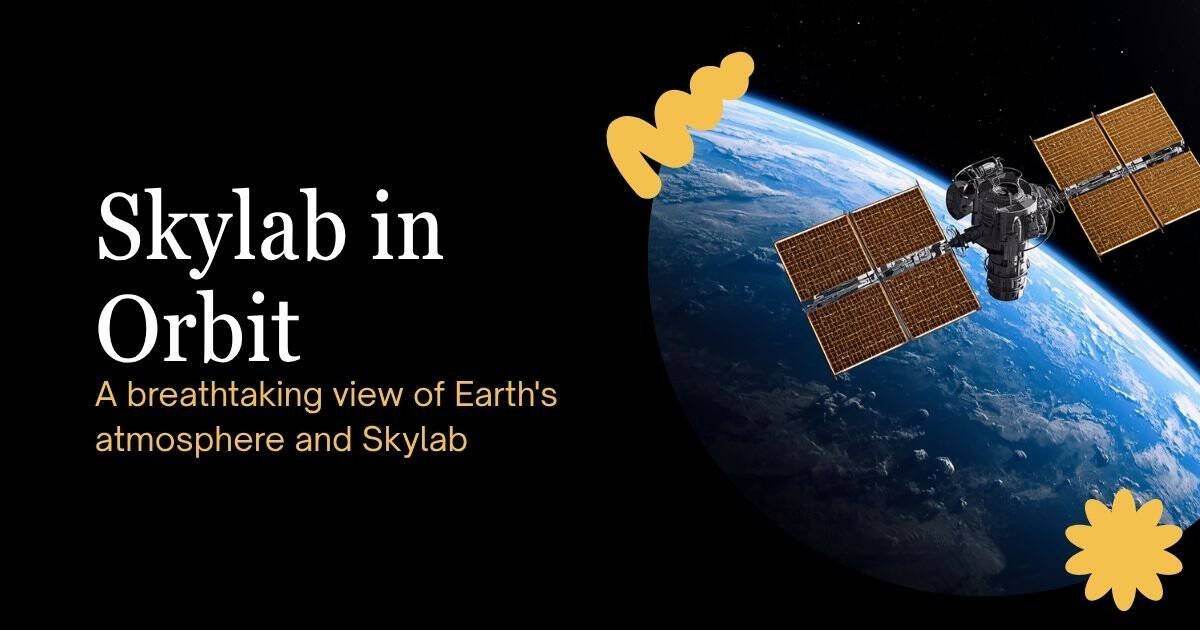
Skylab was the first American space station, launched on May 14, 1973 — 53 years ago today — aboard the final Saturn V rocket ever flown. It was not a capsule that returned to Earth after a few days. It was a structure designed to stay in orbit and host rotating crews for extended periods, a concept that was genuinely new for the United States at the time. The Soviet Union had launched its first experimental station, Salyut 1, two years earlier in 1971. Skylab was NASA’s answer: larger, more ambitious, and — for a few critical hours after launch — nearly a complete loss.
The station itself was built from the upper stage of a Saturn V rocket — an enormous cylinder nearly 36 meters long. That meant its interior was far larger than any single module on the International Space Station. Skylab’s pressurized volume was approximately 350 cubic meters. The largest module on the ISS, the Japanese Kibō laboratory, has 150 cubic meters. This is worth sitting with for a moment: America’s very first space station, built in the early 1970s, had more interior space than any individual piece of the station currently orbiting Earth. If that number seems wrong, it is not.
The Day Everything Went Wrong
The problem started almost immediately. About 63 seconds into the launch, a design flaw allowed air pressure to build beneath Skylab’s micrometeoroid shield — a panel designed to protect the station from debris and reflect solar heat. The aerodynamic forces tore it completely off the vehicle. One solar array panel went with it. A second panel was jammed in a partially deployed position, producing far less power than the station needed to operate.
With no thermal protection and one solar panel gone, Skylab was in serious trouble. Temperatures inside the station climbed above 130°F — and in some areas reached as high as 150°F (65°C). At those temperatures, film, food, and scientific equipment were at risk. Toxic off-gassing from overheated materials was a genuine concern. The planned first crew was grounded. NASA had ten days to figure out a fix before the situation became irreversible.
The Repair That Saved It
Jack Kinzler, Chief of the Technical Services Division at NASA’s Johnson Space Center, devised the solution: a foldable shade — he called it a “parasol” — made from nylon, Mylar, and aluminum poles, small enough to pass through a scientific airlock and deploy from the outside like an umbrella. Engineers built and tested it in ten days. The astronauts had never trained for this exact procedure. Some of the tools they used had not existed the week before.
The first crew — Skylab 2, launching on May 25, 1973 — deployed the parasol on their second day in orbit. It worked. Interior temperatures dropped to a livable range within hours. On June 7, astronauts Pete Conrad and Joe Kerwin conducted a spacewalk to free the jammed solar array. They succeeded. Skylab, which had seemed lost on launch day, was operational.
This was the first time in history that a crew had performed repairs of that scale and complexity on a damaged spacecraft in orbit. Every subsequent in-space repair mission — including the five servicing missions to the Hubble Space Telescope — exists in the tradition that Skylab 2 started. You can trace a direct line from Pete Conrad cutting that stuck solar panel free to the astronauts who saved Hubble in 1993. Most accounts of that lineage skip the beginning.
What Skylab Actually Accomplished
Three crews visited Skylab between May 1973 and February 1974, staying for 28 days, 59 days, and 84 days respectively — at the time, 84 days in orbit was a record for human spaceflight. At the time, 84 days in orbit was a record — it demonstrated that human beings could survive extended spaceflight without catastrophic physical deterioration, which was not something anyone had confirmed at that duration. Studies of the human body’s response to microgravity conducted on Skylab directly informed the medical protocols still used on the ISS today.
The science was substantial. The crews conducted roughly 300 experiments across medicine, materials science, Earth observation, and solar physics. They logged more than 2,000 hours of scientific work, took 127,000 photographs of the Sun, and returned 46,000 images of Earth’s surface. The Apollo Telescope Mount — a dedicated solar observatory built into the station — gave scientists their first prolonged, uninterrupted view of the Sun from orbit.
The Discovery Most Accounts Skip Over

Skylab’s solar observations confirmed the existence of coronal holes — regions on the Sun’s surface where the magnetic field opens outward into space rather than looping back, allowing streams of high-energy particles to escape at high velocity. These streams are now understood to be a primary driver of the solar wind that constantly flows past Earth. Before Skylab, coronal holes had been theorized but never clearly documented from orbit.
Think about what that actually means for a moment. Space weather — the kind that disrupts GPS signals, degrades satellite orbits, and in extreme cases can knock out power grids — is largely driven by these same particle streams. The forecasting models that protect infrastructure today are built on a foundation of solar physics that Skylab helped establish in 1973 and 1974. That is not a small footnote.
How Skylab Fell
Skylab was never supposed to fall to Earth the way it did. NASA had plans to boost it to a higher orbit using the Space Shuttle, then still under development. But solar activity in the late 1970s exceeded predictions. When the Sun is active, Earth’s upper atmosphere expands slightly — and that expansion increases aerodynamic drag on objects in low orbit. Skylab’s orbit decayed faster than engineers had calculated.
On July 11, 1979, Skylab reentered the atmosphere. Most of it burned up. Approximately 500 kilograms of debris survived, scattering across the Indian Ocean and the remote Australian outback near Esperance, Western Australia. No one was injured. The town of Esperance issued NASA a $400 fine for littering. NASA paid it in 2009, after a California radio station organized a public fundraiser to cover the cost.
Why It Still Matters in 2026

The ISS is scheduled to be deorbited around 2030. Commercial replacements — Axiom Space, Starlab, and others — are in various stages of development. For a sense of the larger structures that surround us, see what the cosmic web looks like beyond our solar system. The question of how humans live and work long-term in orbit, which Skylab was the first to seriously investigate, is more active right now than it has been in decades.
I have read through enough original Skylab documentation to know that most popular accounts undersell what was actually accomplished in those 24 weeks. The science was real. The repair was extraordinary. The 84-day mission proved something that no one had proven before. And the station itself — built from a rocket’s upper stage and deployed half-broken on its first day — was by some measures larger and more capable than anything that followed it for two decades.
Skylab did not survive long enough to become familiar. It never had the decades of continuous presence that made the ISS a household name. That may be why it tends to get treated as a historical footnote rather than the foundation it actually was. Fifty-three years later, it still deserves better than that.
FAQs
What happened to Skylab?
Skylab's orbit decayed faster than expected due to higher-than-predicted solar activity in the late 1970s. On July 11, 1979, it reentered Earth's atmosphere. Most of it burned up, but around 500 kg of debris fell over the Indian Ocean and remote parts of Western Australia. No one was injured.
Why did Skylab fall back to Earth?
When the Sun is more active, Earth's upper atmosphere expands slightly — increasing drag on objects in low orbit. Solar activity in the late 1970s was higher than NASA's models predicted, which caused Skylab's orbit to decay faster than planned. The Space Shuttle, which was supposed to boost it to a safer orbit, was not yet ready in time.
What did Skylab discover?
Skylab made major contributions to solar physics, including confirming the existence of coronal holes — regions of the Sun where magnetic field lines open outward and allow high-speed particle streams to escape. These streams drive much of what we now call space weather. The station also produced the first long-duration data on how the human body adapts to weightlessness.
How long did astronauts stay on Skylab?
Three crews visited Skylab between May 1973 and February 1974. They stayed for 28 days, 59 days, and 84 days respectively. The 84-day mission set a human spaceflight endurance record at the time and helped prove that extended stays in orbit were medically survivable.
Where did Skylab debris land?
When Skylab reentered the atmosphere on July 11, 1979, debris scattered across the Indian Ocean and remote areas of Western Australia near Esperance. The town of Esperance famously issued NASA a $400 fine for littering, which NASA paid in 2009 after a radio station ran a fundraiser to cover the cost.