

May 2026 is one of the most event-rich months in recent astronomy. From a nearby asteroid reaching peak brightness to a historic joint space mission launching toward Earth’s magnetic field, there is a lot happening in the sky and beyond right now.
What Are the Biggest Space Events Happening in May 2026?
In May 2026, the major space events include asteroid Vesta reaching opposition on May 2, the Eta Aquariids meteor shower peaking on May 5–6, NASA’s Psyche spacecraft completing a gravity assist at Mars, the ESA-CAS SMILE mission launching on May 19, and SpaceX Crew-13 targeting a September ISS departure. Several of these events are visible from Earth with minimal equipment.
Key Takeaways
- Asteroid Vesta is at its brightest all year on May 2 — visible with binoculars in the constellation Libra at magnitude +5.7.
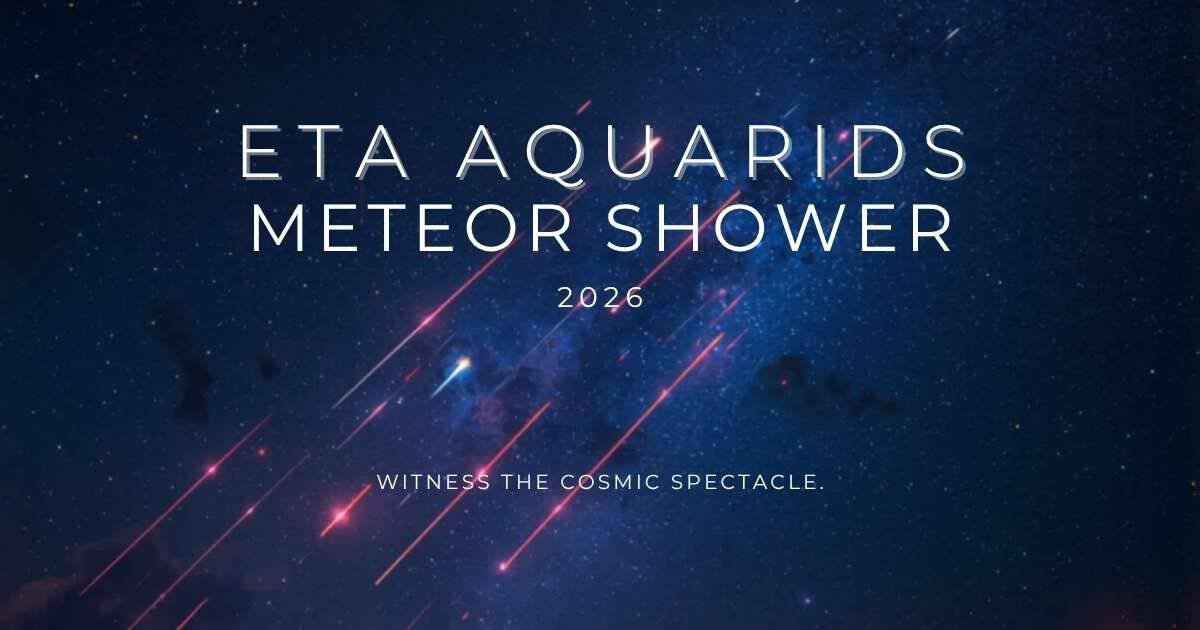
- The Eta Aquariids meteor shower, made of Halley’s Comet debris, peaks on the night of May 5–6 and can produce up to 50 meteors per hour.
- NASA’s Psyche spacecraft will fly within ~4,400 km of Mars this month, using the planet’s gravity to slingshot toward the metal-rich asteroid Psyche.
- The ESA-Chinese SMILE satellite launches May 19 to study how solar wind interacts with Earth’s magnetic field — using the first-ever X-ray camera aimed at our magnetosphere.
- May 31 will bring a rare Blue Moon — the second full moon of the month.
What Is Asteroid Vesta and Why Can You See It This Week?
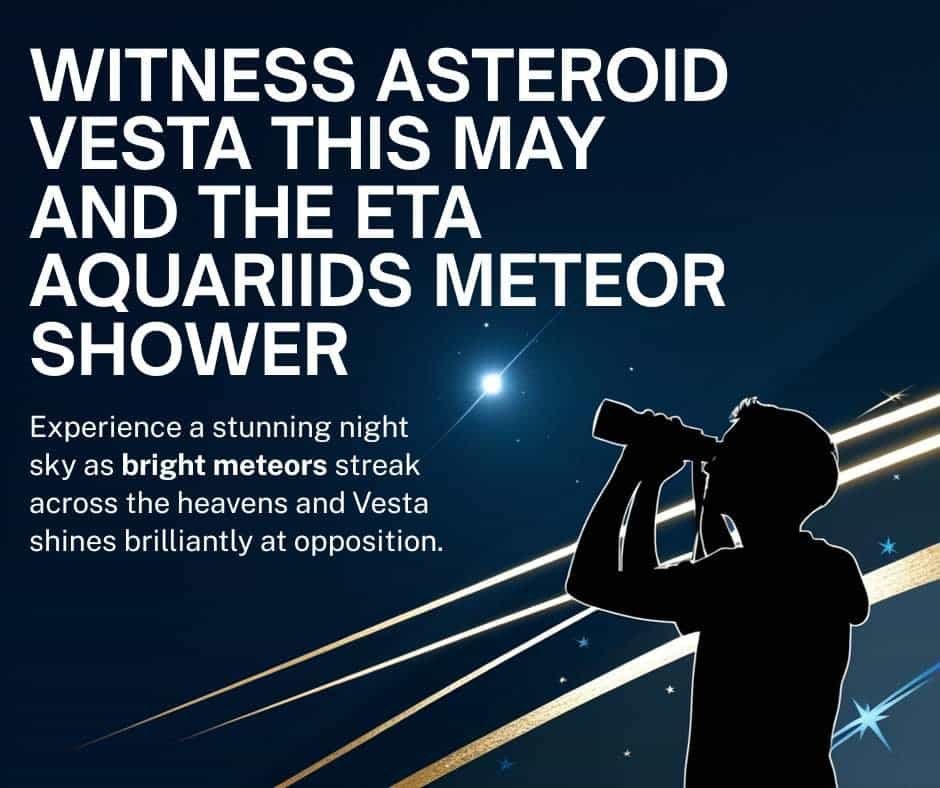
On May 2, 2026, asteroid Vesta reached opposition — the moment when Earth passes directly between Vesta and the Sun. At opposition, a solar system object is closest to Earth, fully illuminated, and at peak brightness. For Vesta, this happens roughly every 16 months.
Vesta is the second-largest object in the main asteroid belt between Mars and Jupiter, measuring about 525 kilometers (326 miles) across. Unlike most asteroids, Vesta is differentiated — it has a rocky crust, a mantle, and an iron core, making it more like a small planet than a rubble pile. NASA’s Dawn spacecraft orbited Vesta from 2011 to 2012 and revealed a surface scarred by ancient impacts, including a giant crater named Rheasilvia near its south pole.
At opposition this week, Vesta shines at magnitude +5.7 in the constellation Libra. It sits roughly 10 degrees above and to the right of Zubeneschamali, the brightest star in Libra. That is faint enough to be invisible to most urban skies, but easily spotted with binoculars or a small telescope. Vesta will not reach opposition again until October 13, 2026, so this week is the best window of the year.
When Does the Eta Aquariids Meteor Shower Peak in 2026?
The Eta Aquariids peak on the night of May 5 into the early hours of May 6. This shower is caused by Earth passing through the trail of debris left by Halley’s Comet — tiny particles, mostly no larger than a grain of sand, that burn up in our atmosphere at speeds of around 66 km/s (148,000 mph). The result: fast, bright streaks across the sky, often leaving glowing trails.
At its best, the Eta Aquariids can produce up to 50 meteors per hour under dark skies. The shower is active from April 19 through May 28, so there are still opportunities to watch even if you miss the peak. For the best view, look southeast toward the constellation Aquarius after midnight. Some moonlight will interfere this year, but the shower is bright enough that you will still catch plenty of meteors. For a full guide on what to expect, read our detailed post on the Eta Aquariids meteor shower and its 2026 peak.
What Is NASA’s Psyche Spacecraft Doing at Mars Right Now?
NASA’s Psyche spacecraft, launched in October 2023, is making a gravity assist flyby of Mars this month. The probe will pass within approximately 4,400 kilometers (2,700 miles) of the Martian surface — close enough to let Mars’s gravity bend its trajectory and boost its speed, but far enough to remain safe. During the flyby, the spacecraft will be traveling at roughly 21,000 km/h (13,000 mph) relative to Mars.
A gravity assist — sometimes called a gravitational slingshot — is a technique where a spacecraft uses a planet’s orbital motion and gravity to change speed and direction without burning extra fuel. It is the same principle used by the Voyager probes, Cassini, and New Horizons. For Psyche, the Mars flyby will redirect it outward to the main asteroid belt. After a six-year journey covering roughly 3.6 billion kilometers, Psyche will begin orbiting the metal-rich asteroid 16 Psyche in August 2029.
Asteroid 16 Psyche is unusual: scientists believe it may be the exposed iron-nickel core of an ancient planetesimal — a building block of the early solar system that was stripped of its outer layers by ancient collisions. Understanding Psyche could reveal what Earth’s own core looks like, since we have no way to drill that deep ourselves.
What Is the SMILE Mission and Why Does It Matter?

On May 19, 2026, the European Space Agency (ESA) and the Chinese Academy of Sciences (CAS) will jointly launch SMILE — the Solar wind Magnetosphere Ionosphere Link Explorer — aboard a European Vega-C rocket. The mission marks one of the most significant ESA–China science collaborations to date.
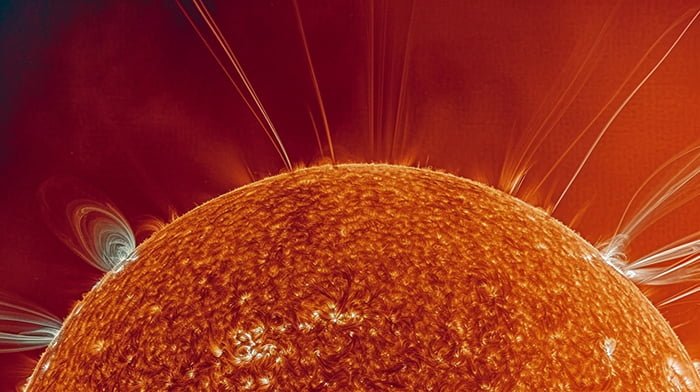
SMILE will carry four science instruments to study how Earth responds to the solar wind — the continuous stream of charged particles flowing outward from the Sun. When the solar wind strikes Earth’s magnetic field (the magnetosphere), it compresses and distorts it, sometimes sending energy surging into the upper atmosphere. This triggers geomagnetic storms, disrupts satellite communications, and produces the aurora borealis. Despite decades of research, scientists still do not fully understand how these interactions unfold in real time.
What makes SMILE unprecedented is its soft X-ray imager (SXI), provided by ESA. For the first time ever, astronomers will be able to photograph Earth’s magnetic shield from space in X-rays. Alongside this, SMILE carries an ultraviolet imager that will watch the northern lights continuously for up to 45 hours at a stretch — far longer than any previous auroral observation campaign. The mission is expected to transform space weather forecasting and deepen our understanding of how all magnetized planets defend themselves from stellar radiation.
What Is Happening at the International Space Station in May 2026?
NASA has announced significant changes to the ISS crew rotation schedule. On May 1, the agency revealed that SpaceX Crew-13 is now targeting launch in mid-September 2026, moved up from a previous November target. The crew will include Commander Jessica Watkins, Pilot Luke Delaney, CSA astronaut Joshua Kutryk, and Roscosmos cosmonaut Sergey Teteryatnikov. Once aboard, they will join Expedition 75 and continue scientific research to support long-duration human spaceflight to the Moon and Mars.
Also this month, SpaceX’s Commercial Resupply Services-34 (CRS-34) mission is targeting a May 12 launch from Cape Canaveral, carrying over 6,400 pounds of cargo and experiments to the station. It is the latest in a long line of routine resupply runs that keep the ISS operational — and a reminder that low Earth orbit is now as close to routine as spaceflight has ever been. For a broader look at what crews are accomplishing up there, check out our deep dive on the April 2026 space update.
What Else Can You See in the Night Sky This Month?
Venus and Jupiter are both prominent in the evening sky after sunset throughout May. Jupiter will host a double transit of moons Europa and Ganymede — visible through a mid-sized telescope — making it particularly rewarding to observe this month. For a detailed guide on the best viewing windows, see our post on the best time to see Jupiter or Saturn this month.
In the morning sky, Saturn and Mars are rising in the predawn hours in the east. Saturn is the easier target — its rings are currently tilted at a favorable angle for telescopes. The month closes with a rare Blue Moon on May 31, the second full moon in a single calendar month. Blue moons occur roughly once every 2.5 years and are a good excuse to look up even if you do not own a telescope.
I make a point of checking the sky at least once a week, and May almost always delivers. The combination of a meteor shower, a bright asteroid at opposition, and two full moons in one month makes this one of the more rewarding months for casual stargazers. You do not need a telescope to enjoy most of it — a clear sky and a willingness to step outside after dark is enough to start.
FAQs
What space events are happening in May 2026?
Major events in May 2026 include asteroid Vesta at opposition on May 2, the Eta Aquariids meteor shower peaking May 5–6, the ESA-CAS SMILE satellite launching on May 19, and a Blue Moon on May 31. NASA's Psyche spacecraft is also completing a gravity assist flyby of Mars this month.
What is the best meteor shower in May 2026?
The Eta Aquariids is the best meteor shower in May 2026, peaking on the night of May 5 into the morning of May 6. At its peak, it can produce up to 50 meteors per hour. The shower originates from debris left by Halley's Comet.
Can you see asteroid Vesta without a telescope in May 2026?
Vesta reaches magnitude +5.7 at opposition on May 2, which is at the very edge of naked-eye visibility under ideal dark-sky conditions. In most locations, binoculars or a small telescope are needed to spot it clearly in the constellation Libra.
What is the ESA SMILE mission?
SMILE stands for Solar wind Magnetosphere Ionosphere Link Explorer. It is a joint mission between ESA and the Chinese Academy of Sciences, launching May 19, 2026. Its goal is to study how solar wind interacts with Earth's magnetic field, using the first-ever X-ray camera pointed at Earth's magnetosphere.
What is a gravity assist and what is Psyche doing at Mars?
A gravity assist is a technique where a spacecraft uses a planet's gravity to change its speed and direction without burning fuel. In May 2026, NASA's Psyche spacecraft will fly within about 4,400 km of Mars, using the planet's gravity to redirect it toward the asteroid belt, where it will orbit the metal-rich asteroid 16 Psyche starting in 2029.