
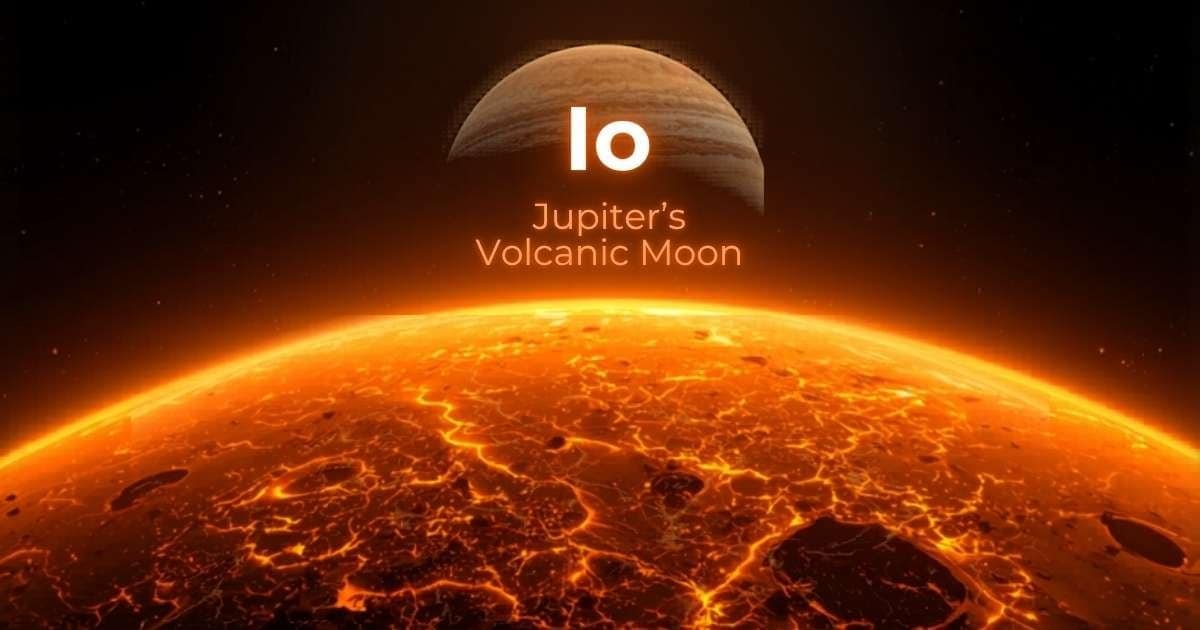
Io is Jupiter’s innermost large moon and the most volcanically active world in the entire solar system. With over 400 active volcanoes, erupting lava fountains that can reach 500 kilometers (310 miles) into space, and a surface constantly reshaped by molten rock, Io makes Earth’s volcanoes look tame by comparison. A new 2026 study using NASA’s Juno spacecraft now suggests we’ve been massively underestimating just how much heat Io actually pumps out — possibly by a factor of ten or more.
Key Takeaways
- Io has 400+ active volcanoes — more than any other body in the solar system
- It is slightly larger than Earth’s Moon and orbits Jupiter at about 422,000 km
- The volcanic heat comes from tidal friction, not from radioactivity
- Tidal forces on Io are roughly 20,000 times stronger than the Moon’s pull on Earth
- A May 2026 paper found we may have underestimated Io’s heat output by an entire order of magnitude (10x or more)
- NASA’s Juno spacecraft continues to fly past Io, delivering new data on each pass
What Is Io?
Io (pronounced “EYE-oh”) is one of Jupiter’s four large Galilean moons, first spotted by Galileo Galilei in January 1610. It orbits Jupiter at a distance of about 422,000 kilometers (262,000 miles) — closer than our Moon is to Earth — completing one full orbit every 1.77 days.
In size, Io is nearly identical to Earth’s Moon: its diameter is about 3,643 km (2,263 miles), roughly one-quarter the width of Earth. But despite its modest size, Io is the fourth-largest moon in the solar system and has the highest surface gravity and density of any natural satellite. Its surface is painted in vivid yellows, reds, blacks, and whites — the result of sulfur and sulfur dioxide constantly being sprayed and redeposited by erupting volcanoes.
When Voyager 1 flew past in 1979, scientists were astonished to find active volcanic plumes rising hundreds of kilometers above the surface. Before that flyby, most astronomers expected Io to look like a dead, cratered rock. Instead, they found the most geologically violent place humanity has ever observed.
What Makes Io So Volcanic? Tidal Heating Explained
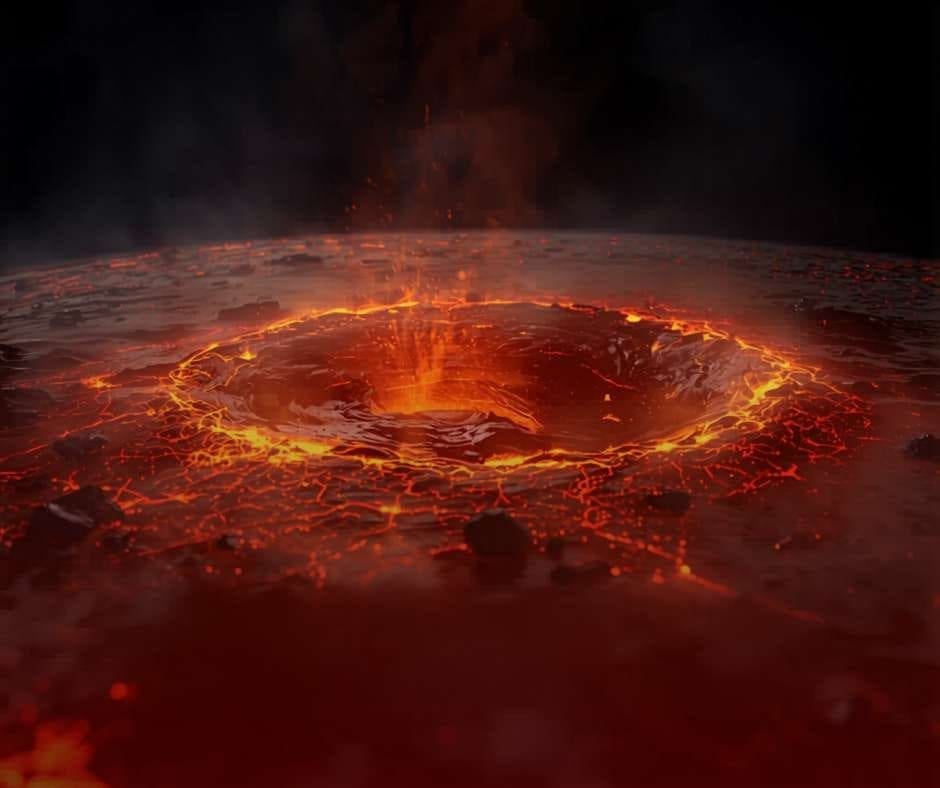
Io’s extraordinary volcanism doesn’t come from radioactive decay in its core — the mechanism that drives most geological activity on Earth. Instead, it comes from something called tidal heating, and it’s powered by Jupiter itself.
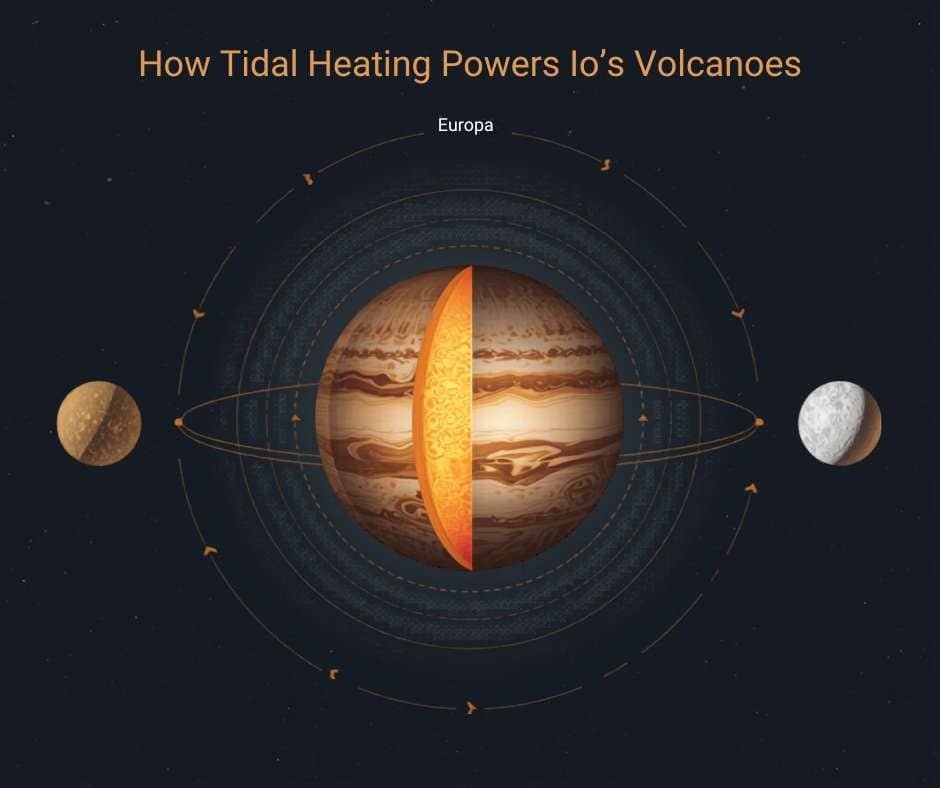
Io is caught in a gravitational tug-of-war between three massive forces: Jupiter’s enormous gravity pulling it inward, and the regularly timed pulls of two neighboring moons — Europa and Ganymede — pulling it outward. Because these three bodies are locked in a precise orbital rhythm called the Laplace resonance (for every one orbit of Ganymede, Europa completes two, and Io completes four), Io’s orbit is kept slightly elliptical rather than perfectly circular.
That elliptical orbit means the distance between Io and Jupiter constantly changes. As the distance changes, Jupiter’s gravitational pull on Io’s near side vs. its far side changes too. This alternating squeeze and release flexes Io’s rocky interior continuously, generating frictional heat — the same way a metal wire heats up when you bend it back and forth rapidly.
The scale of this tidal squeezing is almost incomprehensible. The tidal forces on Io are roughly 20,000 times stronger than the tidal forces our Moon exerts on Earth. Io’s surface itself rises and falls by up to 100 meters (330 feet) with each orbit — imagine the entire ground under your feet heaving up and down the height of a 30-story building, every 42 hours, forever.
How Hot and Violent Are Io’s Volcanoes?
Io’s volcanic features — called paterae (singular: patera) — are essentially enormous lava lakes, some stretching hundreds of kilometers across. Scientists have mapped 266 active volcanic hotspots across the moon’s surface. Lava temperatures can reach above 1,600°C (2,900°F), comparable to some of the hottest eruptions ever recorded on Earth.
The volcanic plumes are among the most striking features. The largest on record rose 500 km (310 miles) above the surface — more than 40 times the altitude of the International Space Station. When these plumes fall back down, they coat the terrain in sulfur compounds, giving Io its distinctive pizza-like coloring.
In December 2024, NASA’s Juno spacecraft captured the most powerful volcanic eruption ever observed on Io: a hotspot near the south pole larger than Earth’s Lake Superior, releasing energy roughly six times the output of all the world’s power plants combined.
What Juno Just Revealed: We’ve Been Getting Io’s Heat Wrong
A paper published in May 2026, using data from Juno’s JIRAM instrument (Jupiter InfraRed Auroral Mapper), suggests our estimates of Io’s total heat output have been significantly off — possibly by an entire order of magnitude.
The reason is subtle but important. Previous measurements focused on the M-band infrared wavelength, which captures the blazing-hot peripheral edges of Io’s lava lakes (up to 900 K). But that same wavelength is essentially blind to the cooler central crust of each patera — the solidified lava “lid” that forms over the molten interior. While the central crust is cooler (around 220–230 K), it is enormously larger in area. Total thermal output is temperature multiplied by area — and the massive cool crust wins that calculation easily.
As the researchers put it, estimating Io’s heat from M-band data alone is like “estimating the brightness of a bonfire by observing only the flames and not the surrounding embers.” When they applied the corrected analysis to one well-studied patera called P63, the heat estimate jumped from 7 gigawatts to 80 gigawatts — more than a tenfold increase. Extrapolated across all of Io’s paterae, the moon may be releasing far more energy than any previous model suggested.
This finding also reshapes what we think Io looks like underground. Rather than a global magma ocean beneath the surface, the data suggests heat is concentrated: roughly half of all detected heat comes from just 17 of Io’s 266 known hotspots. That pattern fits better with individual magma chambers under separate volcanoes, much like what we have on Earth.
For more on how scientists model the interior of rocky planets and moons, our piece on what the two main elements in stars tell us about planetary formation explains how composition shapes geology from the inside out.
Could Io Support Any Form of Life?
Almost certainly not. Io has the lowest water content of any known astronomical body — essentially zero. Its surface is a toxic landscape of sulfur compounds, and it sits within Jupiter’s intense radiation belt, which bombards it with high-energy particles continuously.
However, Io’s existence teaches us something important about habitability elsewhere. The same tidal heating mechanism that makes Io a hellscape may make Europa — the next moon outward — potentially habitable. Europa experiences gentler tidal heating, enough to maintain a liquid ocean beneath its icy crust without vaporizing it. Life in the outer solar system, if it exists at all, may owe its home to exactly the kind of orbital dynamics that Io demonstrates so vividly.
How Can You See Io From Earth?
With binoculars or a small telescope, you can see Jupiter’s four Galilean moons as tiny points of light arranged in a rough line beside the planet. Io — as the innermost of the four — is typically the one closest to Jupiter. Over consecutive nights, you can watch them shift position as each orbits at a different speed. Io completes its orbit in just 1.77 days, so its position changes noticeably even within a single night of viewing.
You won’t see the volcanoes themselves — that requires a spacecraft orbiting the Jovian system. But knowing that one of those pinpoints of light is continuously erupting, constantly remaking its own surface, and now apparently releasing ten times more heat than our best models predicted makes those binocular nights feel a little different.
For current space news including upcoming Jupiter system missions, see our May 2026 space news roundup.
A Note on What We’re Still Getting Wrong
What’s striking about the 2026 Juno findings isn’t just the number — it’s the lesson. Io has been observed closely since 1979. Hundreds of scientists have studied it. And we were still significantly wrong about something as fundamental as how much heat it produces. The error wasn’t from a lack of data; it was from a limitation in how that data was interpreted — a blind spot built into the measurement method.
That pattern shows up throughout planetary science: Pluto surprised everyone in 2015. Mars keeps hiding water in unexpected forms. Io, apparently, is still hiding energy. The solar system remains genuinely mysterious, even in the places we thought we understood.
FAQs
Why is Io the most volcanic moon in the solar system?
Io is the most volcanic world in the solar system because of tidal heating: it is caught in a gravitational tug-of-war between Jupiter and the moons Europa and Ganymede. The constant flexing of Io's rocky interior generates enormous frictional heat, which escapes as volcanic eruptions across 400+ active volcanoes on the surface.
How many volcanoes does Io have?
Io has over 400 active volcanoes, with scientists mapping 266 confirmed volcanic hotspots. The volcanic depressions, called paterae, are essentially giant lava lakes. A May 2026 study found that just 17 of those 266 hotspots account for roughly half of all the heat Io releases.
What causes the volcanoes on Io?
Io's volcanoes are caused by tidal heating, not radioactive decay. Jupiter's enormous gravity and the orbital pull of Europa and Ganymede squeeze and flex Io's interior continuously, generating friction and heat. This process is about 20,000 times stronger than the tidal forces Earth's Moon exerts on Earth.
How far is Io from Jupiter?
Io orbits Jupiter at an average distance of about 422,000 kilometers (262,000 miles), completing one full orbit every 1.77 days. This is actually closer to Jupiter than our Moon is to Earth (the Moon orbits at about 384,000 km).
Has any spacecraft visited Io?
Yes. Voyager 1 first revealed Io's active volcanoes during a 1979 flyby. NASA's Galileo spacecraft studied Io in the 1990s and early 2000s. Currently, NASA's Juno mission has made multiple close flybys of Io, most recently capturing the most powerful eruption ever observed there in December 2024 and providing new thermal data published in 2026.