
The rings are younger than the dinosaurs. Not Saturn — Saturn is 4.5 billion years old, roughly as old as the Sun. But the rings themselves, the ones you see in every astronomy textbook and telescope ad, are almost certainly less than 100 million years old. Possibly as young as 10 million. When Tyrannosaurus rex was still walking the Earth, Saturn may have had no rings at all.
That number still does not feel real to me every time I revisit it.
So How Many Rings Does Saturn Have?

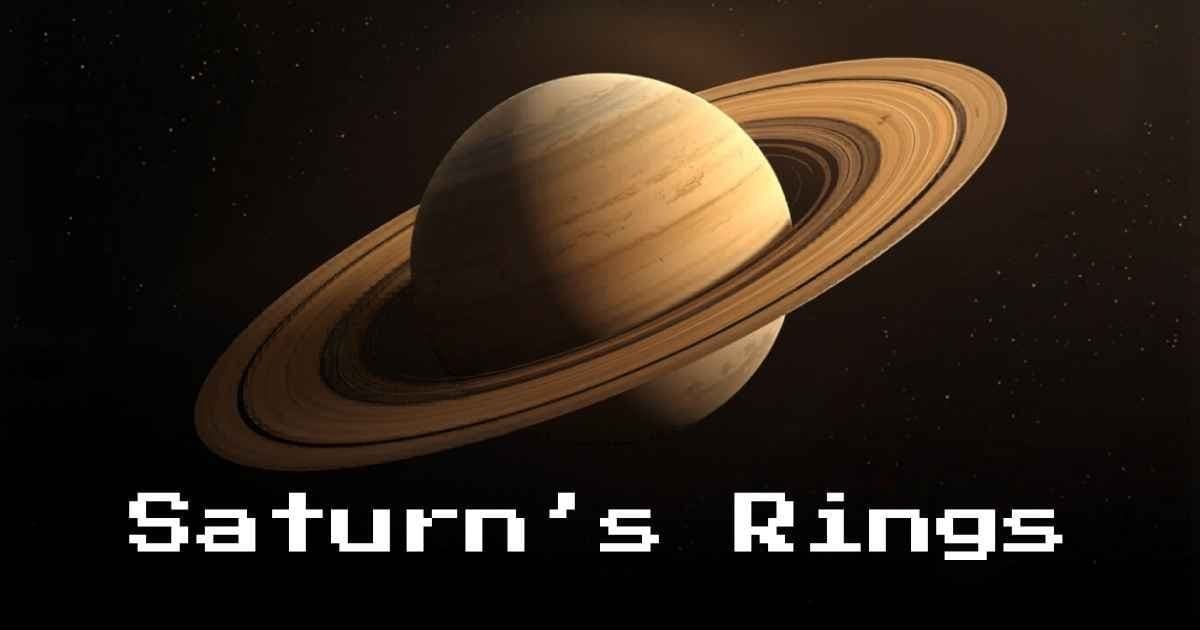
The short answer: 7 main named rings, labeled D, C, B, A, F, G, and E — named in the order they were discovered, not in order from the planet outward. Starting at Saturn and moving away, you encounter them in this sequence: D, C, B, then a significant gap called the Cassini Division, then A, F, G, and finally E.
The longer answer is that the number depends entirely on what you call a “ring.” With the naked eye, you can see one bright disk. Through a modest backyard telescope, you can distinguish three. With a larger instrument, eight. The Cassini spacecraft, which orbited Saturn from 2004 to 2017, showed that the main rings are themselves composed of thousands of narrower ringlets — individual bands of material, each orbiting at its own speed. When you account for all of those divisions and sub-rings, the count climbs past 30, and that is before you include some of the faint, diffuse structures barely detectable at all.
Most sources describe this as “7 rings.” That is not wrong, but it leaves out something important: the 7 labels are organizational categories, not discrete objects. What we call the B ring alone contains hundreds of individual ringlets packed tightly together.
The Rings Up Close: What They Actually Are
The main rings — B, A, and C — are the ones visible in most photographs. The B ring is the brightest and widest. The A ring contains the Encke Gap and, at its outer edge, the narrow F ring shaped and confined by two small shepherd moons, Prometheus and Pandora. The C ring is fainter and more transparent; looking through it at the planet beneath, you can see Saturn’s atmosphere directly.
Between rings A and B sits the Cassini Division — a gap 2,920 miles (4,700 km) wide. That is roughly the distance from New York to Los Angeles and back. It looks empty from Earth. Up close, Cassini showed it contains faint, sparse material rather than nothing at all.
The outer rings — F, G, and E — are thin and diffuse. The E ring is enormous in extent but nearly invisible; it is continuously replenished by ice particles erupting from the south pole of Saturn’s moon Enceladus. Far beyond all of them, in the orbit of the moon Phoebe, lies the Phoebe ring — discovered in 2009, so large it would span two full Moons side by side in the sky if it were visible to the human eye, yet so faint it was only detected by an infrared telescope.
What the Rings Are Made Of
Mostly ice. The main rings are approximately 95% water ice, with the rest being rocky debris and dust — according to NASA’s Cassini mission findings. The individual particles range from grains smaller than a grain of sand to chunks the size of a house, with a few as large as mountains. Each piece orbits Saturn independently, at slightly different speeds depending on its distance from the planet. The whole system is not a solid disk. It is a crowd of individual objects all moving in the same direction, so densely packed that from a distance it looks continuous.
Here is the part that takes a moment to absorb. The entire ring system stretches 175,000 miles (282,000 km) from Saturn — roughly three-quarters of the distance from Earth to the Moon. Yet its average vertical thickness is about 30 feet (10 meters). Not 30 kilometers. Not 30 miles. Thirty feet. Imagine a sheet of paper scaled up to the size of a football field. That is roughly the proportional relationship between the rings’ width and their depth.
Think about what that actually means for a moment. Something spanning hundreds of thousands of miles is thinner than a two-story building is tall.
Why They Seemed to Disappear in 2025
Saturn’s axis is tilted about 27 degrees relative to its orbit — similar to Earth’s tilt. As Saturn moves around the Sun over its 29-year orbital period, our viewing angle on the rings changes. Twice per orbit, the rings align nearly edge-on to Earth’s line of sight. When that happens, those 30-foot-thin rings become effectively invisible. They do not disappear — they just become geometrically impossible to see from our angle.
On March 23, 2025, Saturn crossed that alignment point. Observers watching through telescopes saw the rings narrow to a thin line, then vanish almost entirely. This happens roughly every 13 to 15 years and will not occur again until October 2038. By October 2026 — when Saturn reaches opposition, its closest and brightest point of the year — the rings will be tilted about 7.5 degrees toward Earth, just starting to re-emerge. They will be visible through a telescope of 60mm aperture or larger, though they will look nothing like the wide-open views common between 2015 and 2023. The best years for ring viewing return gradually through 2032.
Where the Rings Came From: A Lost Moon Named Chrysalis

This is the part most articles skip over.
For a long time, astronomers assumed Saturn’s rings were ancient — relics of the solar system’s formation 4.5 billion years ago. Then Cassini’s data, analyzed after the mission ended in 2017, suggested something stranger: the rings are surprisingly pure. Almost no rocky contamination. If they had been collecting dust and debris for billions of years, they would be far dirtier. The current best estimate puts their age at between 10 million and 100 million years, meaning they formed long after the solar system was already well-established.
In May 2026, research presented at a planetary science conference updated an earlier theory from 2022: the rings most likely formed from the tidal destruction of a moon called Chrysalis. Chrysalis is estimated to have been roughly the size of Saturn’s moon Iapetus — about 1,469 km (913 miles) in diameter, a world in its own right. According to computer simulations, Chrysalis was a differentiated moon with an icy mantle over a rocky core. At some point, it drifted inside Saturn’s Roche limit — the distance at which Saturn’s tidal gravity overcomes the internal gravity holding a moon together. The planet tore the ice away and left the rock. The icy debris became the rings. The rocky remnant, simulations suggest, may have played a role in tilting Saturn’s axis to its current angle.
There is no observation that proves this conclusively. But the model fits the data in a way few alternatives do.
Saturn Is Not the Only Ringed Planet — But It Is the Most Extreme
Jupiter, Uranus, and Neptune all have ring systems. Jupiter’s rings were discovered by Voyager 1 in 1979. Uranus has 13 known rings. Neptune has 5. All of them are faint, narrow, and composed largely of darker material — nothing like Saturn’s bright, reflective ice rings, which are among the most reflective surfaces in the solar system and visible through a small telescope from Earth, 1.4 billion kilometers away.
What makes Saturn’s rings unusual is not just their scale but their composition and youth. The other ring systems are older, darker, and thinner in a different sense — they have far less total material. Saturn’s rings contain enough ice to form a moon approximately 400 km in diameter, according to estimates from Cassini data. The rings are not a small accessory. They are a major feature of the outer solar system.
What You Can Actually See Tonight
Saturn is currently in the morning sky, rising before dawn. It will not reach opposition — its best viewing position — until October 4, 2026. At that point, even a small telescope with a magnification of 25× or more will show you the ring system clearly, slightly angled at 7.5 degrees. You will not see the wide-open “textbook” view yet — that takes more years of the tilt increasing — but you will see them. A distinct oval around the planet. That is the thing itself: hundreds of thousands of miles of orbiting ice, compressed into a visual line, 1.4 billion kilometers from where you are standing.
The rings exist right now. They are there in the sky. Formed from a dead moon, slowly losing mass — NASA estimates the rings are currently draining into Saturn’s atmosphere at a rate of several tons per second — and probably will not exist in their current form hundreds of millions of years from now. We happen to be here at exactly the right time to see them. That does not feel like nothing.
FAQs
How many rings does Saturn have?
Saturn has 7 main named rings: D, C, B, A, F, G, and E — labeled in the order they were discovered. The main rings visible through a telescope are B, A, and C. With spacecraft instruments, the system resolves into thousands of individual ringlets. The total number depends on how you count.
What are Saturn's rings made of?
The rings are approximately 95% water ice, with small amounts of rocky debris and dust. Individual particles range from the size of a sand grain to the size of a house, with a few as large as mountains. They are not a solid disk — each particle orbits independently.
Is Saturn the only planet with rings?
No. Jupiter, Uranus, and Neptune all have ring systems, but they are faint, narrow, and composed of darker material. Saturn's rings are by far the largest and most reflective — bright enough to see with a small backyard telescope from 1.4 billion kilometers away.
Why did Saturn's rings disappear in 2025?
They did not actually disappear — they appeared to. Saturn's rings are only about 30 feet thick, so when the planet's orbit brought them edge-on to our line of sight on March 23, 2025, they became geometrically invisible. This happens roughly every 13-15 years. The rings are returning to view and will be visible again by October 2026.
How old are Saturn's rings?
Far younger than most people assume. Data from NASA's Cassini mission suggests the rings formed between 10 million and 100 million years ago — not at the dawn of the solar system. The leading theory is that they formed from the tidal destruction of an ancient moon called Chrysalis, which Saturn's gravity tore apart.