

4.24 light-years. That is the distance to the closest known exoplanet. It sounds, honestly, like it should be manageable — a number small enough to write down. Then you do the math. Traveling at the speed of NASA’s Voyager 1 spacecraft, it would take roughly 73,000 years to get there. That number still does not feel real to me, and I have spent years writing about this subject.
The Closest Exoplanet to Earth, Explained
The closest exoplanet to Earth is Proxima Centauri b, a planet orbiting the red dwarf star Proxima Centauri at a distance of 4.24 light-years. It was confirmed in August 2016 by the European Southern Observatory using years of Doppler spectroscopy measurements — a technique that detects the tiny gravitational wobble a planet causes in its host star. Its minimum mass is 1.06 times that of Earth, and it sits within its star’s habitable zone, the range of distances where liquid water could theoretically pool on a surface.
That last detail gets repeated constantly. What gets mentioned less often is how complicated “habitable zone” actually is when your star behaves the way Proxima Centauri does.
Where Exactly Is It?
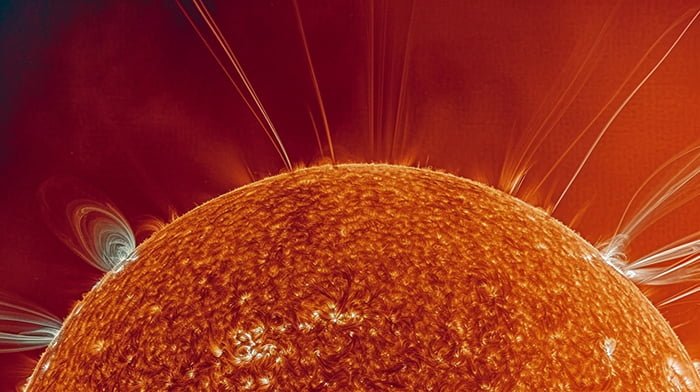
Proxima Centauri is part of the Alpha Centauri system — a triple-star system and our nearest stellar neighborhood. The two larger stars, Alpha Centauri A and B, orbit each other at roughly the distance between our Sun and Uranus. Proxima Centauri is the smallest of the three: a red dwarf about one-seventh the diameter of the Sun, orbiting far out from the pair.
Proxima Centauri b orbits this faint star at a distance of only 0.048 AU — more than 20 times closer to its star than Earth is to the Sun. Because Proxima Centauri is so cool and dim, this tight orbit still places the planet squarely within the habitable zone. One full orbit takes just 11.2 Earth days. A “year” on Proxima b lasts less than two weeks of our time.
What Is Proxima Centauri b Actually Like?

Probably not like anything you would want to visit.
The planet is almost certainly tidally locked — meaning the same side permanently faces its star, baking in unending daylight, while the opposite side sits in permanent frozen darkness. There is no sunrise. No seasons. The terminator line between the two hemispheres — if the planet has an atmosphere thick enough to circulate heat — might be the most temperate region. Whether anything could be stable there is genuinely unknown.
Surface gravity would feel only marginally stronger than Earth’s. The mass difference is small enough you would barely notice. But the light would be entirely wrong. Proxima Centauri radiates primarily in the infrared and near-infrared spectrum. To human eyes, the star would appear as a dim, dark-reddish smudge — and what passed for “midday” there would feel dimmer than a heavily overcast afternoon here.
The planet receives roughly 70% of the infrared energy that Earth gets from the Sun — sitting right inside the energy sweet spot on paper. But energy balance is only part of the habitability equation. The violent part comes next.
The Problem: Its Star Is Actively Eroding the Atmosphere
Red dwarf stars are small. They are also, temperamentally, catastrophic neighbors.
Proxima Centauri produces stellar flares — sudden, enormous bursts of radiation and charged particles — far more frequently and violently than our own Sun. In 2025, researchers using the Atacama Large Millimeter/submillimeter Array (ALMA) detected 463 separate flare events in just 50 hours of observation. Some flares lasted three seconds. Others lingered far longer, bathing any nearby planet in sustained ultraviolet and X-ray radiation long after the initial burst.
NASA modeling puts the atmospheric damage in stark terms: an Earth-like atmosphere around Proxima b would be eroded at roughly 10,000 times the rate that solar wind strips Earth’s atmosphere. Over geological timescales, that is effectively a death sentence for anything breathable. Oxygen, nitrogen, water vapor — all vulnerable. Without a strong planetary magnetic field (which we have no way to measure from here), the atmosphere would be slowly, relentlessly stripped away.
Most articles describe Proxima b as “potentially habitable.” That is not wrong. But it leaves out something important: “potentially habitable” refers to the planet’s orbital position, not its actual conditions. It means the geometry is right for liquid water. It says nothing about whether a star that produces hundreds of superflares per day has left any water — or atmosphere — to work with.
Could We Ever Reach It?

With current technology, no. Not in any timeframe a human civilization could plan around.
Voyager 1, launched in 1977 and now the most distant human-made object in existence, travels at roughly 17 km per second. At that speed, the journey to Proxima Centauri would take approximately 73,000 years. The Parker Solar Probe — the fastest spacecraft ever built — briefly reaches speeds of around 690,000 km/h at its closest solar approach. Even that would require roughly 6,000 to 7,000 years for the same trip.
The most credible proposal on the table is Breakthrough Starshot: an initiative that would send gram-scale, laser-powered probes — called StarChips — to Alpha Centauri at approximately 20% the speed of light. At that velocity, the crossing would take about 20 years. Data from the flyby would then take another 4.24 years to reach us. Total wait for information: roughly 24 years from launch. The engineering challenges remain enormous — keeping a ground-based laser array precisely focused across interstellar distances, protecting the probes from interstellar dust, and cramming useful sensors into a device the size of a postage stamp. No launch date has been set.
Think about what that actually means for a moment. Our most optimistic plan involves microscopic probes, two decades of travel, and a signal back that still cannot tell us whether anything is alive on the other end.
Two Recent Discoveries That Change the Neighborhood Map
Most coverage of “the closest exoplanet” stops at Proxima b and moves on. Here is what has happened since.
In January 2026, astronomers using the SPIRou infrared spectrograph announced the detection of Gl725Bc, a planet orbiting the star Gl725B at a distance of just 11.4 light-years from Earth. It carries a minimum mass of 3.4 times Earth’s and completes one orbit every 37.9 days — placing it inside its star’s habitable zone. The team describes it as the second-closest potentially habitable exoplanet known. Crucially, Gl725B is a substantially quieter, less flare-prone red dwarf than Proxima Centauri. That distinction matters more than the extra light-years.
Then this week, astronomers at the University of Warwick published results from their RAVEN AI pipeline — a machine learning system designed to extract exoplanet signals from NASA’s TESS satellite archive. Scanning over 2.2 million stars, it confirmed 118 previously unvalidated planets and flagged more than 2,000 additional candidates. Many orbit nearby stars on short-period paths. The catalog is now publicly available for follow-up targeting, and the team has already begun discussions to apply RAVEN to ESA’s PLATO mission, expected to launch in late 2026.
What this means: the list of known worlds close to our solar system is expanding faster than at any point in history — and most of that expansion is coming not from new telescopes, but from smarter analysis of data we already have. Much like the cosmic web that connects galaxies across billions of light-years, the nearby stellar neighborhood is being mapped in increasing detail. The blank spaces are shrinking.
The Closest Is Not the Most Promising
Proxima Centauri b gets nearly all of the attention because of proximity. It is the nearest confirmed exoplanet, and in astronomy, nearest matters — for any hypothetical future mission, for the possibility of detecting atmospheric biosignatures with a sufficiently powerful telescope, and for the human tendency to want a specific destination rather than a statistical abstraction.
But the honest scientific position in 2026 is that Proxima b’s stellar environment makes it a less promising candidate for life than it seemed when first confirmed a decade ago. The 2025 ALMA flare data was a significant downgrade. Gl725Bc, 11.4 light-years away, orbits a calmer star. Among the thousands of new TESS candidates emerging from AI pipelines like RAVEN, some will turn out to be nearby, rocky, and sitting in far quieter systems. We simply have not confirmed them yet.
The closest exoplanet to Earth is probably not the one where, if we somehow arrived after 73,000 years, we would find anything. But it is the one that taught us how to look. And right now, we are looking better than we ever have.
FAQs
What is the closest exoplanet to Earth?
The closest exoplanet to Earth is Proxima Centauri b, located approximately 4.24 light-years away. It orbits the red dwarf star Proxima Centauri, which is the nearest star to our Sun, and was confirmed by the European Southern Observatory in August 2016.
Is Proxima Centauri b habitable?
Proxima Centauri b orbits within its star's habitable zone, but habitability is far from certain. Its host star, Proxima Centauri, produces hundreds of intense stellar flares that would erode an Earth-like atmosphere roughly 10,000 times faster than solar wind strips Earth's atmosphere. The planet is also likely tidally locked, with one side in permanent daylight and the other in permanent darkness.
How long would it take to travel to Proxima Centauri b?
Using Voyager 1's current speed of about 17 km/s, the trip would take roughly 73,000 years. The proposed Breakthrough Starshot project aims to send laser-powered probes at 20% the speed of light, which would cut the journey to approximately 20 years — but the technology does not yet exist.
How was Proxima Centauri b discovered?
Proxima Centauri b was discovered using Doppler spectroscopy — a method that detects the tiny wobble a planet's gravity causes in its host star's light. Researchers at the European Southern Observatory analyzed years of radial velocity measurements before announcing the confirmed discovery in August 2016.
Are there other exoplanets close to Earth?
Yes. In January 2026, astronomers announced the discovery of Gl725Bc, a planet in the habitable zone of a star just 11.4 light-years away — making it the second-closest potentially habitable exoplanet known. Additionally, NASA's TESS satellite data, recently analyzed by the AI pipeline RAVEN, has surfaced over 2,000 new exoplanet candidates, some orbiting nearby stars.