

The closest star to Earth (after our own Sun) is Proxima Centauri, located just 4.25 light-years away in the southern constellation of Centaurus. It is a dim red dwarf star, invisible to the naked eye, and part of the Alpha Centauri triple star system. At least two planets orbit it — including one inside its habitable zone.
Key Takeaways
- Proxima Centauri is 4.2465 light-years from Earth — the closest known star to our solar system after the Sun.
- It is a red dwarf with only about 12.5% of the Sun’s mass, making it far too faint to see without a telescope.
- Proxima is part of the Alpha Centauri system, a group of three gravitationally linked stars.
- At least two confirmed planets orbit Proxima Centauri, one of which sits in the habitable zone.
- In 2025, NASA’s James Webb Space Telescope found evidence of a possible giant planet near the neighboring star Alpha Centauri A.

How Far Away Is the Closest Star to Earth?
Proxima Centauri sits 4.2465 light-years from Earth. To put that in perspective, one light-year equals nearly 6 trillion miles (9.46 trillion km). That means Proxima Centauri is roughly 25 trillion miles away — about 266,000 times farther from Earth than our Sun is.
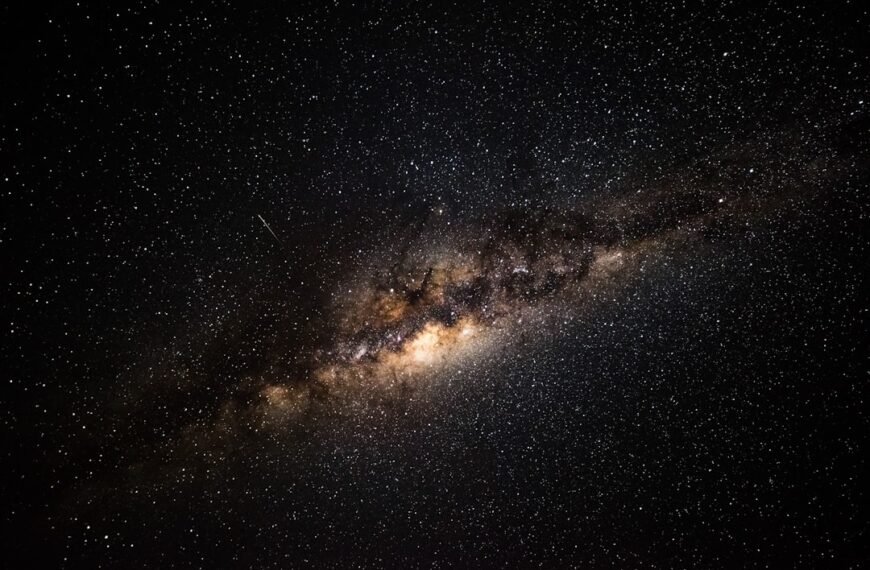
Even at those distances, Proxima is astronomically close by galactic standards. The Milky Way stretches roughly 100,000 light-years from end to end, so Proxima Centauri is practically in our backyard.
If you could travel at the speed of light, you would still need over four years to reach it. At the speed of NASA’s New Horizons spacecraft — one of the fastest objects humans have ever launched — the journey would take roughly 73,000 years.
What Kind of Star Is Proxima Centauri?
Proxima Centauri is a red dwarf star, the most common type of star in the Milky Way. It has only about 12.5% of the Sun’s mass and roughly one-seventh of its physical size. Its surface temperature is far cooler than the Sun’s, which gives it a reddish hue — hence the name “red dwarf.”
Despite being our nearest stellar neighbor, Proxima Centauri cannot be seen without a telescope. Its apparent magnitude is 11.13, far below the threshold the human eye can detect in a dark sky (about magnitude 6.5). You would need at least a moderately powerful amateur telescope to spot it.
One of Proxima’s more dramatic characteristics is that it is a flare star. Intense convection processes inside the star cause random, violent bursts of brightness. These solar flares are far more powerful, relative to the star’s size, than anything our Sun produces. This has significant implications for any life that might exist on its orbiting planets.
NASA scientists have noted that Proxima Centauri is expected to remain in its current stable, middle-aged phase for another four trillion years — roughly 300 times the current age of the universe.
Is the Sun Also the Closest Star to Earth?
Yes — technically, the closest star to Earth is the Sun itself, at an average distance of just 93 million miles (150 million km). But when people ask about the closest star, they almost always mean the nearest star other than our own Sun. That title belongs to Proxima Centauri.
This distinction matters because the Sun is a star in every sense — a massive ball of plasma powered by nuclear fusion. Proxima Centauri is simply the closest of the remaining 300 billion or so stars in our galaxy.
What Is the Alpha Centauri System?
Proxima Centauri does not travel alone through space. It belongs to the Alpha Centauri triple star system, which also contains Alpha Centauri A and Alpha Centauri B — formally named Rigil Kentaurus and Toliman by the International Astronomical Union.
Alpha Centauri A and B are a tightly bound binary pair, orbiting each other every 80 years. Both are roughly similar in size and type to our own Sun. Together, their combined light makes Alpha Centauri the third-brightest star visible from Earth.
Proxima orbits this pair at a much greater distance — about 12,950 AU away — completing one full orbit of the AB pair approximately every 550,000 years. Whether Proxima is truly gravitationally bound to the system or merely passing through is a question astronomers have debated, though current evidence supports a genuine orbital relationship.
Proxima has been the closest of the three to our solar system for about 32,000 years. Astronomers calculate it will hold that title for another roughly 25,000 years, after which Alpha Centauri A and B will alternately take the crown.
Does the Closest Star to Earth Have Planets?
Yes — and this is where things get genuinely exciting. Proxima Centauri hosts at least two confirmed planets:
- Proxima Centauri b: Confirmed in 2016, this planet has a mass of approximately 1.07 times Earth’s mass. It orbits Proxima in just 11.2 days and sits within the star’s habitable zone — the region where liquid water could theoretically exist on a surface. However, the extreme stellar flares and intense ultraviolet radiation from Proxima Centauri make surface habitability uncertain.
- Proxima Centauri d: A much smaller planet with only 0.26 times Earth’s mass, orbiting even closer to the star in just 5.1 days. Its discovery was announced in 2025, making it one of the lightest exoplanets ever detected.
The existence of Earth-sized planets in such close proximity to our solar system has made Proxima Centauri one of the most studied stars in modern astronomy. If humanity ever hopes to reach another star system, this is the most likely destination to be explored first.
What Did JWST Discover Near the Closest Star System? (2025 Update)
In August 2025, NASA’s James Webb Space Telescope made a stunning announcement: it had found strong evidence of a giant planet orbiting Alpha Centauri A — the Sun-like star just 4 light-years away and part of the same triple system as Proxima Centauri. The planet, if confirmed, would be a gas giant roughly the mass of Saturn, orbiting in an elliptical path within the habitable zone of its star.
The detection was made using JWST’s MIRI coronagraph instrument, which blocks the blinding light of the star to reveal fainter objects nearby. The object appeared clearly in August 2024 observations — but then vanished in follow-up images taken in February and April 2025, leaving astronomers puzzled. Researchers nicknamed it “the disappearing planet.”
Computer models of possible orbits suggest the planet — if real — should reappear on the opposite side of its star in August 2026. JWST teams are expected to be watching when it does. If confirmed, it would be the first planet ever directly imaged around a Sun-like star in our closest stellar neighborhood — a landmark discovery for the search for other Earths.
This discovery is closely related to the broader story of the Alpha Centauri system. For a deeper look at other recent developments in our cosmic neighborhood, check out our guide on what is happening in space right now.
Could We Ever Travel to the Closest Star?
With current technology, a mission to Proxima Centauri would take tens of thousands of years. But researchers are actively exploring ideas that could reduce that timescale. The most ambitious is Breakthrough Starshot — a concept backed by physicist Stephen Hawking before his death — which proposes firing a fleet of gram-scale laser-sail probes at 20% the speed of light. At that velocity, they could reach the Alpha Centauri system in roughly 20 years.
NASA has also studied swarm-based approaches using laser propulsion, in which thousands of tiny probes travel together and communicate as a network. A mission designed around this concept could, in theory, perform a flyby of Proxima b and Alpha Centauri A’s candidate planet within this century.
None of these missions have been approved or funded beyond early research stages — but the fact that they are being seriously studied tells you something important: Proxima Centauri is no longer just a point of light in a telescope. It is becoming a real destination.
If you’re curious how the sheer scale of interstellar distance compares to distances within our solar system, our piece on how far Mars is from the Sun offers a useful sense of scale.
FAQs
What is the closest star to Earth?
The closest star to Earth, after our own Sun, is Proxima Centauri. It is located 4.2465 light-years away in the constellation Centaurus and is part of the Alpha Centauri triple star system.
Can you see the closest star to Earth without a telescope?
No. Proxima Centauri is far too faint to see with the naked eye. Its apparent magnitude is 11.13, well below what the human eye can detect. You need at least a mid-sized amateur telescope to observe it.
How long would it take to travel to the closest star?
With today's fastest spacecraft, reaching Proxima Centauri would take approximately 73,000 years. Advanced laser-sail concepts like Breakthrough Starshot aim to reduce that to around 20 years by traveling at 20% the speed of light.
Does Proxima Centauri have any planets?
Yes. Proxima Centauri has at least two confirmed planets: Proxima b, which orbits in the habitable zone with a mass similar to Earth's, and Proxima d, a tiny planet announced in 2025 with just 0.26 times Earth's mass.
Is Alpha Centauri the same as Proxima Centauri?
Not exactly. Alpha Centauri is a triple star system that includes Alpha Centauri A, Alpha Centauri B, and Alpha Centauri C — which is the same star as Proxima Centauri. Proxima is the closest of the three to Earth.