
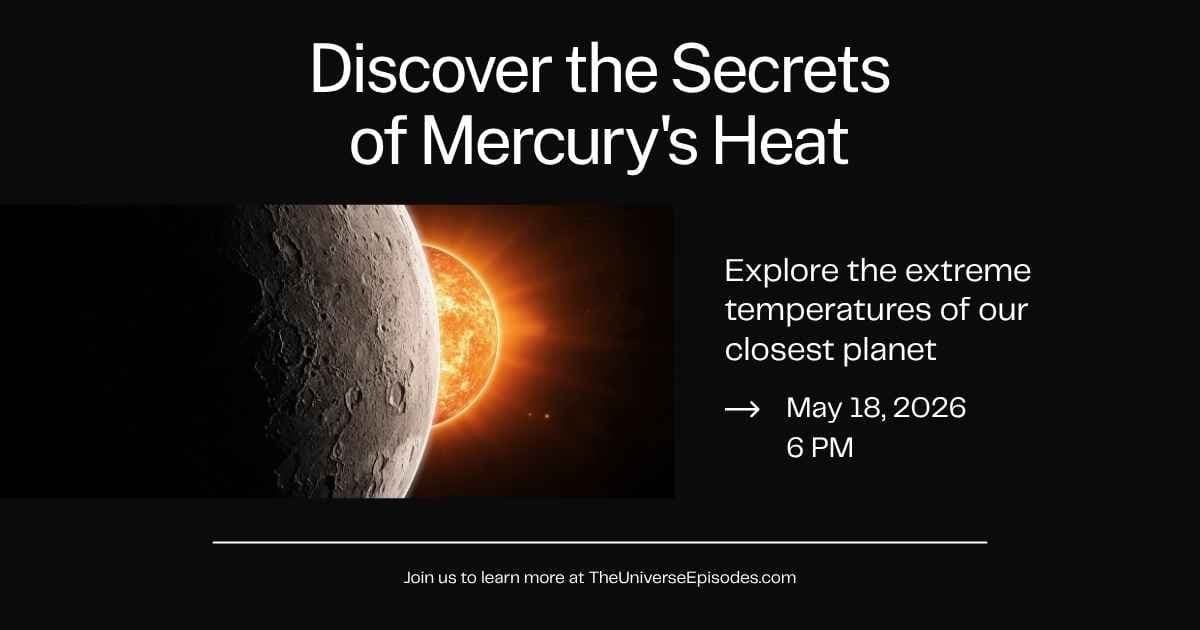
Mercury is the closest planet to the Sun. It is not the hottest one. That title belongs to Venus — a planet 50 million kilometres further out — and the reason why is one of the more honest lessons in planetary science.
But Mercury is brutal in a different way. According to NASA, daytime surface temperatures climb to 800°F (430°C), hot enough to melt lead. At night, with no atmosphere to hold any of that heat, the same surface plunges to -290°F (-180°C). That is a swing of around 1,000°F across a single day-night cycle — the largest of any planet in the solar system.
And in November 2026, a European-Japanese spacecraft called BepiColombo is finally going to settle into orbit and tell us why.
How Hot Mercury Actually Gets — In Numbers
The figures, from NASA’s official Mercury fact sheet, are these:
Maximum daytime surface temperature: 800°F / 430°C / about 700 Kelvin.
Minimum nighttime surface temperature: -290°F / -180°C / about 93 Kelvin.
To put 800°F in perspective — a household pizza oven tops out around 500°F. The melting point of lead is 621°F. So in Mercury’s daytime equator, a lead bar would simply pool into the dust.
The 93 Kelvin nighttime figure is harder to picture, because nothing in everyday human life gets that cold. It is colder than the surface of Pluto. Colder than liquid oxygen. If you took a breath there, your lungs would freeze before you finished exhaling.
Why Mercury Heats Up — and Then Cannot Hold On to It
Mercury sits an average of 58 million kilometres from the Sun — about 0.4 astronomical units, where one AU is the Earth-to-Sun distance. From Mercury’s surface, the Sun would appear more than three times larger than it does from Earth, and roughly seven times brighter, according to NASA.
That intensity is why daytime gets so extreme. But here is what most sources skip over: the real story is not the heat. It is the lack of an atmosphere.
Mercury has no real atmosphere. What it has instead is something called an exosphere — a wisp of atoms blown off the surface by the solar wind, mostly oxygen, sodium, hydrogen, helium, and potassium. The exosphere is so thin that, for practical purposes, you can ignore it. It cannot trap heat. It cannot redistribute warmth from the day side to the night side. The moment the Sun drops below the horizon, the heat radiates straight back into space, and the surface temperature collapses.
This is why Mercury holds the record for the most extreme day-night temperature variation in the solar system. Not because of how hot it gets — but because it has no way to stay warm.
Why Mercury Is Not the Hottest Planet
This is the part that catches most people off guard. Mercury is the closest planet to the Sun. Logically, it should be the hottest. It is not.
Venus — the second planet from the Sun, nearly 50 million kilometres further out — has an average surface temperature of about 867°F (464°C). That is hotter than Mercury’s daytime maximum, and Venus stays that hot. There is no night-time cooling, no swing. The whole planet is a sustained furnace.
The reason is Venus’s atmosphere. It is about 96 percent carbon dioxide, and it is dense — surface pressure on Venus is about 92 times Earth’s, equivalent to being roughly 900 metres underwater. That thick CO₂ blanket traps solar heat with brutal efficiency. It is the greenhouse effect taken to a planetary-scale extreme.
So the lesson is counterintuitive but cleanly stated: proximity to the Sun does not determine a planet’s surface temperature. Atmosphere does.
Mercury, exposed and atmosphere-less, runs hot and cold. Venus, wrapped in a CO₂ pressure cooker, runs hot and stays there.
Yes, There Is Ice on Mercury — and That Is Not a Typo
This is the strangest fact in the whole Mercury file, and it is true. The closest planet to the Sun has water ice on its surface.
The reason is Mercury’s tilt — or rather, its lack of one. Its axis of rotation is tilted just 2 degrees relative to its orbit around the Sun. That means there are deep craters at Mercury’s poles where sunlight has, for billions of years, never reached the floor. According to NASA, those permanently shadowed regions stay cold enough to preserve water ice indefinitely, even while equatorial daytime temperatures are crisping the rest of the planet.
NASA’s MESSENGER spacecraft, which orbited Mercury from 2011 to 2015, found strong evidence for these polar ice deposits — and BepiColombo, the mission arriving in late 2026, was built in part to study them in detail.
BepiColombo Arrives in November 2026 — What It Will Tell Us

Here is the freshest piece of this story. BepiColombo is a joint European Space Agency and Japan Aerospace Exploration Agency mission. It launched in October 2018. As of this writing, it has spent more than seven years in deep space, looping through six flybys of Mercury to bleed off speed before it can settle into a stable orbit around such a small planet so deep in the Sun’s gravity well.
The sixth and final flyby happened on 8 January 2025, when the spacecraft passed just 295 kilometres above Mercury’s surface. ESA confirmed in February 2025 that the trajectory was now correct for orbital insertion in November 2026.
Originally the mission was supposed to arrive in December 2025, but in September 2024 the spacecraft experienced a thruster anomaly that forced engineers to revise the plan. The arrival was pushed back by about eleven months. That is what now puts orbital insertion in late 2026 — only six months from the time of this writing.
Once in orbit, BepiColombo will do something MESSENGER could not: study Mercury in mid-infrared light using the MERTIS spectrometer, an instrument built by Germany’s DLR and the University of Münster. That matters because mid-infrared is the wavelength that maps temperature directly. We will get, for the first time, a high-resolution thermal map of Mercury — and a much better answer to the question of how those extreme temperatures actually flow through the planet’s crust and into its interior.
Recent research from DLR has already hinted at strange surprises: Mercury’s crust appears to have a porosity of 9 to 18 percent, comparable to lighter parts of the lunar crust, and the planet’s huge metallic core makes up roughly 80 percent of its radius. Mantle and crust together are only about 400 kilometres thick. We do not yet know why Mercury is built like that. That is one of the questions BepiColombo was sent to answer.
How a Mercury Day Actually Works
To understand why temperatures swing so violently, it helps to know how Mercury moves.
Mercury completes one orbit around the Sun every 88 Earth days. But it rotates on its axis slowly — once every 59 Earth days. That gives it a 3:2 spin-orbit resonance, meaning it spins three times for every two orbits. The practical result is unsettling: one solar day on Mercury — from sunrise to sunrise — lasts 176 Earth days. Just over two Mercury years.
That long day-night cycle is part of why the temperature extremes are so severe. The night side has 88 Earth days to radiate heat into space before the Sun rises again. There is nothing to stop it.
And because Mercury’s orbit is unusually elliptical — ranging from 47 million kilometres at closest to 70 million kilometres at farthest — the Sun in Mercury’s sky does something almost no other planet’s does. At certain longitudes, the Sun appears to rise, pause, reverse direction, set briefly, then rise again. It is the orbital mechanics version of a glitch.
What This Means for You, Looking Up

Most people will never see Mercury with their own eyes. Not because it is hidden — it is the eighth-brightest object in our sky — but because it never strays far from the Sun. You can only catch it briefly at dawn or dusk, low on the horizon, and only during specific elongations. If you have ever looked toward sunset and seen a single bright dot just above the glow before the stars come out, that was probably Mercury.
Think about what that small dot actually is. A scorched, airless world with no moons and no rings, where the surface burns by day and freezes by night, where ice survives in craters that have not seen sunlight in billions of years, and where a single sunrise takes as long as an entire summer on Earth.
The number that still does not feel real to me is the temperature gap. 1,000 degrees Fahrenheit, between the side facing the Sun and the side facing away. On the same planet. On the same day. We use the word “extreme” a lot in astronomy and it loses its weight. Mercury is what the word was actually built for.
In November 2026, BepiColombo will become the third spacecraft in history to study Mercury up close — after Mariner 10 in the 1970s and MESSENGER in the 2010s. If you want a single space mission to follow over the next few years, this is one of the better ones. It is going somewhere we barely understand, to answer questions about heat, ice, and a planet that should not exist in the shape it does.
If you want more on this neighbourhood, here is how far Mercury actually sits from the Sun and how Mercury’s extremes compare to the volcanic chaos of Jupiter’s moon Io.
FAQs
How hot does Mercury get at its hottest?
Mercury's surface reaches around 800°F (430°C) on the side facing the Sun, according to NASA. That is hot enough to melt lead. Temperatures are highest near the equator at midday.
Can humans survive on Mercury?
No. Between the 800°F daytime heat, the -290°F nighttime cold, the lack of any breathable atmosphere, and the unfiltered solar radiation, Mercury is one of the most hostile places in the solar system. Even a robot mission has to be heavily shielded to operate there.
Why is Mercury so hot and cold?
Mercury has almost no atmosphere — only a wisp of atoms called an exosphere. With nothing to trap heat, the day side burns under direct sunlight and the night side dumps its heat straight into space. The result is the largest day-night temperature swing of any planet in the solar system.
Is Mercury hotter than Venus?
No. Venus is the hottest planet in the solar system, despite being further from the Sun than Mercury. Venus has a dense carbon dioxide atmosphere that traps heat, holding its surface at about 864°F (462°C) day and night. Mercury gets hotter at noon, but cools off severely at night — Venus does not.
Does Mercury have ice?
Yes, surprisingly. There are deep craters at Mercury's north and south poles where the floor never sees sunlight. NASA's MESSENGER spacecraft found strong evidence of water ice in those permanently shadowed regions, even while the rest of the planet is roasting.