
Listen:
Main Star Types in the Milky Way
| Star Type | Spectral Class | Color | % of Milky Way Stars | Example |
|---|---|---|---|---|
| Red Dwarf | M | Red/Orange | ~70% | Proxima Centauri |
| Orange Dwarf | K | Orange | ~13% | Epsilon Eridani |
| Yellow Dwarf | G | Yellow-White | ~7% | The Sun |
| White/Blue-White | F | White | ~3% | Procyon |
| Blue-White | A | White-Blue | ~0.6% | Sirius |
| Blue Giant | B | Blue | ~0.1% | Rigel |
| Blue Supergiant | O | Bright Blue | ~0.00003% | Eta Carinae |
🔑 Key Takeaways
- Stars fall into OBAFGKM classes, ordered by temperature and color (NASA).
- The Milky Way is dominated by red dwarfs (M-type stars), which make up ~73–76% of its stellar population (NASA/ESA).
- Rare but luminous O and B stars power stellar nurseries and end as supernovae.
- Stars evolve into giants, white dwarfs, neutron stars, or black holes, depending on mass.a
- Populations I and II stars reveal the Milky Way’s assembly history, traced by Gaia and chemical “fingerprinting.”
What Are the Main Types of Stars?
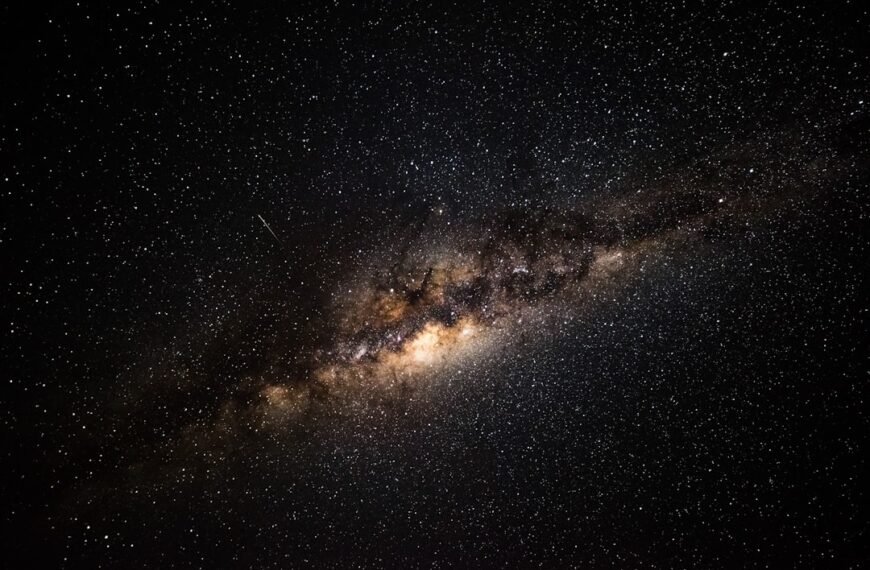
 galaxy.” class=”wp-image-21681″/>
Astronomers group stars by their surface temperature, spectra, and luminosity. The Harvard system orders them as O, B, A, F, G, K, M.
- O-type: Blue-violet, >30,000 K, most massive.
- B-type: Blue-white, 10,000–30,000 K.
- A-type: White/blue-white, 7,500–10,000 K.
- F-type: Yellow-white, 6,000–7,500 K.
- G-type: Yellow (Sun class), 5,200–6,000 K.
- K-type: Orange, 3,700–5,200 K.
- M-type: Red dwarfs, <3,700 K.
This classification was pioneered by Annie Jump Cannon, who cataloged 225,000 stars in the early 1900s. Cecilia Payne-Gaposchkin later proved that stellar spectra depend mainly on temperature, not composition (Wikipedia).
Stellar Classification vs. Types of Stars: What’s the Difference?
- Stellar classification = scientific taxonomy (OBAFGKM + luminosity).
- Types of stars = categories people use (main sequence, red giants, white dwarfs, etc.).
For example, Sirius A is an A1V main-sequence star, while Sirius B is a white dwarf. Together they form a binary system visible even to backyard telescopes (LCO Global).
How the H-R Diagram Explains Types of Stars
The Hertzsprung–Russell diagram is astronomy’s map of stellar life:
- Main sequence: ~90% of stars (NASA).
- Giants/supergiants: Bright, cool, swollen stars.
- White dwarfs: Hot but faint stellar remnants.
Plotting a star here reveals its mass, luminosity, and evolutionary stage. For instance, the Sun sits in the middle of the main sequence, while Rigel shines as a blue supergiant high above.
Which Types of Stars Dominate the Milky Way?
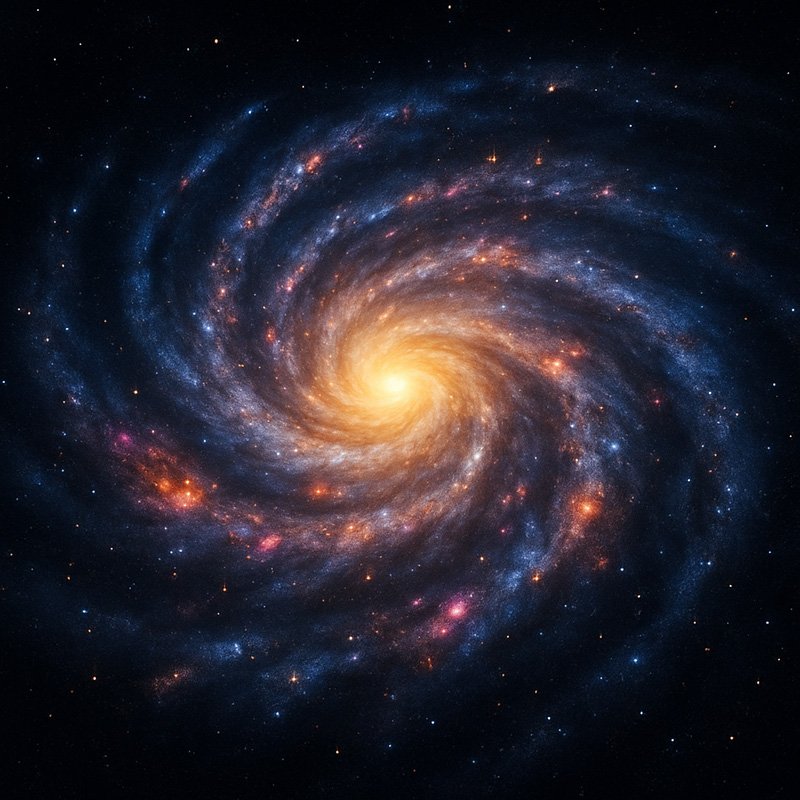
The Milky Way holds 100–400 billion stars, but the mix is skewed:
- M dwarfs: ~73–76% (NASA/ESA; EarthSky).
- K dwarfs: ~12–13%.
- G dwarfs: ~6–7.6%.
- F dwarfs: ~3%.
- A dwarfs: ~0.6%.
- B dwarfs: ~0.13%.
- O dwarfs: ~0.00003%.
👉 Our naked-eye view is biased. The stars we see—Rigel, Betelgeuse, Vega—are the rare giants, not the faint red dwarfs that actually dominate.
Red Dwarfs: The Most Common Type of Star
- Temperature: <3,700 K.
- Mass: 0.08–0.5 solar masses.
- Lifespan: Trillions of years (NASA).
- Examples: Proxima Centauri, Barnard’s Star.
Red dwarfs are fully convective: hydrogen circulates throughout, allowing them to use nearly all their fuel. This efficiency is why they live so long.
But they also flare violently, producing bursts of radiation that may strip atmospheres from orbiting planets (EarthSky). This duality makes them fascinating targets in the search for life.
Giants, Supergiants, and Rare Types of Stars
- Red giants: Sun-like stars that expand after hydrogen runs out.
- Supergiants: Massive, bright, short-lived (e.g., Betelgeuse, Rigel).
- Wolf–Rayet stars: Stripped O-stars with powerful winds, ~1,200 known in the Milky Way (arXiv).
- Carbon & S-stars: Peculiar stars with exotic molecules.
These luminous outliers are rare but crucial: their supernovae enrich space with heavy elements like carbon and iron, essential for planets and life.
Stellar Evolution: From Birth to Death
Stars live predictable lives based on mass:
- Sun-like stars: Main sequence → Red giant → Planetary nebula → White dwarf.
- Massive stars: O/B → Supergiant → Supernova → Neutron star or black hole.
- Example: SN 1987A in the Large Magellanic Cloud gave astronomers a live view of a massive star’s explosive death.
Betelgeuse, a red supergiant only 650 light-years away, may go supernova within the next 100,000 years—a cosmic “soon.”
Multiplicity: Stars Rarely Live Alone
The Sun is unusual. At least 30–50% of stars are in binaries (NASA).
- Sirius system: Bright Sirius A + faint white dwarf Sirius B.
- Alpha Centauri: G2V + K1V + red dwarf Proxima.
- M-dwarfs: ~27% have companions (arXiv).
Binary systems are vital tools: orbital mechanics let astronomers weigh stars with precision.
Galactic Archaeology: Populations I & II
- Population I: Young, metal-rich stars in the disk (Sun, O/B stars).
- Population II: Ancient, metal-poor stars in the halo and bulge, ~11–13 billion years old.
- Thick disk stars: Intermediate, created during a merger ~8–11 billion years ago (Gaia-Enceladus-Sausage).
Chemical ratios like [α/Fe] act as “galactic clocks,” telling astronomers how fast stars formed. High [α/Fe] = rapid starburst (halo). Low [α/Fe] = long, steady star formation (disk).
Data from the Gaia mission has revealed streams of stars—the debris of dwarf galaxies consumed by the Milky Way. The galaxy is still a work in progress.
Firsthand Perspective: Observing Star Types
 space background dotted with faint stars and various types of stars.” class=”wp-image-21679″/>
Through binoculars, I first saw the Orion Belt: blue-white stars Alnitak, Alnilam, and Mintaka—all massive O/B stars. Later, in a telescope, I was struck by Betelgeuse, glowing orange-red against Orion’s shoulder.
But when I compared my observations with data, I learned that the true majority—red dwarfs—are invisible without instruments. This experience taught me that astronomy is a blend of human wonder and scientific correction.
Why “Mass Is Destiny” in Stellar Types
A star’s mass dictates:
- Color (blue O vs. red M).
- Lifespan (millions vs. trillions of years).
- Fate (white dwarf vs. neutron star vs. black hole).
As NASA puts it, mass is the master key of stellar evolution.
FAQs About Types of Stars
Conclusion
The Milky Way is built from billions of stars, but their mix is counterintuitive. The night sky we see is rare and misleading—dominated by bright but scarce O, B, and A stars. The real galaxy is hidden: an ocean of faint, long-lived red dwarfs.
By studying the types of stars, astronomers not only classify celestial objects but also reconstruct the Milky Way’s violent, dynamic past. From ancient Population II halo stars to newborn O-stars in Orion, every stellar type is a piece of our galaxy’s living history.

What types of stars make up the Milky Way?
The Milky Way is dominated by red dwarf stars (M-type), which account for about 70% of all stars. Orange dwarfs (K-type) make up about 13%, yellow dwarfs like the Sun (G-type) about 7%, and blue giants and supergiants (O and B type) together less than 0.2%. The most common stars are the smallest and dimmest.
What is the most common type of star in the Milky Way?
Red dwarf stars (spectral class M) are by far the most common, making up roughly 70% of all stars in the Milky Way. They are small, cool, and very long-lived — some have been burning for trillions of years. Despite being so common, red dwarfs are all too dim to see with the naked eye.
What type of star is the Sun?
The Sun is a G-type main sequence star, also called a yellow dwarf. It sits in the middle of the stellar mass range — larger than red and orange dwarfs but smaller than blue and white giants. G-type stars make up about 7% of stars in the Milky Way.
What is the largest type of star?
The largest stars are red and blue supergiants. UY Scuti, a red supergiant, is one of the largest known stars with a radius about 1,700 times the Sun's. Blue supergiants like Eta Carinae are among the most luminous. However, size and brightness are different — some blue hypergiants are brighter but smaller than red supergiants.
How are stars classified?
Stars are classified by their spectral type (O, B, A, F, G, K, M) based on surface temperature. O-type stars are the hottest and most massive (blue); M-type are the coolest and least massive (red). The Sun is a G-type star with a surface temperature of about 5,500°C.