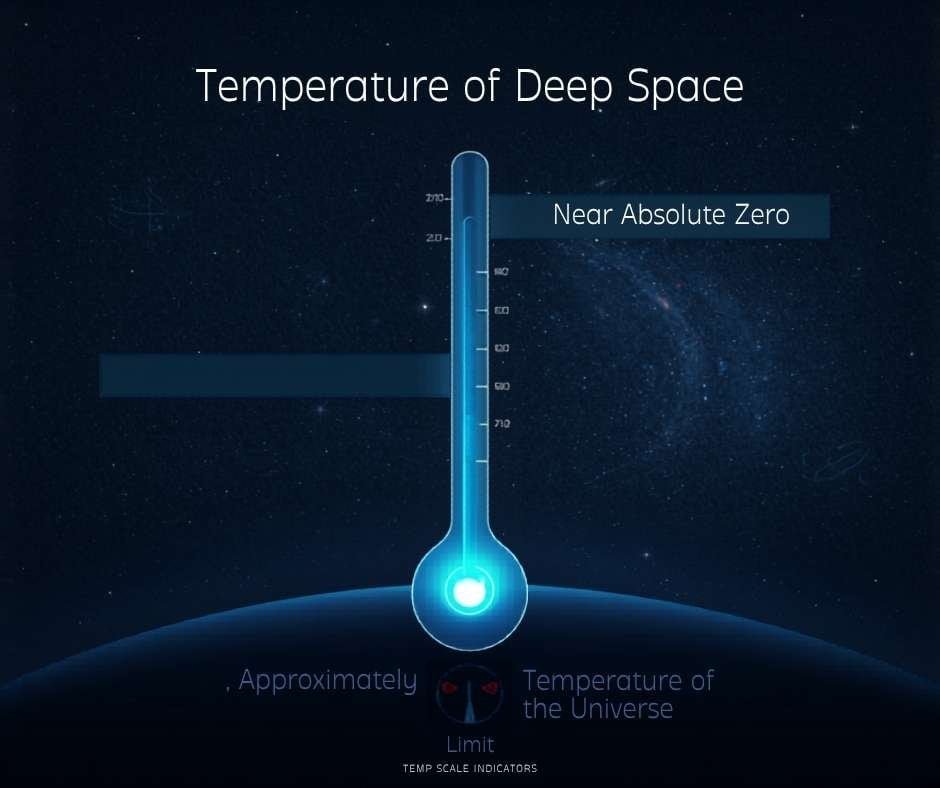
The average temperature of deep space is −270.45°C (−454.81°F, or 2.725 Kelvin) — just 2.725 degrees above absolute zero. This value is set by the Cosmic Microwave Background (CMB), the faint afterglow of the Big Bang that fills all of space. However, space is not uniformly cold: temperatures range from −270°C in deep intergalactic voids to over 15,000,000°C inside the Sun’s core, depending on location and energy sources nearby.
Key Takeaways
- Deep space averages −270.45°C (2.725 K) — set by the Cosmic Microwave Background radiation
- Space near Earth is not uniformly cold — the ISS swings between +121°C in sunlight and −157°C in shadow
- Space is cold because of how heat travels — without air, conduction and convection don’t work; only radiation does
- The coldest known natural place is the Boomerang Nebula — 1 Kelvin (−272°C), colder than the CMB itself
- You would not instantly freeze in space — without air to conduct heat away, a human body loses heat very slowly through radiation alone
Space Temperature — Quick Reference
| Location | Temperature (°C) | Temperature (°F) | Temperature (K) |
|---|---|---|---|
| Deep space (CMB average) | −270.45°C | −454.81°F | 2.725 K |
| Boomerang Nebula (coldest natural) | −272.15°C | −457.87°F | 1 K |
| ISS in shadow | −157°C | −250°F | 116 K |
| ISS in sunlight | +121°C | +250°F | 394 K |
| Moon (nighttime) | −184°C | −300°F | 89 K |
| Moon (daytime) | +121°C | +250°F | 394 K |
| Pluto (surface) | −220 to −230°C | −364 to −382°F | 40–53 K |
| Absolute zero | −273.15°C | −459.67°F | 0 K |
Why Is Space So Cold?
Heat needs a medium — and space has almost none
On Earth, heat moves in three ways: conduction (through physical contact), convection (through moving fluids like air or water), and radiation (through electromagnetic waves). In the near-vacuum of space, conduction and convection are essentially impossible — there are no molecules to pass heat along. The only way an object gains or loses heat in space is through radiation.
This is why deep space feels “cold” — any object floating in the void slowly radiates its stored heat outward as infrared light, with nothing coming back in return except the faint 2.725 K warmth of the CMB. An object absorbing no sunlight will eventually cool to near the CMB temperature. This is also why astronauts overheat inside their spacesuits rather than freeze: the suit insulates so well that the body’s own metabolic heat has nowhere to go.
What Is the Cosmic Microwave Background and Why Does It Set the Temperature of Space?
The Cosmic Microwave Background (CMB) is thermal radiation left over from the Big Bang, now permeating all of space. About 380,000 years after the Big Bang, the universe cooled enough for protons and electrons to combine into neutral hydrogen — releasing photons that have been traveling freely ever since. As the universe expanded, these photons were stretched to longer wavelengths (cosmological redshift), cooling from roughly 3,000 K at release to the 2.725 K we measure today. According to NASA’s WMAP and ESA’s Planck missions, this temperature is uniform to within 1 part in 100,000 across the entire sky.
The CMB is effectively the “floor” of space temperature — the minimum an isolated object in the void will reach without active cooling. Any body in thermal equilibrium with its environment and receiving no other radiation will stabilize at 2.725 K. The precise measured value, according to the Planck mission data, is 2.72548 ± 0.00057 K.
How Cold Is Space Near Earth?
The ISS swings 278°C every 90 minutes
Space near Earth is far from uniformly cold — it depends entirely on whether you’re in sunlight or shadow. The International Space Station completes one orbit every 90 minutes, passing in and out of Earth’s shadow repeatedly. In direct sunlight, the ISS’s external surfaces reach +121°C (+250°F). When the station slides into Earth’s shadow, those same surfaces drop to −157°C (−250°F) — a swing of 278°C in minutes. According to NASA’s thermal control engineers, managing this cycle is one of the primary engineering challenges of keeping the ISS operational.
The “average” temperature of space near Earth is sometimes cited as about +10°C (50°F), but this is a calculated average — not something a thermometer would read. It reflects the balance between solar input, Earth’s infrared emission, and radiative cooling to deep space across a full orbit.
What Is the Coldest Known Natural Place in Space?
The coldest known natural place in the observable universe is the Boomerang Nebula, located 5,000 light-years away in the constellation Centaurus. Its temperature is approximately 1 Kelvin (−272.15°C or −457.87°F) — about 1.7 degrees colder than the CMB. This makes it the only known natural object colder than the background temperature of the universe itself.
The Boomerang Nebula achieves this record through adiabatic expansion: its central dying star is ejecting gas outward at 164 km/s (500,000 km/h). As this gas expands rapidly into the surrounding vacuum, its internal energy converts to kinetic work — the same physics as a refrigerant expanding in a household fridge or gas rushing out of an aerosol can. The expansion is so fast that it outpaces any heating from surrounding radiation, driving the gas temperature below even the CMB floor. ALMA (Atacama Large Millimeter/submillimeter Array) telescope observations confirmed both its structure and its record-breaking temperature.
Would You Freeze Instantly If Exposed to Space?
No — you’d overheat before you’d freeze
Contrary to popular belief, a human body exposed to space would not freeze instantly. Because space has no air to conduct heat away, the body loses heat only through radiation — an extremely slow process. A person in space would face more immediate threats: loss of consciousness from lack of oxygen within about 15 seconds, and tissue damage from decompression. The actual cooling from radiation would take hours to become lethal on its own.
Paradoxically, overheating is a greater danger for active astronauts. This is why NASA’s spacesuit — the Extravehicular Mobility Unit (EMU) — includes a Liquid Cooling and Ventilation Garment (LCVG): a layer of tubing carrying chilled water against the skin to remove metabolic heat. Without it, a working astronaut would rapidly overheat inside the suit’s excellent insulation. The suit uses an ice sublimator to dump heat into space by turning water ice to vapor, expelling it through the suit’s porous nickel plate.
How Cold Is Space Compared to the Coldest Places on Earth?
| Location | Temperature (°C) | Temperature (°F) |
|---|---|---|
| Average room temperature (Earth) | +20°C | +68°F |
| Antarctica (coldest recorded) | −89.2°C | −128.6°F |
| Liquid nitrogen | −196°C | −321°F |
| Moon (nighttime) | −184°C | −300°F |
| Pluto (average) | −225°C | −373°F |
| Deep space (CMB) | −270.45°C | −454.81°F |
| Boomerang Nebula | −272.15°C | −457.87°F |
| Absolute zero (theoretical) | −273.15°C | −459.67°F |
Will Space Keep Getting Colder Over Time?
Yes. The universe is still expanding, which means the CMB temperature continues to drop. As space expands, the wavelengths of CMB photons stretch further (cosmological redshift), lowering their energy and temperature. The relationship is direct: if the universe doubles in size, the CMB temperature halves. Currently cooling by about 0.000000002 K per year, the CMB will eventually approach — but never quite reach — absolute zero over trillions of years, in what cosmologists call the “Heat Death” or “Big Chill” of the universe.
From the Editors
When we first researched this topic for The Universe Episodes, we were surprised by how counterintuitive the answer is. Space feels “cold” not because it contains cold stuff — it contains almost nothing. The coldness comes from absence: no air, no conduction, no convection. An object in deep space radiates its heat into an effectively infinite sink and receives almost nothing back. The 2.725 K temperature of the CMB is one of the most precisely measured constants in all of science — measured to six decimal places by the ESA’s Planck satellite. We found it remarkable that the “temperature of the universe” is something we can state with that level of confidence. If you want to go deeper, the Planck mission’s data release papers on the CMB are publicly available and genuinely fascinating reading.
FAQs
How cold is space?
Deep space has an average temperature of −270.45°C (−454.81°F, or 2.725 Kelvin) — set by the Cosmic Microwave Background radiation, the afterglow of the Big Bang. This is just 2.7 degrees above absolute zero. However, space near the Sun or near Earth can be much warmer depending on solar radiation exposure.
How cold is space in Fahrenheit?
Deep space is approximately −454.81°F (−270.45°C or 2.725 Kelvin). The International Space Station experiences temperatures ranging from −250°F (−157°C) in shadow to +250°F (+121°C) in direct sunlight. The coldest known natural place in space — the Boomerang Nebula — reaches −457.87°F (−272.15°C or 1 Kelvin).
Why is space cold if the Sun is so hot?
Space is cold because it is nearly empty — a vacuum. Heat can only transfer through space via radiation, not through conduction or convection. Without air or matter to carry heat, any object in space that is shielded from the Sun radiates its stored heat away into the cold 2.725 K background and slowly cools toward that temperature. The Sun's surface is 5,500°C, but that heat only reaches you if you're in its direct line of sight.
What is the coldest place in space?
The coldest known natural place in the observable universe is the Boomerang Nebula, located 5,000 light-years away in Centaurus, with a temperature of approximately 1 Kelvin (−272.15°C or −457.87°F). This is colder than the Cosmic Microwave Background (2.725 K) due to rapid adiabatic expansion of gas from its central star. In laboratories, humans have achieved temperatures as low as 38 picokelvin — 38 trillionths of a degree above absolute zero.
Would you freeze instantly if exposed to space?
No. A human body in space would not freeze instantly because space has no air to conduct heat away — the body loses heat only through radiation, which is a very slow process. The immediate dangers of space exposure are oxygen deprivation (unconsciousness in about 15 seconds) and decompression, not freezing. Paradoxically, active astronauts are more at risk of overheating inside their insulated suits than of freezing.