
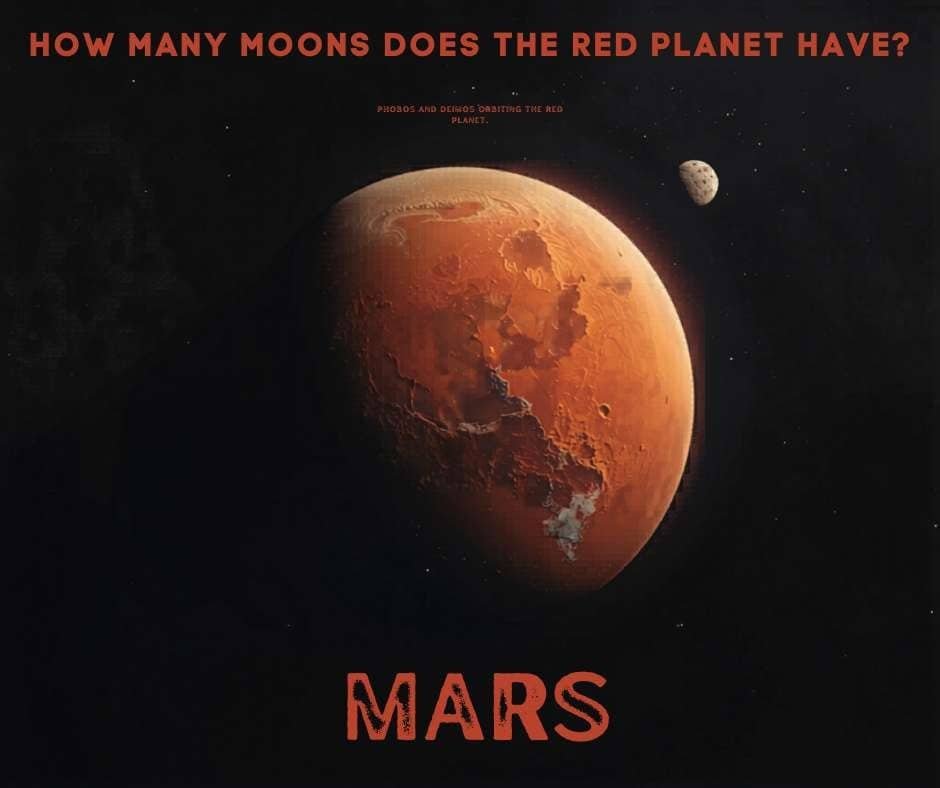
Mars has 2 moons: Phobos and Deimos. Both were discovered by American astronomer Asaph Hall on August 11 and August 17, 1877, using the US Naval Observatory’s 26-inch refractor telescope in Washington D.C. They are the only two natural satellites of Mars, and neither is large enough to be spherical — both are small, irregularly shaped, and covered in craters and dust.
Key Takeaways
- Mars has exactly 2 moons — Phobos and Deimos — and this number has not changed since their discovery in 1877
- Both moons are tiny — Phobos is about 22 km across and Deimos only 12 km, far smaller than Earth’s Moon (3,474 km)
- Phobos is doomed — it orbits so close to Mars that tidal forces are pulling it inward; in ~50 million years it will either crash into Mars or break apart to form a ring
- Their origin is still debated — captured asteroids or debris from an ancient impact on Mars; JAXA’s MMX mission (launching October 2026) will return a sample from Phobos to answer this
- Phobos rises in the west — it orbits Mars faster than Mars rotates, so from the Martian surface it rises in the west and sets in the east — the opposite of every other moon in the solar system
Mars Moons — Side by Side
| Phobos | Deimos | |
|---|---|---|
| Meaning of name | Fear (Greek) | Dread/Terror (Greek) |
| Discovered | August 17, 1877 | August 11, 1877 |
| Diameter | ~22.5 km (14 mi) | ~12.4 km (7.7 mi) |
| Distance from Mars | 9,376 km | 23,458 km |
| Orbital period | 7 hours 39 minutes | 30 hours 18 minutes |
| Shape | Irregular (potato-like) | Irregular (smoother) |
| Surface gravity | 0.0057 m/s² | 0.003 m/s² |
| Fate | Will crash or form a ring in ~50 million years | Slowly drifting away from Mars |
What Are the Names of Mars’s Two Moons and What Do They Mean?
The two moons are named Phobos (meaning “Fear”) and Deimos (meaning “Dread” or “Terror”) after the twin sons of Ares, the Greek god of war. Since Mars is the Roman equivalent of Ares, naming its moons after the god’s attendants was a natural choice. The names were suggested by Henry Madan, a science teacher at Eton College, shortly after Asaph Hall’s discovery was announced.
Why Does Phobos Rise in the West?
Phobos orbits Mars faster than Mars rotates
Phobos completes one full orbit around Mars in just 7 hours and 39 minutes — far faster than Mars’s own rotation period of 24 hours and 37 minutes. This means Phobos overtakes Mars’s spin, causing it to rise in the west and set in the east when viewed from the Martian surface. This makes Phobos unique in the solar system: it is the only moon known to orbit its planet faster than that planet rotates. From Mars, Phobos crosses the sky in about 4 hours and 15 minutes and can be seen to rise and set twice in a single Martian day.
Where Did Mars’s Moons Come From?
Two competing theories — and a mission to find out
The origin of Phobos and Deimos is one of the most debated questions in planetary science. Two main theories compete. The capture hypothesis argues that both moons were once asteroids from the outer asteroid belt that were gravitationally captured by Mars. This is supported by their low density, dark color, and composition — all similar to carbon-rich C-type asteroids. However, their nearly circular, equatorial orbits are unusual for captured objects, which typically end up in tilted, eccentric orbits.
The impact hypothesis proposes that a large object struck young Mars billions of years ago, ejecting debris that coalesced into Phobos and Deimos — similar to how Earth’s Moon formed. This better explains the circular orbits but requires the moons to have formed from Martian rock, which their composition seems to contradict. JAXA’s MMX (Martian Moons eXploration) mission, launching in October 2026, will land on Phobos, collect at least 10 grams of material, and return it to Earth by 2031 — the first sample return from the Martian system. Analysis of those samples will likely settle the debate once and for all.
Is Phobos Going to Crash Into Mars?
Yes — eventually. Phobos orbits Mars at just 9,376 km above the surface — closer to its planet than any other moon in the solar system, and well below the altitude of many Mars-orbiting spacecraft. Mars’s tidal forces are pulling Phobos inward at a rate of about 1.8 cm per year. In approximately 50 million years, Phobos will cross the Roche limit — the point at which Mars’s tidal forces will overcome Phobos’s own gravity and tear it apart. The resulting debris will form a ring around Mars, similar to Saturn’s rings, before gradually raining down onto the Martian surface.
Deimos is heading in the opposite direction — it orbits beyond the synchronous orbit radius, meaning Mars’s tidal forces are pushing it slowly outward. Given enough time, Deimos will drift away from Mars entirely, though this will take billions of years.
How Big Are Phobos and Deimos Compared to Earth’s Moon?
| Moon | Diameter | vs Earth’s Moon | Gravity vs Earth |
|---|---|---|---|
| Earth’s Moon | 3,474 km | baseline | 0.165 g |
| Phobos | ~22.5 km | 154× smaller | 0.00058 g |
| Deimos | ~12.4 km | 280× smaller | 0.00031 g |
The gravity on Phobos is so weak (less than 0.06% of Earth’s surface gravity) that a person weighing 80 kg on Earth would weigh just 46 grams on Phobos. You could jump off the surface entirely with a running leap. For this reason, any future crewed mission to Phobos would require astronauts to use tethers to avoid floating away.
Could Mars Get More Moons in the Future?
It is theoretically possible but unlikely in any human-relevant timeframe. Mars could in principle capture a passing asteroid from the nearby asteroid belt, though the conditions for a stable capture are very specific. Mars does not have a large enough moon (like Jupiter’s Galilean moons) to help facilitate three-body capture. More likely, Mars will go from 2 moons to 1 as Phobos breaks apart — and eventually, after Deimos drifts away, to zero permanent moons.
From the Editors
When we wrote about Mars’s moons for The Universe Episodes, the detail that surprised us most wasn’t the size or the orbits — it was the fact that Phobos rises in the west. We’re so accustomed to the Moon rising in the east from Earth that a moon doing the opposite feels almost impossible. It’s a reminder that the rules we take for granted depend entirely on where you’re standing. Phobos completes nearly three full orbits in the time it takes Mars to rotate once — from the Martian surface, you’d watch it shoot across the sky in about four hours, crossing from west to east. For the latest on Mars’s moons, the JAXA MMX mission website is tracking the October 2026 launch in real time.
How many moons does Mars have?
Mars has exactly 2 moons: Phobos and Deimos. Both were discovered by American astronomer Asaph Hall in August 1877 using the US Naval Observatory's telescope. Neither moon is spherical — both are small, irregularly shaped bodies that resemble large asteroids more than traditional moons.
What are the names of Mars's moons?
Mars's two moons are named Phobos (meaning 'Fear') and Deimos (meaning 'Dread' or 'Terror'), after the twin sons of Ares, the Greek god of war. The names were suggested by Henry Madan of Eton College shortly after their discovery in 1877. Phobos is the larger and closer of the two moons.
Will Phobos crash into Mars?
Yes — in approximately 50 million years. Phobos orbits Mars only 9,376 km above the surface and is being pulled inward by tidal forces at a rate of about 1.8 cm per year. When it crosses the Roche limit, Mars's gravity will tear it apart, forming a ring. Eventually that ring material will rain down onto Mars's surface.
How big is Phobos compared to Earth's Moon?
Phobos is tiny compared to Earth's Moon. Phobos has a diameter of about 22.5 km, while Earth's Moon is 3,474 km across — making Earth's Moon about 154 times wider. Phobos's gravity is so weak (0.00058 g) that a person weighing 80 kg on Earth would weigh only about 46 grams on Phobos.
Why does Phobos rise in the west?
Phobos rises in the west because it orbits Mars faster than Mars rotates. Phobos completes one full orbit in just 7 hours and 39 minutes, while Mars takes 24 hours and 37 minutes to rotate once. Because Phobos 'laps' Mars's rotation, it appears to move from west to east across the Martian sky — the opposite of what any moon does when seen from the surface of its planet.