

Space: Collection of 6 Books (Knowledge Encyclopedia For Children)
Wonder House Books Space: Collection of 6 Books (Knowledge Encyclopedia For Children)
You are standing in the children's section of a bookstore, or perhaps you're at home scrolling through a long list of "best STEM books" while a cereal bowl grows cold beside you. Either way, this boxed set arrives like a small, polite telescope on your doorstep: a collection of six bright, slightly bossy little books that explain the universe in a tone that is clear enough for a child and satisfyingly clever enough for you to read aloud without needing a coffee IV. These are not the sorts of books that talk down. They are the sorts that hold your hand, point up, and say, without ceremony, "This is how gravity loses its temper."
What this set gives you (and your young astronomer)
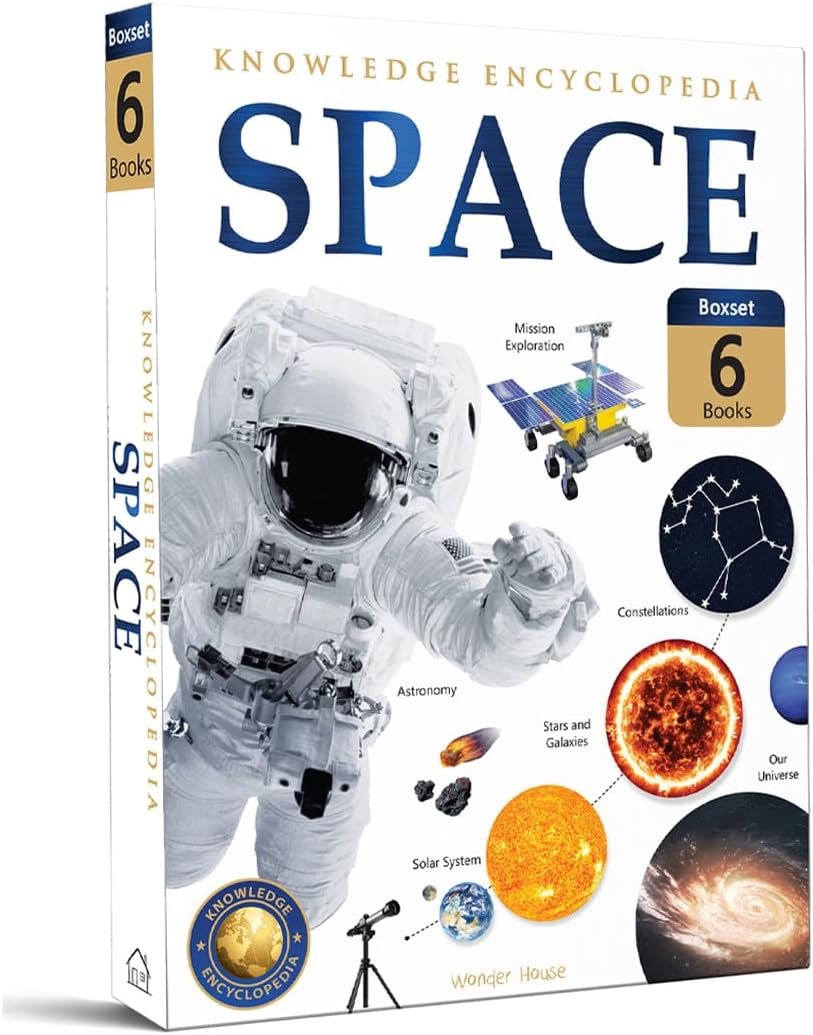
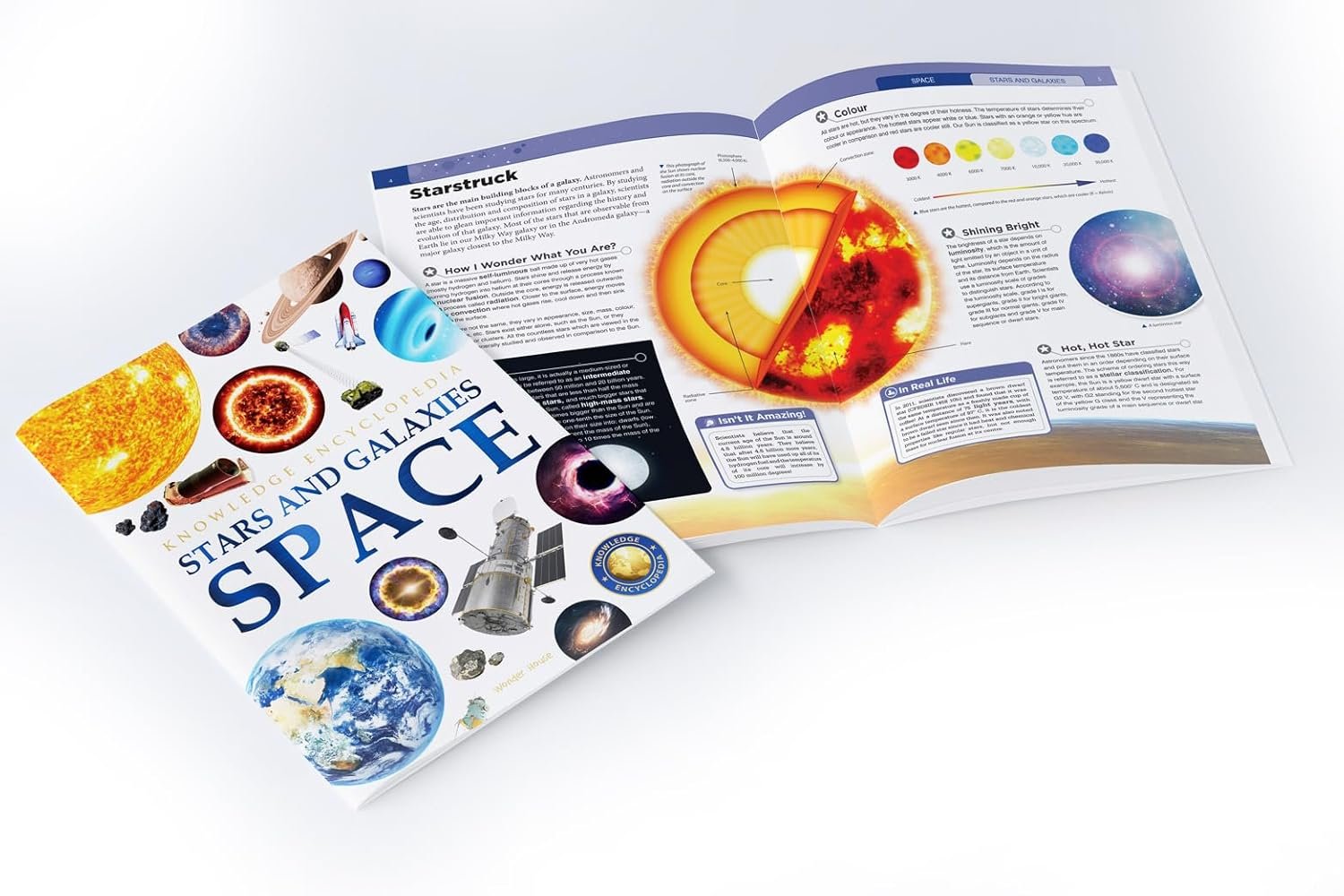
You get six compact encyclopedias, each one focused on a different corner of space knowledge: planets, stars, the solar system, space travel, the moon and Earth, and curious phenomena like black holes and comets. Each volume is written in plain English, illustrated with colorful diagrams and images, and built to answer the kinds of questions that keep children awake at night — and that will, inevitably, remind you of the time you tried to sleep in a sleeping bag with a nightlight shaped like Saturn.
Because these are kid-focused encyclopedias, they prioritize clarity over poetic heroics. That means your child will learn what an asteroid really is (not a “rock with attitude”), why Saturn’s rings are not made of sequins, and how astronauts go to the bathroom in zero gravity — a topic both irresistible and necessary for any true conversation about space.
Why you’ll like giving this as a gift
You will look calm and competent handing this set to a child at a birthday party, school event, or your own kitchen table. It says you care about learning and that you understand the durable value of curiosity. It also promises hours of quiet reading time that are not screen-based, which you will appreciate in a non-religious, slightly surprised way. The set makes a lovely gift for a budding scientist, a curious cousin, or your neighbor’s kid who keeps asking why the moon changes shape like an indecisive coin.
How these books fit into everyday life
- Bedtime reading with a twist: these are short enough to fit into the five- to fifteen-minute reading windows you have left after dishes, homework, and the small domestic dramas that always appear at 8 p.m.
- Homework ally: the format is perfect for school projects where accuracy matters and paraphrasing is mandatory.
- Road-trip sanity saver: the pictures and bite-size facts can silence questions such as “Are we there yet?” or at least replace them with “How far is Jupiter?” which is, frankly, a dignified improvement.
- Classroom supplement: teachers will find them accessible for group reading and for prompting classroom experiments or mini research tasks.
What’s inside each book
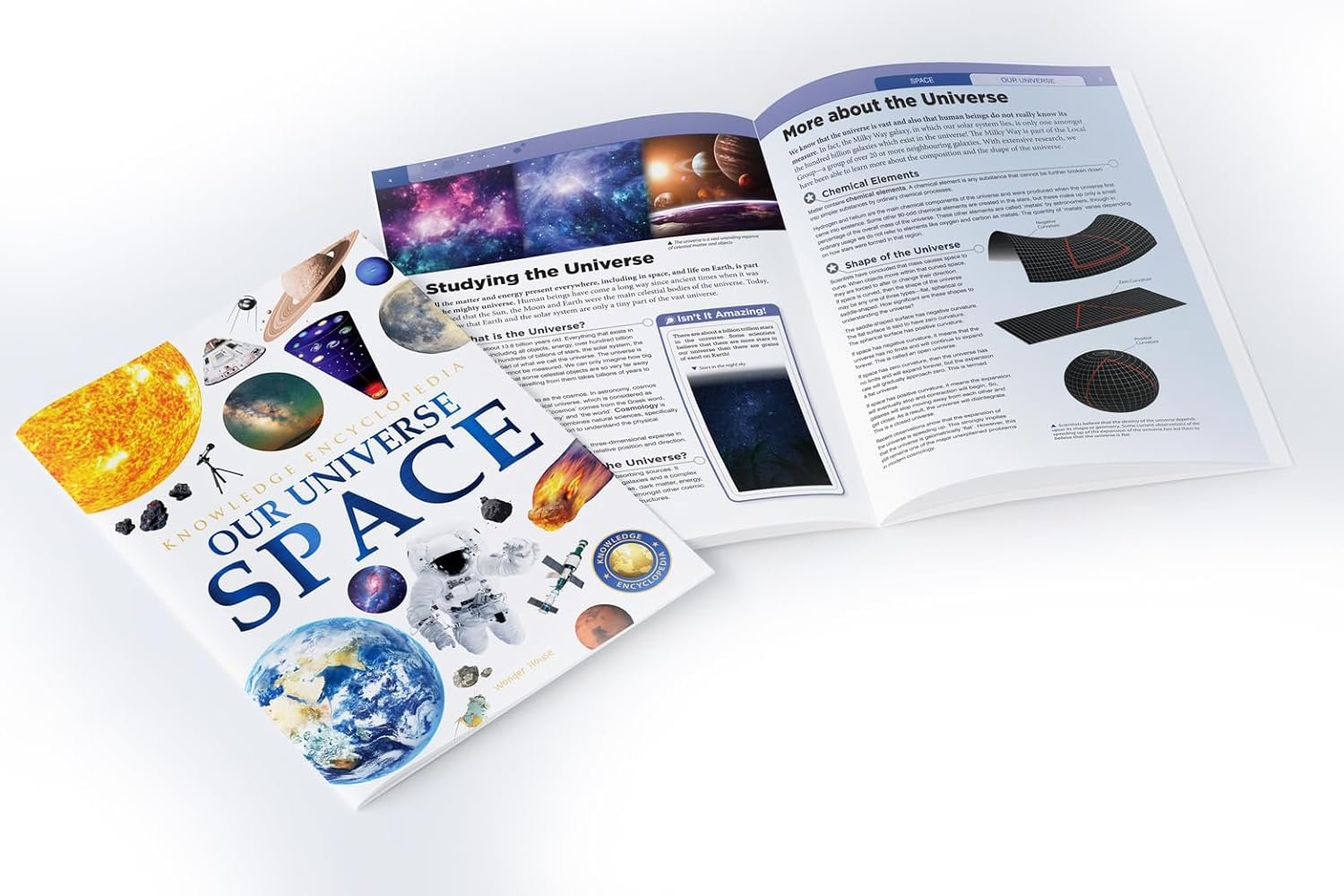
Each volume presents short, tightly edited chapters, large-font headings, and a careful mixture of photographs, illustrations, and labeled diagrams. You will find quick facts that you can recite during dinner to impress relatives, and short experiments or observation prompts that make the whole subject feel less like memorizing and more like noticing. There is a subtle respect for the intelligence of children: the books don’t oversimplify to the point of boredom, nor do they assume prior knowledge that would make a teenager roll their eyes.
Design and durability
The books are printed on thick, kid-friendly paper with robust bindings to withstand the accidental thwacks and bedside tumbles that are inevitable. The cover art is cheerful, with bold typography that signals “This is fun, but also factual.” If you are the sort of person who appreciates order, the boxed set sits neatly on a shelf, spine-aligned, like a tiny mission control.
Safety and educational standards
These books follow common educational design principles for children’s non-fiction: clear labeling, age-appropriate language, and visual supports that match text explanations. Your child can navigate the books alone or with you, and the content is carefully framed to avoid sensationalism while still catering to the natural drama of space phenomena.
Product specifications (approx.)
| Specification | Details |
|---|---|
| Publisher | Wonder House Books |
| Series Title | Space: Collection of 6 Books (Knowledge Encyclopedia For Children) |
| Number of Books | 6 |
| Format | Boxed set of illustrated paperback volumes |
| Pages per Book | Approximately 32–48 pages |
| Recommended Age | 6–10 years (suitable for curious readers up to 12) |
| Language | English |
| Illustrations | Full color, diagrams, and photographs |
| Binding | Sturdy paperback with box sleeve |
| Use Cases | Home reading, classroom, travel, homework aid |
Who will benefit most
You will find these books particularly valuable if you are nurturing a child who asks persistent questions, prefers facts to fable, or likes to be handed a tool for understanding the world. If your child draws all the planets as circles of different sizes and wants to label them correctly, this set will be a quiet joy. If you secretly hope to cultivate a future scientist, engineer, or just someone who knows what an exoplanet is, this is a practical, attractive nudge in that direction.
A few candid notes you will appreciate
These books are not a substitute for a telescope, an observatory, or an asteroid. They do not come with glow-in-the-dark stickers or a free Mars rock (if they did, shipping would be a nightmare). What they do provide is reliable information, presented with charming art and accessible language. If you are a person who enjoys reading things aloud in exaggerated tones, these books will reward you with lines that sound impressive when spoken to a receptive audience.
How to use the set for maximum effect
- Read one book at a time as a weekly mini-theme. Make a small poster with the planet of the week.
- Assign a “research minute” where your child reads one page and then teaches you something new. You will secretly enjoy being taught.
- Pair the reading with a simple drawing or model-making session. The books give you accurate facts; your child supplies the glitter.
Shipping, returns, and customer care
The set ships in a protective box to ensure the artwork and bindings remain pristine. If any volume arrives damaged, most sellers will offer an exchange or refund; check the retailer’s policy for specifics. The books are lightweight and easy to add to a gift package if you intend to send them to far-flung relatives.
Final note about why this set matters
You will watch a child go from asking, "Why is the sky blue?" to articulating the layers of the atmosphere, or from casually saying "comet" to describing a nucleus and a tail. These are small victories, the kind that will make you smile while making coffee, and later, look back and feel faintly astonished that a book could be part of that change. The space set gives you a tidy, two-handed way to share one of the oldest human impulses: to point upward and try to make sense of what’s out there. It does so with intelligence, humor, and the kind of patience that children return with interest and, occasionally, very specific questions about toilets in space.

Space: Collection of 6 Books (Knowledge Encyclopedia For Children)
If you’ve ever tried to answer a child’s question about planets and ended up inventing an orbit made of spaghetti because you didn’t know better, this set is for you. Space: Collection of 6 Books (Knowledge Encyclopedia For Children) from Wonder House Books arrives like a polite, patient teacher who doesn’t interrupt when your kid asks whether Jupiter is the name of a giant cat.
You get six compact, well-structured volumes that turn bewildering cosmic concepts into something your child can hold, point at, and insist is “fact.” You will feel smart when your youngster demands specifics about black holes and you can hand them a book instead of your phone (which, let’s be honest, only makes things worse once the algorithm suggests “aliens confirmed” videos).
What’s inside the set
- Clear explanations of planets, stars, moons, asteroids, comets, and the solar system’s neighborhoods
- Bright, simple illustrations that don’t talk down
- Age-appropriate language pitched at curious readers (roughly ages 5–10)
- Facts that you can trust because they’re presented with the kind of calm authority that suggests someone checked the telescope before printing
This is not a dry textbook with footnote wars or a sci-fi novella pretending to be educational. It’s an encyclopedic set written with the clarity of someone who remembers what it’s like to ask the awkward question in a room full of adults who don’t have good answers.
Why this set works for you and your kid
You’ll appreciate that the books fit in your bag without spilling glitter or taking out a knee. Your child will appreciate that the pages don’t whisper “boring” the second bedtime approaches. These volumes are the rare item that makes both of you feel intelligent in the same afternoon.
- You won’t need to translate complicated jargon into conversational English.
- Your child will stop asking you the same three questions about the moon because they’ll have new ones (which is a risk, but a delightful one).
- This set supports independent reading. Your kid can read alone and then come to you with precise, alarming facts to test your parenting credibility.
How it helps learning (without turning story time into a lecture)
The books use short sections, bold headings, and friendly diagrams so your young scientist won’t lose interest mid-sentence. There’s a rhythm to the pages that lets you read a single topic in the time it takes to finish a cup of tea—no lectures, no need for interpretive dance to keep attention.
- Introduces basic astronomy vocabulary in manageable chunks
- Encourages curiosity and follow-up questions (which you can now answer or pretend to)
- Reinforces reading skills with non-fiction structure: headings, captions, and fact boxes
Practical scenarios where this set proves invaluable
- Bedtime: Replace the endless jungle of fairy tales (which are wonderful) with a superhero-free program of cosmic facts. Your kid will sleep dreaming of craters, not dragons. Or perhaps both.
- Rainy days: These books are better than screen time when the weather makes outdoor plans impossible. Also, they do not require charging.
- Gift-giving: Perfect for birthday parties where a sensible present is expected, but you want to keep your reputation for being imaginative.
A small promise about accuracy and tone
The tone is friendly and gently witty. Not every page will make you snort-laugh (that would be excessive), but the writers don’t assume you’re a pillar of perpetual knowledge. The illustrations help seal facts into memory without making your child think they’re back in math class.
Product specifications
Below is a compact table summarizing the set so you can glance and move on with your day, which is probably full of other responsibilities you will now handle with slightly more cosmic gravitas.
| Item | Details |
|---|---|
| Title | Space: Collection of 6 Books (Knowledge Encyclopedia For Children) |
| Publisher | Wonder House Books |
| Format | Set of 6 hardcover/board (depending on edition) |
| Age Range | Approximately 5–10 years |
| Dimensions | Compact volumes—fit in a standard backpack |
| Pages | Short, focused chapters across six books |
| Language | English |
| Themes | Planets, stars, moons, asteroids, comets, solar system basics |
| Use Cases | Independent reading, bedtime, classroom supplement, gifts |
How to use the set so it actually sticks
You will learn quickly that children keep attention in bursts. Read one section aloud and then perform a small ceremony: close the book, ask one question, and give a snack. Those three rituals—fact, question, snack—work wonders. If your child wants to keep reading, allow it. If they want to lick the page (some children are poets), gently redirect to the next book.
Make it interactive: create a “space drawer” with a flashlight, a rock that “might be a meteorite,” and a piece of aluminum foil that is definitely just foil but can stand in for a space helmet. The books give you content; you provide low-budget props. Together, you create memory.
Answers to the questions you were going to have anyway
- Are the books durable? Yes, they’re made for handling by small hands. Spilling juice is not encouraged, but survivable.
- Will my child get bored? If they like stories, you might need to show them how facts can be as compelling as fiction—start with dramatic topics like comets or strange moons.
- Is this for classrooms? Absolutely. Teachers will appreciate the clarity and the ability to dip in for quick lessons.
Giftability and presentation
If you want to present these books as a gift and seem thoughtful without pretending you created a themed scavenger hunt, wrap them in simple paper and attach a small toy rocket or glow-in-the-dark star. You will appear both casual and cultured, which is the ideal balance in today’s gift economy.
What makes this set different from other children’s space books
- Six focused volumes rather than one sprawling encyclopedia, which means your child won’t get lost in a single, unreadable tome.
- Language that respects young readers—it treats their questions seriously and answers them plainly.
- Visuals that complement rather than compete with the text. Not every page is a parade of flashing graphics; some pages simply explain, which allows imagination to do some of the work.
A note about parent-child dynamics
You will become the person who can pronounce “Kuiper Belt” without hesitation (or with very graceful hesitation). This has social consequences: relatives will nod at you at dinner parties. Children will consult you before bed. Pets will look at you differently. Use your new authority responsibly.
Ready to bring the sky inside?
If you like the idea of handing your child a book that meets curiosity with clarity, and you prefer your household learning to involve a book instead of a black mirror, then this collection is a practical, charming option. It will turn uneven knowledge and awkward guesses into neat facts you can use in conversation (and trivia nights you don’t have to dread).
You get six volumes, a reasonable price for sustained interest, and a resource that grows with your child for several early reading years. That is, if your child chooses to grow with it and not just use it as a coaster for their toy rocket. Either way, it’s a thoughtful addition to your home library.