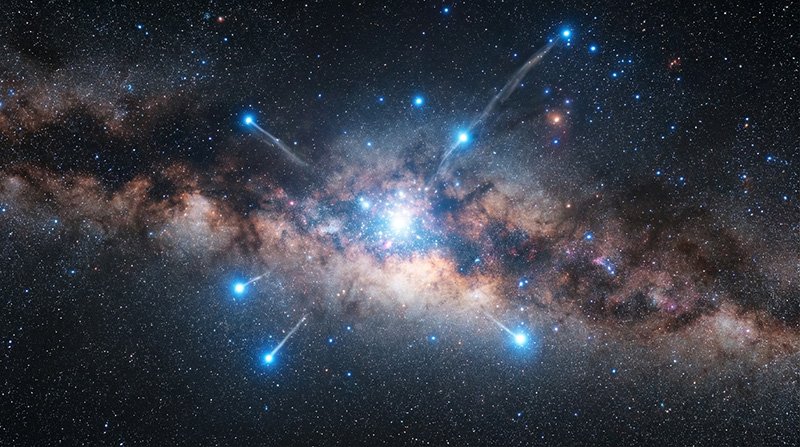

The observable universe spans approximately 93 billion light-years in diameter. The full universe may be much larger — or even infinite. To grasp this scale: if the Sun were the size of a grain of sand, the Milky Way would stretch across the continental United States. The observable universe would be millions of times larger still. This interactive visual guide takes you through those scales step by step.
Feel the Scale of the Universe
Scroll down to begin your cosmic journey 🌌
Experience the Mind-Blowing Scale of Space
Have you ever wondered just how vast the universe really is? Prepare to have your perspective completely transformed! This interactive journey takes you from the familiar human scale all the way to the edge of the observable universe.
A Journey Beyond Imagination
Starting from something we all understand – the human body – you’ll scroll through an awe-inspiring progression of cosmic scales:
- 🚶 Begin with humanity – Our everyday perspective
- 🌍 Explore our planet – Earth in all its glory
- 🪐 Marvel at planets – From tiny Mercury to mighty Jupiter
- ⭐ Witness stars – Giants that dwarf our entire solar system
- 🌌 Discover galaxies – Islands of billions of stars
- ♾️ Reach the observable universe – 93 billion light-years across
The Ultimate Perspective
By the time you reach the end of this cosmic journey, you’ll understand why astronomers speak in light-years and why the universe continues to inspire wonder. The observable universe contains over 2 trillion galaxies, each with billions of stars, and it’s still expanding!
💫 The observable universe is 93 billion light-years wide — and still expanding.
Why This Matters
Understanding cosmic scale helps us:
- 🌟 Appreciate our place in the grand scheme of things
- 🔭 Grasp astronomical concepts more intuitively
- 🤔 Inspire curiosity about space and science
- 🌍 Gain perspective on our shared home
More Cosmic Adventures Await
This incredible scale journey is just one of many experiences at The Universe Episodes! Explore our collection of:
- 🎮 Space Games – Like Space Tetris and Space Sudoku
- 🧪 Interactive Tests – Discover your cosmic personality
- 📚 Fascinating Facts – Deep dives into space mysteries
- 🌌 Visual Experiences – More mind-bending perspectives
Ready to Feel Small (In the Best Way)?
Take a few minutes to scroll through this cosmic journey. It’s perfect for:
- 📱 Students learning about space
- 🤓 Space enthusiasts of all ages
- 🧘 Anyone seeking perspective
- 👨👩👧👦 Families exploring together
Start scrolling now and prepare to see the universe – and yourself – in a whole new light!
How big is the universe?
The observable universe is about 93 billion light-years across. This is the portion we can detect — limited by the speed of light and the age of the universe (~13.8 billion years). The full universe may extend far beyond what we can observe, and may be infinite in size.
How big is the universe compared to Earth?
The observable universe is roughly 5.4 × 10²³ times wider than Earth. Earth's diameter is about 12,742 km. The observable universe is 8.8 × 10²⁶ km across. If Earth were a grain of sand, the observable universe would be larger than the entire Milky Way galaxy.
Is the universe infinite?
We don't know. The observable universe is finite — about 93 billion light-years across. But the full universe may extend far beyond what we can see. Some cosmological models suggest the universe is flat and infinite; others suggest it may be finite but unbounded. No current observation can resolve this.
How many light-years across is the universe?
The observable universe is about 46.5 billion light-years in radius, or 93 billion light-years in diameter. This may seem paradoxical since the universe is only 13.8 billion years old, but the universe has been expanding since the Big Bang, stretching space itself beyond what light has traveled.
What is the largest structure in the universe?
The largest known structure in the universe is the Hercules–Corona Borealis Great Wall, a massive filament of galaxies spanning approximately 10 billion light-years — about 10% of the observable universe's diameter.