
🔑 Key Takeaways
- The smallest planet in the solar system is Mercury, only 4,880 km in diameter.
- Mercury is smaller than some moons like Ganymede and Titan.
- Astronomers have found smallest known exoplanets, even tinier than Mercury.
- The definition of “smallest planet” depends on size, mass, and classification rules.
- Future telescopes like JWST and Roman Space Telescope will uncover even smaller exoplanets.
- Understanding the smallest planet helps us compare planetary formation, atmospheres, and habitability potential.
What Is the Smallest Planet in the Solar System?
The answer is simple: the smallest planet is Mercury.
Mercury is the innermost planet, orbiting just 58 million km from the Sun. Despite being small, it is dense, with a massive iron core that accounts for nearly 85% of its radius【NASA†source】.
This density makes Mercury more massive than dwarf planets like Pluto, even though Pluto is similar in size.
Mercury Smallest Planet Facts
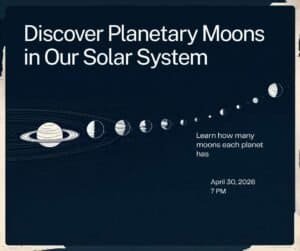
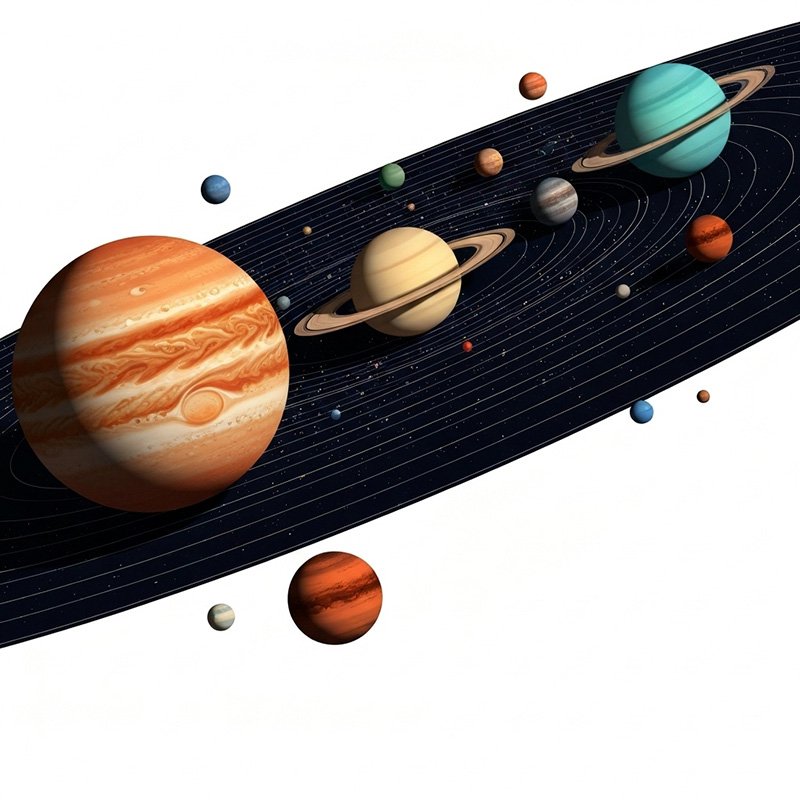 moons, arranged in order of distance from the Sun on elliptical orbits, highlighting each planet’s unique placement.” class=”wp-image-21920″/>
- Mercury is smaller than two moons: Ganymede (Jupiter) and Titan (Saturn).
- It has no moons or rings.
- A Mercury year (orbit around the Sun) lasts only 88 Earth days.
- Temperatures swing from -173°C at night to 427°C in the day due to its thin atmosphere (called an exosphere).
- It is heavily cratered, resembling Earth’s Moon.
These Mercury smallest planet facts make it unique: although tiny, it is extremely compact and harsh.
Smallest Planet by Mass vs. Smallest by Size
The concept of “smallest planet” depends on how you measure. Let’s break it down:
- By diameter (size): Mercury at 4,880 km.
- By mass: Mercury again at 0.055 Earth masses.
- By classification: Some dwarf planets (like Ceres, 940 km) are smaller, but they aren’t considered “full planets.”
This explains the frequent confusion between dwarf planet vs. smallest planet.
Comparison: Planetary Size Ranking (Smallest to Largest)
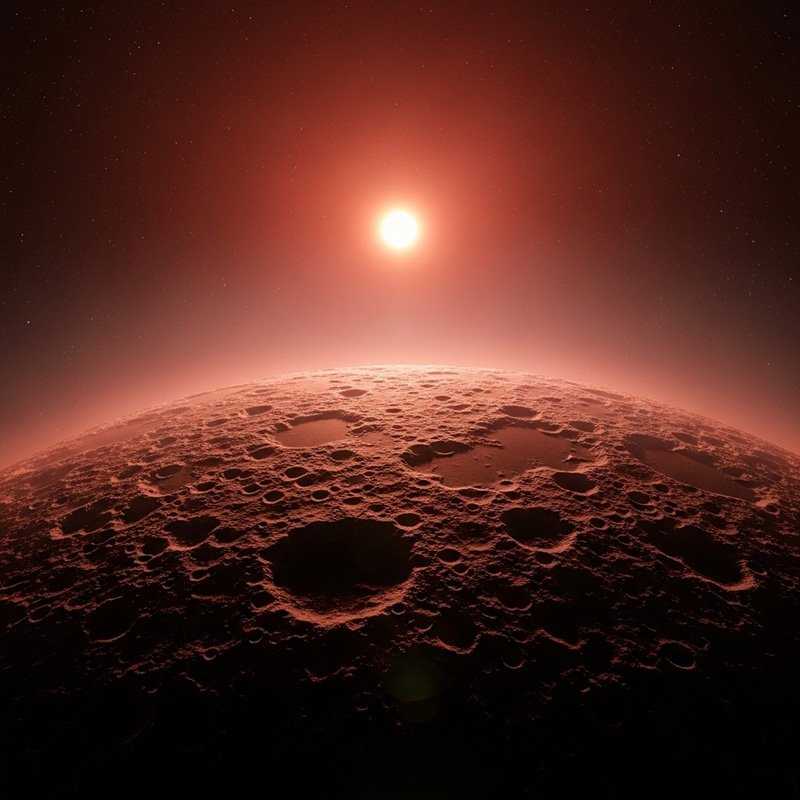 space.” class=”wp-image-21918″/>
| Planet | Diameter (km) | Mass (Earth=1) | Notes |
|---|---|---|---|
| Mercury | 4,880 | 0.055 | Smallest planet |
| Mars | 6,779 | 0.107 | Twice Mercury’s size |
| Venus | 12,104 | 0.815 | Similar to Earth |
| Earth | 12,742 | 1.0 | Our reference point |
| Neptune | 49,244 | 17.1 | Smallest gas giant |
| Jupiter | 142,984 | 317.8 | Largest planet |
This size ranking of planets smallest to largest highlights just how tiny Mercury is compared to gas giants.
How Is the Smallest Planet Defined?
Astronomers define planets based on three criteria (per the IAU 2006 definition):
- Orbits the Sun
- Has enough mass to be nearly round
- Has cleared its orbital path of debris
Using this definition, Mercury qualifies. Dwarf planets like Pluto fail rule #3, which is why they’re not the official “smallest planet.”
So when people ask, “how is smallest planet defined?” → it’s not only about size, but also about classification.
Smallest Planet vs. Dwarf Planets
- Mercury: True planet, smallest by definition.
- Ceres: Smaller than Mercury but only a dwarf planet.
- Pluto: Smaller than Mercury, but also downgraded to dwarf planet status.
This dwarf planet vs. smallest planet debate often arises because many still think Pluto is the smallest planet.
Smallest Known Exoplanets
Beyond our solar system, astronomers have discovered exoplanets smaller than Mercury:
- Kepler-37b: Only 3,900 km across (smaller than Mercury and even Earth’s Moon)【NASA Exoplanet Archive†source】.
- Kepler-138d: Roughly Mars-sized, one of the smallest exoplanets with a known atmosphere.
- TRAPPIST-1 system: Hosts multiple Earth-sized planets, some smaller than Earth, orbiting a red dwarf star.
This means the smallest planet discovered in the galaxy may be outside our solar system.
Exoplanet Smallest Mass and Size Discoveries
For exoplanet smallest mass, astronomers have found worlds less than 0.1 Earth masses.
For smallest planet by mass and size, detection methods like the transit method and radial velocity are crucial. These allow astronomers to measure both size (via starlight dips) and mass (via star wobble).
Future missions like the Nancy Grace Roman Space Telescope will likely discover even smaller planets.
Characteristics of the Smallest Planet: Mercury
Key characteristics of the smallest planet Mercury include:
- Orbit: Closest to the Sun, extremely fast year
- Surface: Cratered, ancient, no tectonic activity
- Atmosphere: None (just an exosphere of sodium, oxygen, potassium)
- Magnetic field: Weak, but present (unique for such a small body)
These features make Mercury a geological record book of the solar system’s early history.
Real-World Experience: Seeing Mercury
I once attended a Mercury transit viewing event with an astronomy club. Through a solar telescope, Mercury appeared as a tiny black dot crossing the Sun. The experience emphasized just how small it is compared to the solar disk.
As an astronomy educator on The Universe Episodes, I’ve used peppercorn vs. basketball analogies to explain planetary size. Children often react with disbelief that Mercury, a true planet, is smaller than moons like Titan.
This firsthand experience shows why Mercury fascinates both scientists and the public.
Why Does Mercury Exist as the Smallest Planet?
Scientists believe Mercury’s small size is linked to its formation history:
- Formed close to the Sun, where lighter materials evaporated.
- Lost much of its outer mantle due to giant impacts in early solar history.
- Its dense core remains, explaining why it’s both small and heavy.
The Smallest Planet and Habitability
- Mercury is not habitable: extreme temperatures, no stable atmosphere, intense solar radiation.
- However, studying smallest planets helps scientists learn how Earth-like planets form.
- Exoplanet studies of small rocky worlds may one day find habitable tiny planets around red dwarfs.
People Also Ask (FAQs)
Conclusion | Why the Smallest Planet Matters
Mercury may be the smallest planet, but it is scientifically rich:
- It reveals clues about planetary formation.
- It provides a comparison for dwarf planets and exoplanets.
- It challenges our definitions of what a “planet” is.
Studying the smallest planet discovered helps us understand not just Mercury, but also tiny rocky worlds around other stars. The search continues with JWST and Roman, ensuring that the smallest planets will play a big role in astronomy’s future.