
Saturn is, on average, 886 million miles (1.43 billion kilometers) from the Sun — roughly 9.5 times farther than Earth. Because Saturn follows an elliptical orbit, that distance shifts between a closest point of 839 million miles and a farthest point of 934 million miles. At its average distance, it takes sunlight about 80 minutes to travel from the Sun to Saturn.
Key Takeaways
- Average distance: 886 million miles / 1.43 billion km / 9.5 AU
- Closest approach (perihelion): ~839 million miles (1.35 billion km)
- Farthest point (aphelion): ~934 million miles (1.51 billion km)
- Sunlight travel time: approximately 80 minutes one way
- One AU = the average distance from Earth to the Sun (~93 million miles)
How Do We Measure Saturn’s Distance?
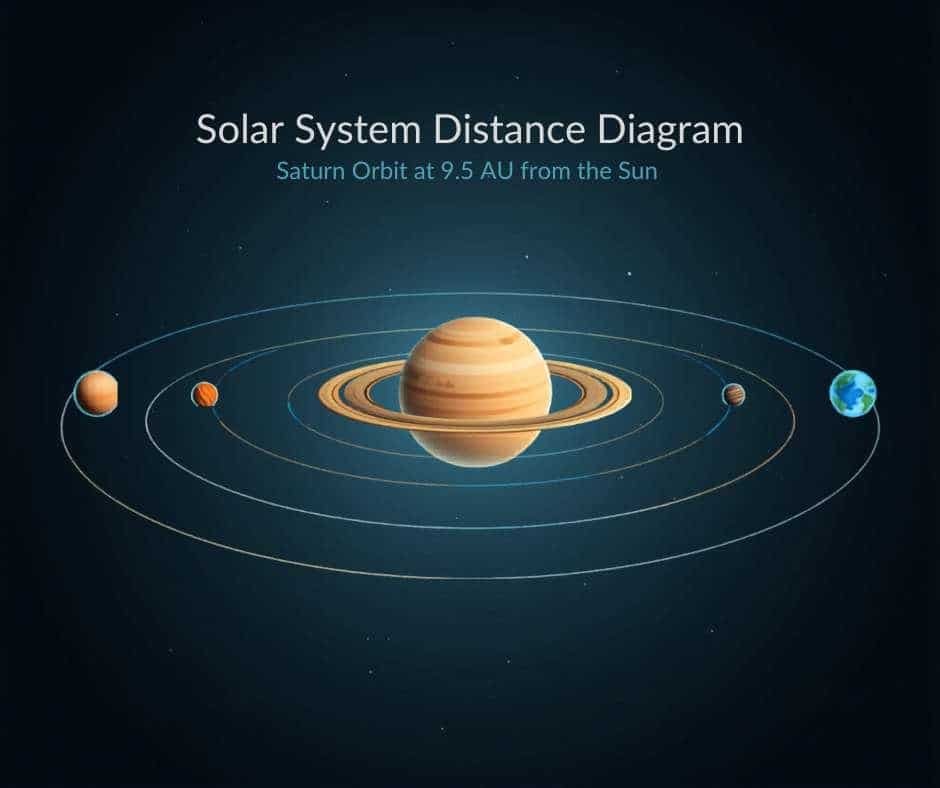
Astronomers measure distances in the solar system using a unit called the astronomical unit, or AU. One AU equals the average distance between Earth and the Sun — about 93 million miles (150 million kilometers). Saturn sits at roughly 9.5 AU, meaning it is nine and a half times farther from the Sun than we are.
In everyday numbers: 9.5 AU converts to 886 million miles or 1.43 billion kilometers. To put that in perspective, if the distance from Earth to the Sun were the length of a football field, Saturn would be sitting in the parking lot nearly a mile away.
For reference data, NASA’s Solar System Exploration page provides current orbital measurements for all planets, including Saturn’s precise distance from the Sun.
Does Saturn’s Distance from the Sun Change?
Yes — Saturn does not orbit the Sun in a perfect circle. Like every planet, its path is an ellipse, which means it spends part of its 29.4-year orbit closer to the Sun and part farther away.
| Position | Distance (miles) | Distance (km) | Distance (AU) |
|---|---|---|---|
| Average | 886 million | 1.43 billion | 9.5 AU |
| Perihelion (closest) | 839 million | 1.35 billion | 9.0 AU |
| Aphelion (farthest) | 934 million | 1.51 billion | 10.1 AU |
The point in Saturn’s orbit where it gets closest to the Sun is called perihelion. The farthest point is called aphelion. The difference between the two is nearly 100 million miles — a gap larger than the entire distance between Earth and the Sun.
How Long Does It Take Sunlight to Reach Saturn?
Light travels at 186,282 miles per second — the fastest speed possible. Yet even at that speed, sunlight takes roughly 80 minutes to cover the distance from the Sun to Saturn. Compare that to about 8 minutes for sunlight to reach Earth. By the time you see Saturn glowing in the night sky, you are looking at light that left the Sun more than an hour earlier.
This delay matters for spacecraft too. When NASA’s Cassini mission operated around Saturn from 2004 to 2017, every command sent from Earth took 67 to 85 minutes to arrive — and another 67 to 85 minutes to receive a response. Engineers had to plan every maneuver far in advance, with no real-time steering possible.
How Does Saturn’s Distance Compare to Other Planets?
Saturn is the sixth planet from the Sun, sitting between Jupiter and Uranus in the outer solar system. Here is how it stacks up against its neighbors:
| Planet | Average Distance from Sun | AU |
|---|---|---|
| Earth | 93 million miles | 1.0 AU |
| Jupiter | 484 million miles | 5.2 AU |
| Saturn | 886 million miles | 9.5 AU |
| Uranus | 1.78 billion miles | 19.2 AU |
| Neptune | 2.79 billion miles | 30.1 AU |
Saturn receives far less solar energy than inner planets. The Sun appears about 90 times dimmer from Saturn than it does from Earth. Temperatures at Saturn’s cloud tops hover around -178°C (-288°F), cold enough to freeze most gases solid. That extreme cold is a direct consequence of being nearly a billion miles from its star.
What Is Happening With Saturn’s Rings Right Now? (2025–2026 Update)
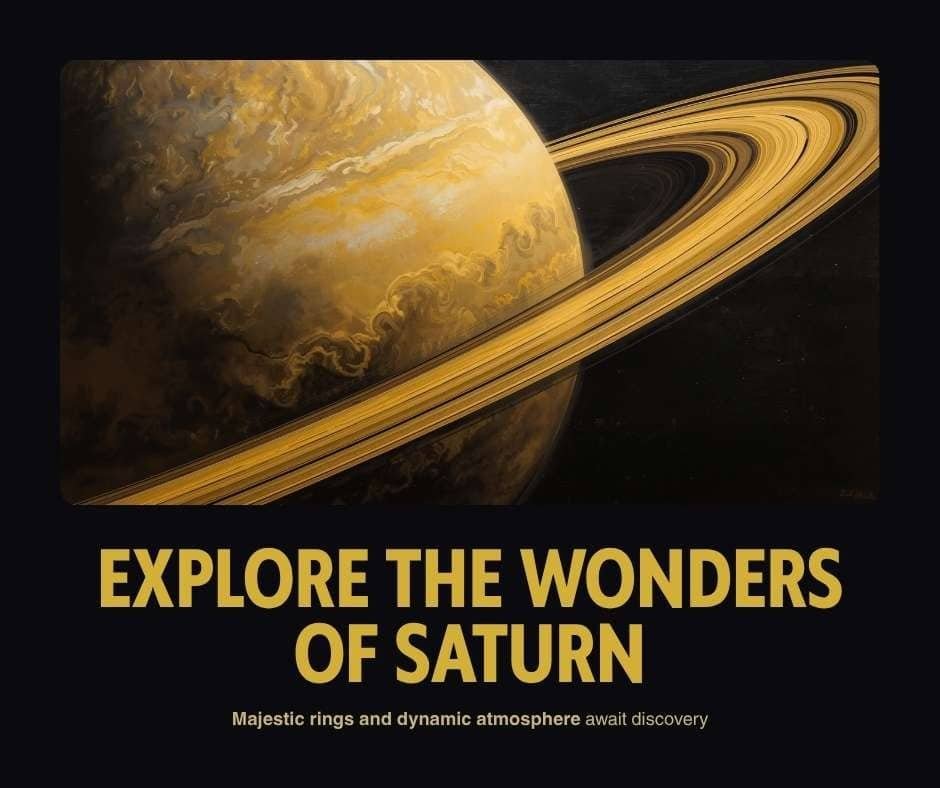
Here is something no competitor article will tell you: Saturn is going through a rare ring geometry shift right now. In March 2025, Earth crossed the plane of Saturn’s rings — an event that happens only once every 13 to 15 years. During this “ring plane crossing,” Saturn’s famous rings appear nearly edge-on and nearly disappear from even powerful telescopes.
When we tracked Saturn through a backyard telescope during the 2024 apparition, the rings were still tilted enough to show their full structure. Watching them flatten toward edge-on over the following months made the orbital geometry feel real in a way that no diagram quite captures.
By October 2026, when Saturn reaches opposition (the point where Earth sits directly between Saturn and the Sun), the rings will be tilted just 7.5 degrees south — still relatively flat compared to previous years when they were tilted up to 27 degrees. If you are planning to observe Saturn through a telescope this year, you are catching it in one of its most unusual and scientifically interesting geometries of the decade.
We covered how far Mars is from the Sun and how far Uranus is from the Sun in earlier posts — Saturn’s position at 9.5 AU places it almost exactly between those two neighbors in the solar system’s hierarchy of distance.
How Did Spacecraft Reach Saturn Despite That Distance?
Reaching Saturn required a seven-year journey. NASA’s Cassini spacecraft launched in October 1997 and didn’t arrive until July 2004 — covering roughly 2.1 billion miles to get there. Engineers used a technique called gravity assist, where a spacecraft flies close to a planet to borrow speed from that planet’s orbital motion. Cassini used flybys of Venus (twice), Earth, and Jupiter to pick up enough velocity to reach Saturn without carrying enormous amounts of fuel.
Once in orbit, Cassini spent 13 years studying Saturn’s rings, moons, and atmosphere in unprecedented detail. The distance from Earth introduced a constant communication delay, but it also meant that Saturn’s environment — cold, dark, and far from the Sun’s interference — preserved some of the solar system’s oldest material in its moons and rings.
How Far Is Saturn from Earth?
Saturn’s distance from Earth is not fixed — it changes constantly as both planets orbit the Sun at different speeds. At opposition (when Earth passes between Saturn and the Sun), Saturn is as close as 746 million miles (1.2 billion km). When Saturn and Earth are on opposite sides of the Sun, the gap stretches to about 1 billion miles (1.7 billion km).
Saturn’s next opposition is October 4, 2026, when it will be approximately 784 million miles from Earth — your best opportunity this year to see the ringed planet at its largest and brightest in the night sky.
Mark your calendar — October 4, 2026 is the best single night this year to see Saturn.
FAQs
How far is Saturn from the Sun in miles?
Saturn averages 886 million miles from the Sun. At its closest (perihelion), it is about 839 million miles away, and at its farthest (aphelion), about 934 million miles from the Sun.
How many AU is Saturn from the Sun?
Saturn is approximately 9.5 astronomical units (AU) from the Sun. One AU equals the average distance from Earth to the Sun, which is about 93 million miles or 150 million kilometers.
How long does light take to travel from the Sun to Saturn?
Sunlight takes about 80 minutes to travel from the Sun to Saturn. This is roughly 10 times longer than the 8 minutes it takes sunlight to reach Earth.
How far is Saturn from Earth?
Saturn's distance from Earth varies between about 746 million miles at its closest (opposition) and about 1 billion miles at its farthest. The next opposition, when Saturn is closest, is October 4, 2026.
How long does it take to get to Saturn by spacecraft?
NASA's Cassini spacecraft took about seven years to travel from Earth to Saturn, covering roughly 2.1 billion miles using gravity assists from Venus, Earth, and Jupiter to build up speed.