

In the fall of 2019, one of the most familiar stars in the night sky started going dark. Betelgeuse — the bright orange-red point of light in Orion’s shoulder — dropped by about 60 percent in brightness over just a few months. Astronomers noticed. The internet speculated. And the question that had quietly existed for years suddenly became urgent: is Betelgeuse about to explode?
The short answer turned out to be no. But the real story is stranger and more interesting than that.
Quick Answer: Betelgeuse is a red supergiant star approximately 700 times wider than the Sun, located about 700 light-years away in the constellation Orion. According to NASA, it will eventually explode as a supernova — but not for roughly another 100,000 years.
What Kind of Star Is Betelgeuse?
Betelgeuse is a red supergiant — a class of star that forms when a very massive star burns through its core hydrogen and begins to expand. Enormously. The star is classified as Alpha Orionis, meaning it was originally designated the brightest in Orion (though that title now belongs to Rigel). It sits at roughly the upper-left of Orion as we see it from Earth, forming what is often described as the hunter’s right shoulder.
At about 10 million years old, Betelgeuse is a young star by cosmic standards — our Sun is nearly 5 billion years old. But Betelgeuse is far more massive, around 15 times the Sun’s mass, which means it burns its fuel much faster and lives a shorter, more spectacular life. It is currently in the late stages of that life.
Here is something that surprises most people: Betelgeuse is actually cooler than the Sun. Its surface temperature runs around 6,000 degrees Fahrenheit (about 3,300 degrees Celsius), compared to the Sun’s roughly 10,000 degrees Fahrenheit (5,500°C). The orange-red color is a direct result of this relatively low temperature. Hotter stars burn blue-white. Cooler ones glow orange and red.
And yet Betelgeuse is between 7,500 and 14,000 times brighter than the Sun. It is consistently one of the ten brightest stars in the entire night sky. That apparent contradiction — cool surface, enormous brightness — is entirely explained by its size.
So How Big Is “Big”?
Betelgeuse has a radius somewhere between 640 and 764 times that of our Sun. The uncertainty exists because measuring the precise size of a distant star is genuinely difficult — its outer atmosphere is diffuse and variable, not a sharp edge.
But the scale comparison still holds. If you replaced the Sun with Betelgeuse and placed it at the center of our solar system, its surface would extend somewhere past the asteroid belt. Mercury, Venus, Earth, and Mars would all be inside it. Jupiter’s orbit — the giant planet that sits about 5 times farther from the Sun than Earth does — would be cutting through Betelgeuse’s outer layers.
I find that comparison doesn’t fully land the first time you read it. Try it again: Jupiter. Inside the star.
At 700 light-years away, Betelgeuse is close enough that it’s one of the very few stars besides our Sun where we can actually resolve surface details with powerful telescopes. Most stars are too far away to appear as anything other than a point of light. Betelgeuse is a disk. A massive, churning, unstable disk — which is part of why it has been studied so intensely.
The Great Dimming: What Actually Happened in 2019

Betelgeuse has always varied in brightness. It follows a roughly 400-day pulsation cycle, brightening and fading over the course of a little over a year. There is also a longer cycle of around five years. This variability is normal for red supergiants and has been documented since the 19th century.
What happened in late 2019 was not normal.
Starting in the fall of that year, Betelgeuse began dimming far outside its usual range. By February 2020, it had dropped to roughly 40 percent of its typical brightness — a 60 percent dimming. This pushed it out of the top-ten brightest stars entirely. Scientists who had been watching the star for decades said they had never seen anything like it. Some wondered, publicly, whether this could be a sign of impending core collapse — the first stage of a supernova.
By April 2020, Betelgeuse had returned to its normal brightness. The mystery remained.
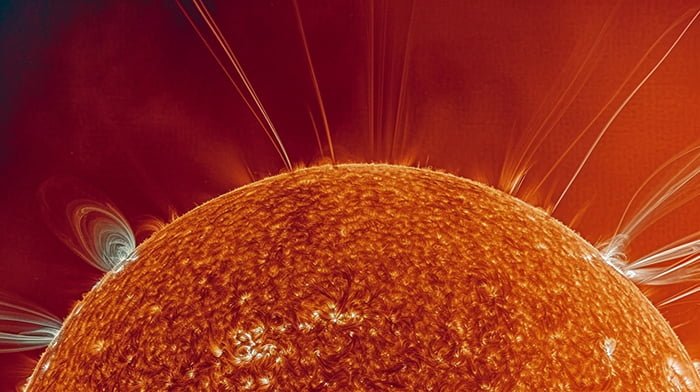
The answer, pieced together from Hubble Space Telescope data in the years that followed, turned out to be dramatic in its own right. Betelgeuse had essentially erupted. The star ejected a massive chunk of its own surface — a surface mass ejection that released approximately 400 billion times as much material as a typical solar coronal mass ejection. That ejected mass likely weighed several times more than our Moon. As it traveled outward, it cooled and formed a dust cloud large enough to block a significant portion of Betelgeuse’s light from our perspective. According to NASA, the ejection was likely triggered by a convective plume rising from within the star, timed with its normal pulsation cycle.
It was, as far as scientists know, the largest stellar surface mass ejection ever directly observed.
The Companion Star Nobody Knew Was There

In January 2026, a team from the Harvard-Smithsonian Center for Astrophysics announced a discovery that changed the picture further. Using nearly eight years of Hubble Space Telescope observations, they confirmed the existence of a previously elusive companion star orbiting Betelgeuse. The companion has been named Siwarha, derived from the Arabic word for Orion.
The team did not see Siwarha directly — it is too close to Betelgeuse’s overwhelming brightness for that. What they detected was its wake: a trail of denser material left behind as the companion star plows through Betelgeuse’s outer atmosphere. As it orbits, Siwarha compresses the gas around it into a detectable ridge, and that ridge moves in a way that matches the companion’s predicted orbital path. The results were published in The Astrophysical Journal and presented at the 247th meeting of the American Astronomical Society (NASA, January 2026).
Most articles describing the 2019 dimming stop at the surface mass ejection. That is not wrong. But the companion star adds a second layer to the story. Its orbital motion creates periodic variations in how Betelgeuse’s material is distributed around it — which may explain some of the star’s irregular brightness changes that the surface ejection alone cannot account for. Betelgeuse’s behavior has, for decades, been more complicated than a single star’s physics would predict. Siwarha may be why.
Betelgeuse is currently eclipsing its companion from our point of view. Astronomers are planning new observations for 2027, when Siwarha is expected to re-emerge from behind the supergiant and become detectable again.
Will It Actually Explode — and Does It Matter for Earth?
Betelgeuse will go supernova. That is certain. The star is simply too massive to end quietly; when it exhausts its nuclear fuel, its core will collapse in a fraction of a second and the outer layers will be blasted outward in an explosion that briefly outshines entire galaxies. What remains will be either a neutron star or a black hole, depending on how much mass survives the explosion.
When this will happen is a different question entirely. NASA’s current estimate puts the supernova roughly 100,000 years in the future. Some models suggest it could be sooner; others, later. The discovery of Siwarha has introduced additional complexity — companion stars can affect a supergiant’s mass loss and evolution in ways scientists are still working out. The honest answer, as of 2026, is that the timeline is uncertain, and anyone claiming precision about it is overstating what the data actually shows.
What can be said with confidence: Earth is not at risk. For a supernova to damage life on Earth, it would need to occur within roughly 160 light-years of us. Betelgeuse is about 700 light-years away — more than four times that threshold. When it does go, the explosion will be spectacular to observe. Estimates suggest it could become as bright as a full moon in the night sky and potentially visible in full daylight. Then it will fade over weeks and months into a remnant — a glowing shell of expanding gas — that astronomers will study for decades.
That is worth looking forward to. Just not urgently.
How to Find Betelgeuse Tonight
Betelgeuse is one of the easiest stars to identify without any equipment. Look for Orion — the constellation recognizable by its distinctive belt of three stars in a nearly straight line. Betelgeuse is the bright, noticeably reddish-orange star at the upper left of the constellation, forming Orion’s right shoulder as seen from Earth.
In the Northern Hemisphere, Orion is best visible in the winter and early spring evening sky. By late spring and summer, it moves closer to the horizon and eventually disappears from evening view entirely, returning in the fall. From the Southern Hemisphere, Orion appears upside-down relative to northern viewing, with Betelgeuse at lower right.
There is no telescope required. Betelgeuse’s color — that unmistakable warm orange — sets it apart from the blue-white stars nearby. Once you’ve found the belt, look up and left. You will see it immediately. The star that is, right now, 700 years into its journey toward your eye. The star that blew off a Moon-sized chunk of itself five years ago. The star with a hidden companion that we only just confirmed.
It does not look like any of that from the ground. It just looks like a steady, orange point of light. Which, somehow, makes it more interesting to look at — not less.
FAQs
What type of star is Betelgeuse?
Betelgeuse is a red supergiant star, one of the largest and most luminous types of stars in the universe (NASA, 2023). It is in the late stages of its life, having expanded dramatically after exhausting the hydrogen in its core — a phase our Sun will eventually reach in about 5 billion years.
How far away is Betelgeuse from Earth?
Betelgeuse is approximately 700 light-years from Earth, meaning the light you see tonight left the star around the year 1326 (NASA/Wikipedia, best current estimate). The exact distance is difficult to pin down precisely because the star's outer atmosphere is diffuse, but estimates consistently fall in the 550–700 light-year range.
Will Betelgeuse go supernova?
Yes — Betelgeuse will eventually explode as a supernova, but NASA estimates this won't happen for roughly another 100,000 years. The discovery of its companion star Siwarha in January 2026 has added new complexity to timeline predictions, as companion stars can affect how a supergiant loses mass and evolves.
How big is Betelgeuse compared to the Sun?
Betelgeuse has a radius approximately 700 times larger than the Sun's, ranging from 640 to 764 solar radii depending on the measurement (Wikipedia/NASA). If placed at the center of our solar system, its surface would extend past the asteroid belt, engulfing Mercury, Venus, Earth, and Mars entirely.
What happened to Betelgeuse in 2019?
In late 2019, Betelgeuse dimmed by about 60 percent in what became known as the Great Dimming — the most dramatic brightness drop ever observed in the star (NASA, 2022). Scientists later determined the cause was a massive surface ejection that released 400 billion times more material than a typical solar outburst, forming a dust cloud that temporarily blocked the star's light.
How is it possible that Betelgeuse is cooler than the Sun but still one of the brightest stars in the sky?
Betelgeuse's surface temperature is about 6,000°F — actually lower than the Sun's 10,000°F — but its sheer size compensates enormously (NASA Science). With a radius roughly 700 times larger than the Sun, its total surface area is so vast that even at lower temperatures it radiates between 7,500 and 14,000 times more light than our star.
Why do scientists now think Betelgeuse has a companion star?
In January 2026, Harvard-Smithsonian CfA researchers confirmed Siwarha's existence by detecting its 'wake' — a trail of denser material as it orbits through Betelgeuse's outer atmosphere, tracked across nearly eight years of Hubble data (NASA/The Astrophysical Journal, 2026). The companion had long been suspected to explain irregularities in Betelgeuse's brightness cycles that a single star's physics could not fully account for.
What would actually happen on Earth if Betelgeuse went supernova right now?
Earth would be completely safe — a supernova poses serious risks to life only within about 160 light-years, and Betelgeuse is roughly 700 light-years away, over four times that distance (phys.org, 2025). What we would see is extraordinary: the explosion could briefly shine as brightly as a full moon, potentially visible in daylight, before fading over weeks into a glowing nebula visible for years.