
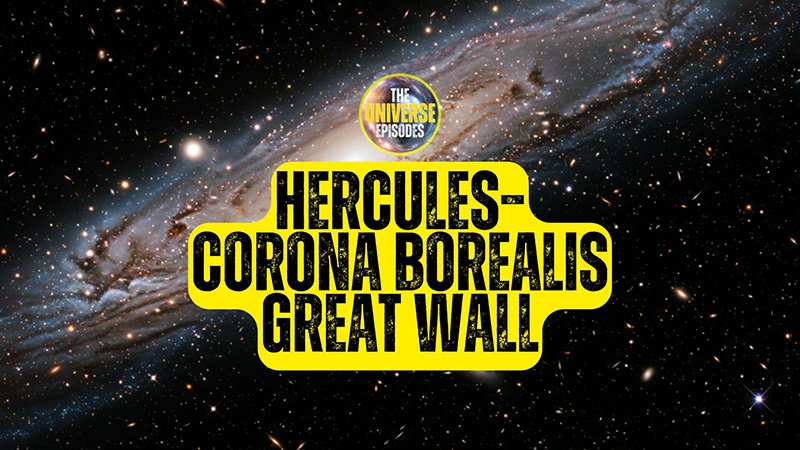
Discover the Hercules–Corona Borealis Great Wall — the largest known structure in the universe, spanning 10 billion light-years across billions of galaxies.
The Hercules–Corona Borealis Great Wall is the largest known structure in the observable universe, spanning approximately 10 billion light-years in length. It is a massive concentration of galaxies discovered in 2013 through gamma-ray burst mapping. Its sheer size challenges the cosmological principle — the assumption that matter is evenly distributed across the universe at large scales.
Key Facts at a Glance
| Property | Value |
|---|---|
| Size | ~10 billion light-years across |
| Discovery year | 2013 |
| Discovery method | Gamma-ray burst (GRB) mapping |
| Location | Hercules & Corona Borealis constellations |
| Distance from Earth | ~10 billion light-years |
| Structure type | Galaxy supercluster complex |
| Previous record holder | Sloan Great Wall (1.4 billion ly) |
Key Takeaways
- The Hercules–Corona Borealis Great Wall (HCBGW) is the largest known structure in the observable universe.
- It spans 10 billion light-years across, containing billions of galaxies.
- Detected in 2013 via gamma-ray burst mapping.
- Too far for human exploration — light would take billions of years to cross it.
- Its size challenges our understanding of cosmic structure formation.
What Is the Hercules–Corona Borealis Great Wall?

The Hercules–Corona Borealis Great Wall (HCBGW) is a galaxy supercluster complex — essentially a “continent” of the cosmic web.
It stretches roughly 10 billion light-years end to end, discovered by astronomers in 2013 while analyzing gamma-ray bursts (GRBs).
These bursts acted as “cosmic lighthouses,” allowing scientists to map dense regions of galaxies across vast distances.
For perspective: The Milky Way is just 100,000 light-years across — meaning this Great Wall is 100,000 times larger.
How Was It Discovered?
The discovery was made by mapping the positions of GRBs detected by NASA’s Swift satellite and other observatories.
Scientists noticed an unusual clustering pattern between redshifts 1.6 and 2.1, indicating galaxies were arranged along a massive filament-like structure.
This finding was surprising because according to the cosmological principle, structures larger than 1.2 billion light-years should be extremely rare — yet this one is nearly 10 times bigger.
How Long Would It Take to Get There?
Even if you could travel at the speed of light, reaching the Hercules–Corona Borealis Great Wall would take billions of years.
Currently, our fastest spacecraft, Voyager 1, would take over 100 trillion years to get there — far beyond the lifespan of the universe.
Is Anything Bigger Than the Hercules–Corona Borealis Great Wall?
So far, no confirmed structure in the observable universe surpasses HCBGW in size.
Other large-scale cosmic features, like the Sloan Great Wall and the Laniakea Supercluster, are enormous, but still smaller by billions of light-years.
How Many Galaxies Are in the Great Wall?
Estimates suggest the HCBGW contains billions of galaxies, each with billions of stars.
However, because it’s so distant, much of its exact makeup remains uncertain.
Future telescopes may reveal detailed maps of its components.
How Big Is a Supercluster of Galaxies Like the HCBGW?

A “supercluster” is a large group of galaxy clusters bound together by gravity.
Typical superclusters span a few hundred million light-years.
HCBGW is tens of times larger, placing it in a unique category of “mega-structures.”
Comparisons With Other Cosmic Giants
- Sloan Great Wall – 1.38 billion light-years
- Laniakea Supercluster – 520 million light-years
- Huge Large Quasar Group – 4 billion light-years
- Hercules–Corona Borealis Great Wall – 10 billion light-years (largest)
Why Its Size Is a Mystery
The sheer scale of HCBGW challenges standard models of cosmic structure formation.
Under ΛCDM cosmology, structures this large shouldn’t have had time to form since the Big Bang.
This raises questions about whether our understanding of dark matter, gravity, and cosmic inflation needs revision.
Future Studies and Exploration

In the coming decades, projects like the Vera Rubin Observatory and the Nancy Grace Roman Space Telescope will provide deeper, wider surveys of the universe.
These may refine our understanding of the HCBGW’s shape, origin, and role in cosmic evolution.
Frequently Asked Questions
How Was the Hercules–Corona Borealis Great Wall Discovered?
Gamma-ray bursts have played a crucial role in the discovery of the Hercules–Corona Borealis Great Wall. These bursts are among the most energetic events in the universe, releasing more energy in a few seconds than the Sun will emit in its entire lifetime. By mapping the distribution of GRBs, astronomers can identify regions of the universe with unusually high concentrations of these events, indicating the presence of massive structures.
The Role of Dark Matter and Dark Energy
Dark matter and dark energy play a significant role in the formation and evolution of cosmic structures. Dark matter, which makes up about 27% of the universe’s mass-energy content, provides the gravitational scaffolding for galaxies and galaxy clusters to form. Dark energy, which accounts for about 68% of the universe’s mass-energy content, drives the accelerated expansion of the universe.
What Are Cosmic Filaments?
Cosmic filaments, like the Hercules–Corona Borealis Great Wall, are among the largest structures in the universe. They form part of the cosmic web, a vast network of interconnected filaments and voids that make up the large-scale structure of the universe. Understanding these filaments is crucial for unraveling the mysteries of the cosmos.
How Does the Hercules–Corona Borealis Great Wall Compare to Earth?
Scale comparison — from Earth to the Great Wall
Comparing the Hercules–Corona Borealis Great Wall to Earth requires numbers so large they lose meaning without context. Earth’s diameter is about 12,742 km. The Great Wall spans roughly 10 billion light-years — one light-year alone equals about 9.46 trillion kilometers. The Great Wall is approximately 7 × 10²⁹ times wider than Earth. If Earth were the size of a single atom, the Great Wall would still be incomprehensibly larger than the entire observable universe.
| Object | Size | Comparison to Earth |
|---|---|---|
| Earth | 12,742 km diameter | baseline |
| Solar System | ~287 billion km across | ~22 million× Earth |
| Milky Way Galaxy | ~100,000 light-years | ~7.4 × 10¹⁷× Earth |
| Observable Universe | ~93 billion light-years | ~6.9 × 10²⁶× Earth |
| Hercules–Corona Borealis Great Wall | ~10 billion light-years | ~7 × 10²⁶× Earth |
The Great Wall spans roughly 10% of the observable universe’s diameter — which itself challenges the cosmological principle, the assumption that matter is distributed uniformly at the largest scales. Something this large should not, in theory, exist.
How long would it take to get to the Hercules–Corona Borealis Great Wall?
Billions of years at light speed; trillions with current technology.
Is anything bigger than the Hercules–Corona Borealis Great Wall?
Not confirmed — it’s the largest known structure in the observable universe.
How many galaxies are in the Great Wall?
Likely billions, but exact numbers are unknown due to its distance.
How big is a supercluster of galaxies like this?
Most superclusters are under 500 million light-years; HCBGW is 10 billion.
How Did Astronomers Discover the Hercules–Corona Borealis Great Wall?
Astronomers discovered it in 2013 while mapping u003cstrongu003egamma-ray bursts (GRBs)u003c/strongu003e from NASA’s u003cemu003eSwiftu003c/emu003e satellite. They noticed many GRBs were clustered in the same sky region between Hercules and Corona Borealis. This unusual pattern revealed a massive network of galaxies stretching over u003cstrongu003e10 billion light-yearsu003c/strongu003e, making it the largest known structure in the observable universe.